

Cummins Vibration Damper & Crankshaft Pulley: What to Verify Before Ordering

4486
Table of Contents
Generating table of contents
When a front-end belt begins to track incorrectly, wear abnormally or produce unusual noise, many inquiries begin with one of two requests:
“We need a Cummins pulley.”
Or: “We need a vibration damper.”
Those two descriptions may refer to completely different parts: a conventional crankshaft pulley, a torsional vibration damper, a combined damper-pulley assembly, or a front-end arrangement that also requires a separate hub or spacer.
These components may all appear as a round disc or a multi-groove pulley, but their functions are different. The crankshaft pulley transfers power from the crankshaft to front-end accessories such as the alternator, water pump, fan drive and air-conditioning compressor. The vibration damper controls torsional vibration generated in the crankshaft by combustion pulses.
One distinction is particularly important: the torsional vibration controlled by the damper is not the same as the general vibration an operator can feel through the machine. Engine mounts, accessory condition, combustion irregularities and equipment structure can also create noticeable vibration. A machine that “feels rough” does not, by itself, prove that a new damper is required.
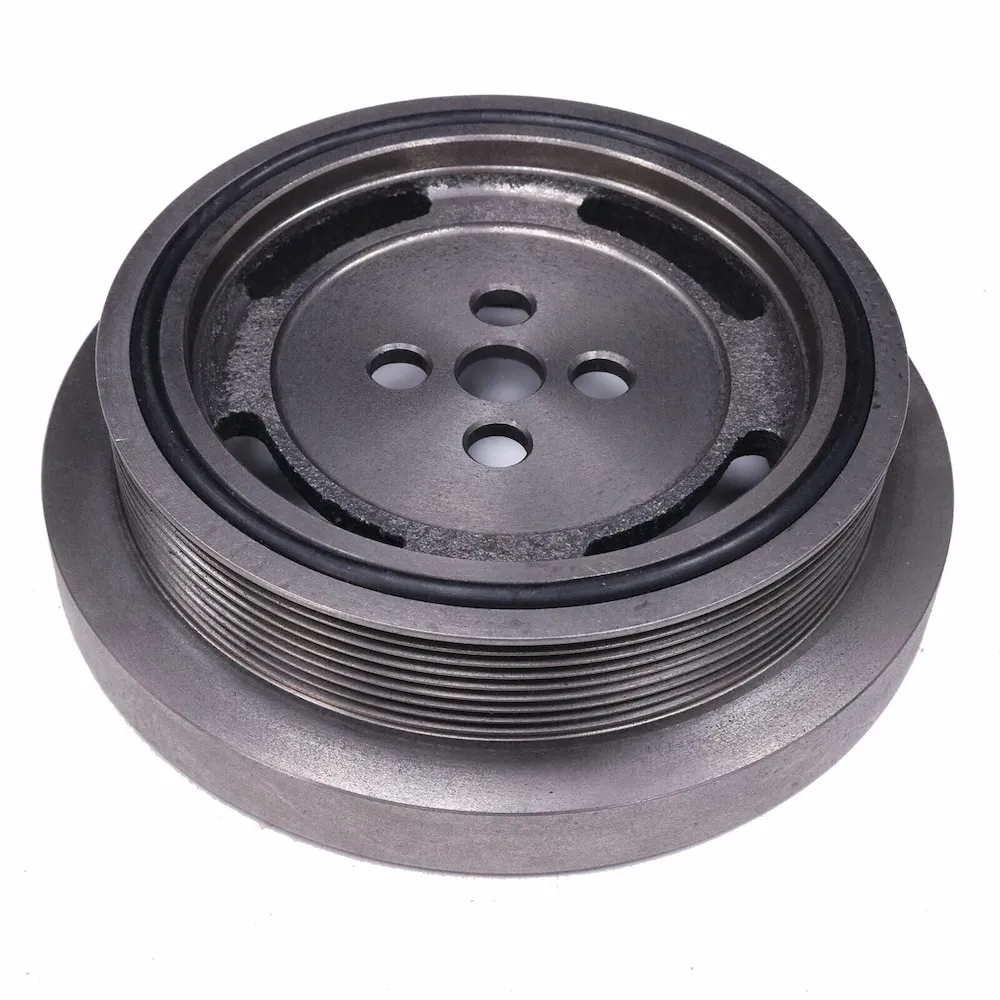
This guide is written for buyers sourcing Cummins vibration dampers, crankshaft pulleys, damper-pulley assemblies and related front-end parts. It explains how these components differ, why matching groove count does not guarantee interchangeability, and which supporting items are commonly omitted from quotations.
The article does not provide removal or installation procedures, bolt-torque specifications, dynamic-balance limits, pulley-runout limits or reuse approval for an existing damper. Those decisions should be made by a qualified repair facility using the applicable service information.
The damper and pulley perform different functions, but they may form one assembly
In the aftermarket and repair industry, the terms harmonic balancer, vibration damper and torsional damper are often used interchangeably. They generally refer to a component that controls crankshaft torsional vibration. For formal purchasing, however, the name, construction and service part number shown in the Cummins parts record should remain the reference.
The functional difference between a damper and a crankshaft pulley is straightforward:
The pulley transfers belt power to front-end accessories; the damper controls torsional vibration in the crankshaft.
Some Cummins engines combine both functions in one damper-pulley assembly. Others use a separate damper, separate pulley and separate hub. A pulley may also be bolted to the damper housing or to an independent hub. The parts can look like one unit when installed while still remaining separately identifiable and separately supplied items in the parts catalog.
Cummins parts records may also manage crankshaft pulleys and tuned vibration dampers as different service parts. The first purchasing question should therefore be whether the requirement is for a pulley only, a damper only or a combined assembly. Confusion at this point is one of the most common causes of incomplete or incorrect quotations in this product category.
A damper is matched to the crankshaft torsional system—it is not a simple counterweight disc
The inertia distribution, internal construction and operating characteristics of a damper form part of the design relationship with the crankshaft torsional system. It should not be treated as a counterweight that can be substituted by visually matching outside diameter and thickness.
Two technical concepts are frequently combined in sales descriptions even though they address different problems.
Dynamic balance concerns the mass balance of the rotating assembly. Its purpose is to control centrifugal vibration created by mass imbalance during rotation. Torsional tuning concerns whether the damper responds correctly to the torsional characteristics of a specific crankshaft system.
A dynamically balanced assembly is not automatically torsionally suitable for the engine. Conversely, a correctly designed damper still has to meet rotational-balance, mounting-interface and manufacturing-consistency requirements.
Two dampers can therefore have the same apparent outside diameter, thickness and bolt pattern while using different inertia distributions, damping structures or operating-speed ranges. Those differences cannot be verified from appearance or basic measurements alone. The formal part number and current engine configuration remain essential.
The internal damping design can also differ.
An elastomer damper uses rubber or another elastomeric material between the inner hub and outer inertia ring. The bonding condition, material performance and manufacturing consistency of this connection affect the working relationship of the assembly. Elastomer condition may be influenced by time, temperature, oil contamination and operating environment, but that does not justify one universal operating-hour or mileage replacement interval for all Cummins dampers. Any scheduled inspection or replacement requirement should be based on the specific engine model, damper part number and applicable service information. The absence of visible cracking does not, by itself, verify functional condition.
A viscous damper typically uses a housing, an internal inertia ring and a viscous medium between them. Relative motion between the housing and inertia ring shears the viscous medium and dissipates part of the torsional vibration energy. The important working components are enclosed within a sealed housing, so a normal external appearance does not confirm that the internal condition is satisfactory.
Pulley integration is a separate design dimension rather than a third damping principle. An elastomer damper may include an integrated pulley, and a viscous damper may do the same. Even where two dampers use the same damping principle, one may include an accessory pulley while the other does not, creating a different supply scope and installation relationship.
The hub interface involves more than the center bore
Whether a damper or pulley can be installed on the front of the crankshaft depends on the complete hub interface, not only the center-bore diameter.
The match may also involve the pilot diameter, bolt circle, number and arrangement of bolt holes, keyway, dowel, shoulder, spacer and the locating relationship among the damper, pulley and crankshaft nose.
For example, two parts may have the same center bore but different pilot diameters or bolt circles, making correct installation impossible. The opposite situation is also possible: a damper may be physically bolted in place while its axial position, pulley layout or torsional function remains unsuitable for the engine.
If the front of the crankshaft has previously been repaired, replaced or converted, the current interface should take priority over the assumed original arrangement. Final verification should combine the ESN, CPL, current part number and actual hub interface. Measurements and photos of the removed part can support identification, but they should not replace the formal parts check.
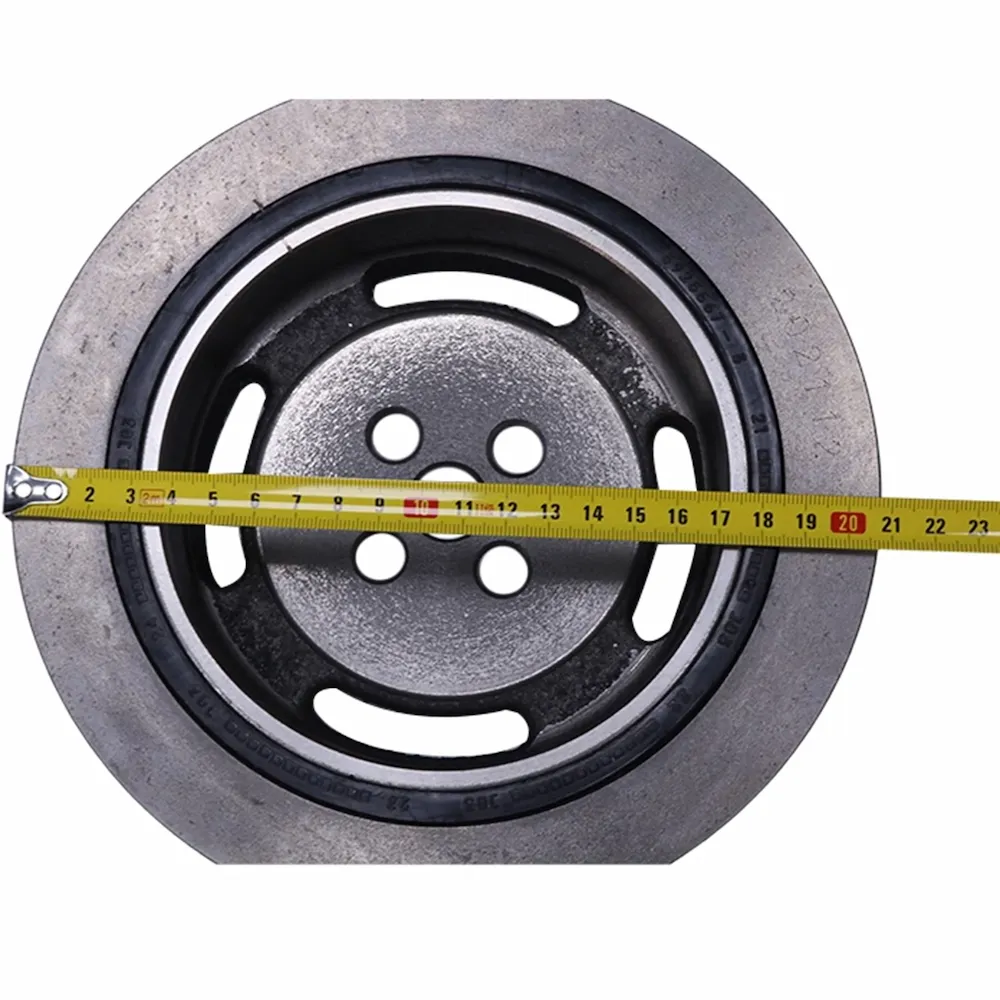
The same groove count does not guarantee the same belt plane
The groove count, groove profile and effective diameter of a crankshaft pulley determine the belt type, transmission capacity and speed relationship it can support. The accessories actually driven by the belt are determined by the full belt routing and front-end equipment layout.
One poly-V belt may pass around the alternator, water pump and several other components. Groove or rib count should therefore not be interpreted as the number of accessories. The same Cummins engine model may also use different crankshaft pulleys depending on the air-conditioning compressor, dual-alternator, fan-drive or hydraulic-pump arrangement.
The most easily overlooked dimension is offset.
Two pulleys may have the same groove count and diameter, but the grooves may sit farther forward or backward than on the original part. The crankshaft pulley will then fail to align in the same belt plane as the alternator, water pump, fan drive or another accessory pulley.
The result is not always a part that cannot be installed. The belt may still be fitted but then develop tracking problems, edge wear, noise, belt walk-off or an abnormal tensioner position. A pulley inquiry should therefore include the groove profile, effective diameter, offset, hub interface and current accessory layout—not only the number of grooves.
Markings on the old part should not be treated automatically as the order part number
Numbers, lines and angle marks on the face of a damper or pulley may represent a service part number, casting number, supplier code, batch code, balance mark or timing mark used to identify crankshaft position.
A visible number should not automatically be treated as an orderable part number.
On an elastomer design, a timing mark located on the outer ring may no longer correspond to the original crankshaft position if the outer ring has moved relative to the inner hub. That does not mean an unusual mark position in one photograph is enough to diagnose a failed damper remotely. Any relative movement should be checked by the repair technician against the actual construction, reference position and applicable service information.
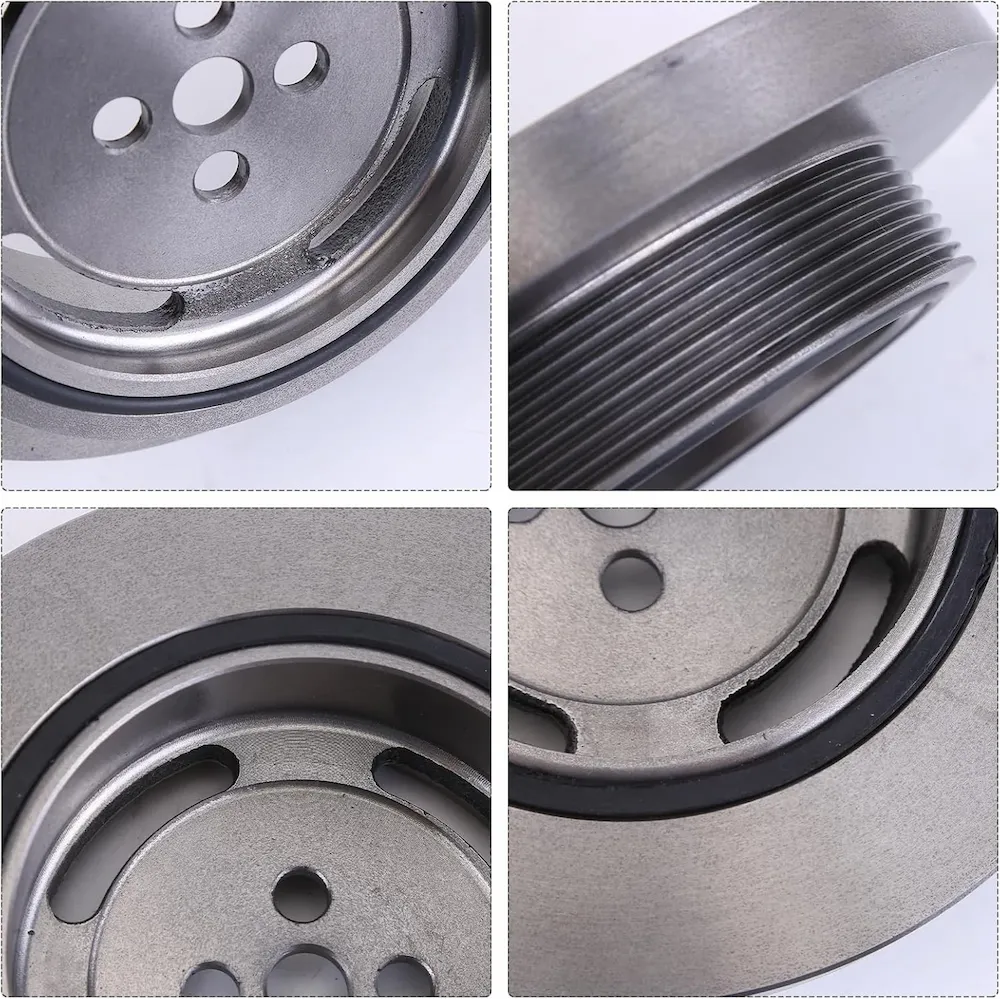
For parts identification, provide clear front, rear and side photographs of the old component and verify the result against the ESN and formal parts record. One timing line or surface number is not enough to establish the final part number.
“Damper Kit” and “Pulley Assembly” do not have a standardized supply scope
Terms such as Vibration Damper Kit, Crankshaft Pulley Assembly and Front Hub Kit do not represent one standardized BOM. One quotation may contain only the damper, while another may include the pulley, hub, spacer, washer and mounting hardware.
Before accepting a quotation, confirm whether it is for a damper only, a pulley only or an integrated assembly. Also confirm whether the hub, spacer and mounting hardware are included, and request the service part number and quantity for each line item.
If the repair also involves the belt, tensioner or idler pulley, treat those as separate purchasing items rather than assuming they are included in a damper kit or pulley assembly.
Clarifying this scope greatly reduces quotation misunderstandings. Final applicability still needs to be checked against the ESN, current part number and actual front-end configuration.
If you already have a damper or pulley quotation and are unsure whether it covers the complete front-end assembly, send the quotation, ESN, CPL and old-part photos to ZEB Power for a line-by-line BOM review before ordering.
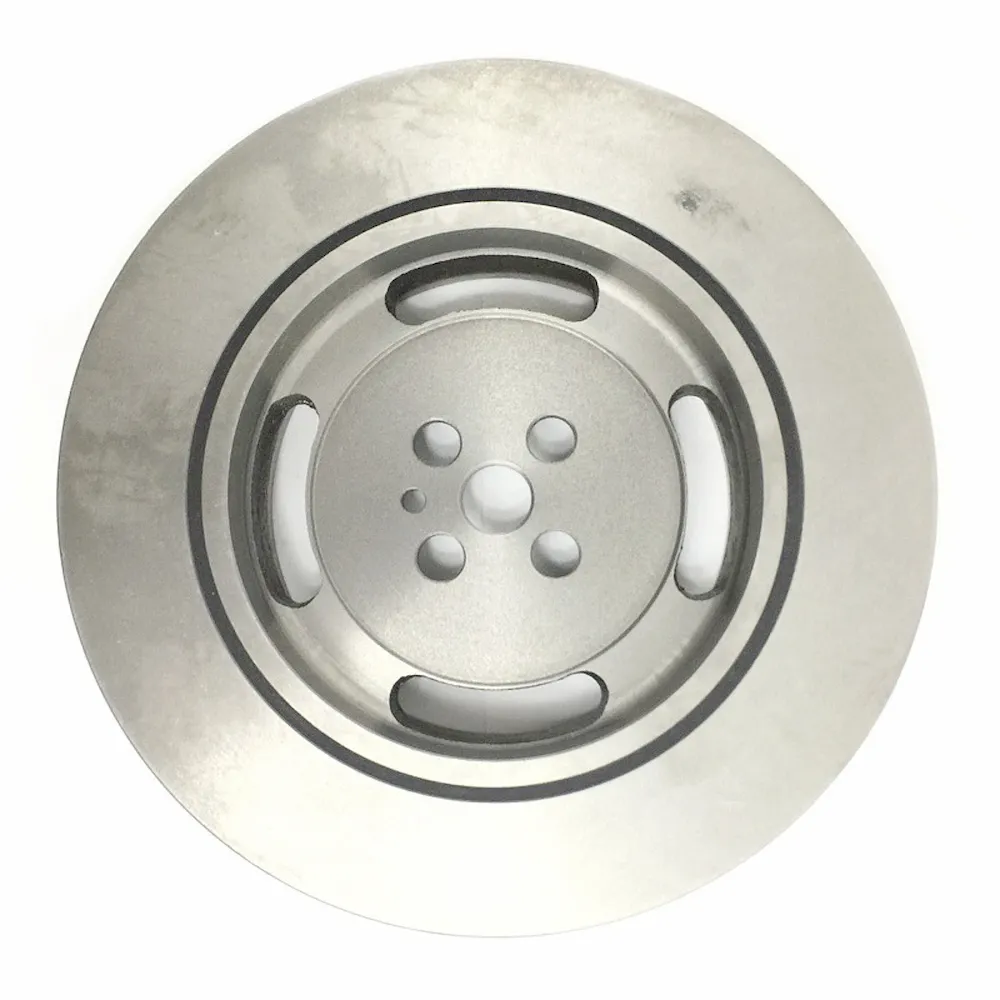
New genuine and quality alternative parts: pulley fit is measurable, but damper function goes further
A conventional crankshaft pulley can usually be evaluated through measurable characteristics such as material strength, groove profile, effective diameter, bore, bolt pattern, offset and dynamic balance.
A vibration damper also involves damping structure, inertia distribution, elastomer or viscous design, the corresponding crankshaft system and operating-speed range. Those factors cannot be established from external dimensions alone.
When evaluating a quality alternative, do not stop at confirmation that the outside diameter, bore and bolt pattern are similar. Ask what applicability and quality evidence the supplier can provide, including a clear cross-reference, corresponding service part number, confirmed engine or application coverage, and the result of checking the part against the current ESN, CPL and front-end configuration.
Depending on supplier capability, relevant evidence may also include damper-construction information, pulley-offset or runout inspection, dynamic-balance records, batch traceability and warranty procedures. Suppliers may disclose different levels of detail. The important point is that the evidence corresponds to the specific part number and application rather than relying only on the statement that the dimensions match and the part can be installed.
If the torsional-control characteristics of a damper do not match the current crankshaft system, torsional stress and long-term durability risk may increase for the crankshaft and related rotating components. Such risk may not become visible immediately after installation.
For continuously operating generator sets, mining equipment and high-load construction machinery, correct applicability, batch consistency and claim responsibility are usually more important than the initial price difference alone.
If you are comparing new genuine and quality alternative options for a specific machine, provide the ESN, CPL, current accessory layout and operating conditions. ZEB Power can help review the available parts and supporting quality information.
Information to provide before ordering
Provide the Cummins engine model, ESN, CPL, equipment brand and complete equipment model, and explain whether the crankshaft front end has previously been repaired or replaced.
Confirm whether the requirement is for the damper, pulley, hub or complete assembly. Include all visible part numbers and clear front, rear, side and hub-area photos. For a pulley inquiry, also provide the belt type, groove count, effective diameter, offset and current belt routing. If the machine uses an air-conditioning compressor, dual alternators, a fan drive, hydraulic pump or another front-end accessory, describe the installed arrangement.
Commercial information should include new genuine or quality alternative preference, quantity, destination, required lead time, and whether runout, dynamic-balance or batch-inspection records are required.
How ZEB Power supplies Cummins dampers and crankshaft pulleys
ZEB Power supplies Cummins vibration dampers, crankshaft pulleys and related front-end accessory-drive parts for construction machinery, mining equipment, generator sets and industrial equipment.
Based on the ESN, CPL, current front-end configuration, old part number and photos, we can help verify the correct part number for the vibration damper, crankshaft pulley, damper-pulley assembly, crankshaft hub, spacer and related mounting components. We also check whether groove arrangement, effective diameter and offset match the machine’s actual accessory layout and can provide new genuine and confirmed quality alternative options.
Damper-condition assessment, reuse decisions, runout or abnormal-vibration checks, and the final decision to replace the component should remain with the repair technician using the applicable service information. Once the repair scope is defined, ZEB Power focuses on verifying the correct part number, assembly scope and accessory configuration.
Send the engine ESN, CPL, actual front-end accessory arrangement, and clear photos and markings from the old part. ZEB Power can help confirm the correct part number and kit scope.
Frequently asked questions
Does belt misalignment or front-end noise always indicate a failed damper?
Similar symptoms can come from the belt, tensioner, idler pulley, pulley grooves or another front-end accessory. The repair facility should identify the source before the purchasing scope is defined.
Are the vibration damper and crankshaft pulley the same part?
They are not the same functional concept. The damper controls crankshaft torsional vibration, while the pulley drives the accessory belt. Some engines use separate parts, while others combine them in one damper-pulley assembly.
What is the difference between a harmonic balancer and a vibration damper?
Harmonic balancer is a common aftermarket term that usually refers to a crankshaft torsional vibration damper. Formal purchasing should still follow the Cummins part name, construction and service part number.
Does successful dynamic balancing prove that the damper is functionally correct?
Dynamic balance verifies the mass balance of the rotating assembly. It does not prove that the damper’s torsional tuning is correct for the crankshaft system. The two requirements are not interchangeable.
Can a damper be reused if no external cracks are visible?
An external inspection provides only part of the evidence. An elastomer design also depends on the inner hub, outer ring and bonding condition, while the working components of a viscous design are enclosed inside the housing. Reuse should be decided by the repair facility.
Can two dampers be interchanged if the outside diameter and bolt pattern are the same?
Those features show only that some external characteristics are similar. They do not even fully confirm correct installation. The pilot, hub interface, offset, damper construction, operating range and formal service part number must also be checked.
Can two pulleys be interchanged if the groove count and diameter match?
The groove profile, offset, hub interface and current belt plane still need to match. Identical groove count and diameter with a different offset can still cause belt tracking, wear or noise.
If the damper and pulley form one assembly, can the pulley be replaced separately?
That depends on the assembly design and formal service-parts structure. Some designs allow the pulley to be removed and supplied separately, while others require replacement of the complete damper-pulley assembly.
Does a “Damper Kit” always include the pulley, hub and mounting bolt?
There is no standardized BOM. Confirm line by line whether the damper, pulley, hub, spacer, washer and mounting hardware are included.
Can an inquiry be started without the old part number?
An initial check is possible. At minimum, provide the ESN, CPL, complete equipment model, multi-angle photos of the old part, hub interface, pulley-groove information and belt routing. If several front-end configurations exist, the current accessory layout will also be required.