

Cummins Timing Gear Train Parts: How to Choose the Right Parts

1065
Table of Contents
Generating table of contents
When a persistent whine or knocking noise develops at the front of an engine, many inquiries begin with one sentence:
“We need a Cummins timing gear set.”
A timing gear train, however, is not one independent gear or a standardized group of parts that can be replaced by matching tooth count and outside diameter.
The crankshaft gear establishes the primary drive. The camshaft gear transfers crankshaft motion to the valve train. Idler gears change the drive path and connect other gears. On some engines, the fuel pump, air compressor and other accessories also participate in the gear train through separate accessory drive gears.
A change in tooth form, gear width, hub position or mounting interface can affect the meshing relationship with adjacent gears. The actual requirement may include more than the gear itself:
- Idler shaft or pin;
- Bushing or bearing;
- Thrust components;
- Retainer;
- Gear housing and related locating parts.
In Cummins parts catalogs, crankshaft gears, idler gears and related components are generally managed as separate service parts. Applicability can be checked through the ESN and formal part-number records. This means a “timing gear” should not be ordered only by engine family name without confirming the actual configuration.
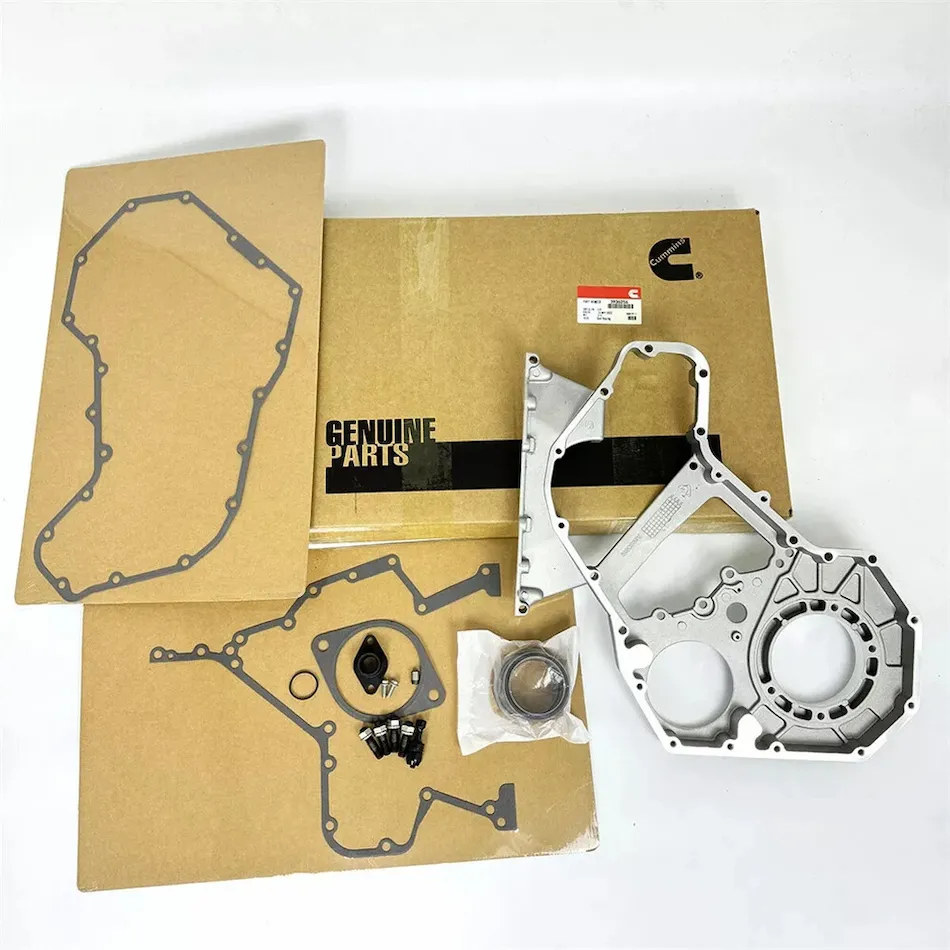
This guide is written for buyers sourcing Cummins timing gear train parts. It explains which components are commonly confused, which supporting parts are often omitted from quotations, and why timing noise may not originate from the gear teeth themselves.
The article does not provide timing-mark alignment procedures, backlash values, press-fit depths or bolt torque. Those are repair procedures that should be completed by a qualified service facility using the applicable technical information.
Timing noise does not automatically mean the gear teeth are worn out
A continuous whine, periodic knocking or abnormal gear noise can come from damaged gear teeth, but that is only one possible cause.
Similar symptoms may result from:
- A worn idler-gear bushing or bearing;
- A worn idler shaft or pin;
- A shifted idler support position;
- Wear, distortion or repair error in the gear-housing support bore, pin location or locating surface;
- A change in backlash or tooth-contact pattern;
- Insufficient lubrication or an oil-passage problem;
- A related crankshaft, camshaft, fuel-pump or accessory-drive fault.
The common point is that the sound comes from the gear-train area, but the gear itself may not be the part that needs replacement.
For example, the teeth on an idler gear may still look acceptable. If its bushing, bearing or shaft is worn, however, the actual rotational center of the gear can move. Installing a new gear may not eliminate the noise because the tooth surface was never the root cause.
The first step should therefore be an inspection of the full meshing chain by the repair facility, not an immediate purchase of a complete gear set based only on sound.
They are all gears, but their mounting and purchasing logic is different
Crankshaft gears, camshaft gears and idler gears all belong to the timing gear train, but they do not operate or mount in the same way.
Crankshaft gear
The crankshaft gear is installed on the crankshaft and rotates with it.
Purchasing checks should include more than tooth count:
- Bore;
- Keyway or other locating feature;
- Gear width;
- Hub design;
- Shoulder position;
- Mounting relationship with the crankshaft;
- Axial relationship with the adjacent gear.
A crankshaft gear may have the correct tooth count but still sit in the wrong meshing plane if the hub offset or gear width differs from the original part.
Camshaft gear
The camshaft gear is mounted at the end of the camshaft through a key, bolt, hub or another fastening arrangement. It transfers motion from the timing gear train to the valve train.
The most common quotation issue is supply scope:
- Does the customer need a camshaft assembly with the gear installed?
- Or is only a separate camshaft gear required?
Depending on the engine, the camshaft gear may be supplied separately or included in a camshaft assembly. The two quotation scopes are not interchangeable and must be confirmed before the order is accepted.
Idler gear
The idler gear uses a different mounting and support arrangement.
It is generally not rigidly fixed to a drive shaft that rotates with the gear. Instead, it rotates around a fixed idler shaft or pin and is held in the correct position by a bushing, bearing or another support arrangement.
Its function is to change the drive path, connect other gears and maintain the intended center distance and meshing relationship.
Because its support arrangement differs from a gear fixed directly to the crankshaft or camshaft, the purchasing checks are also different.
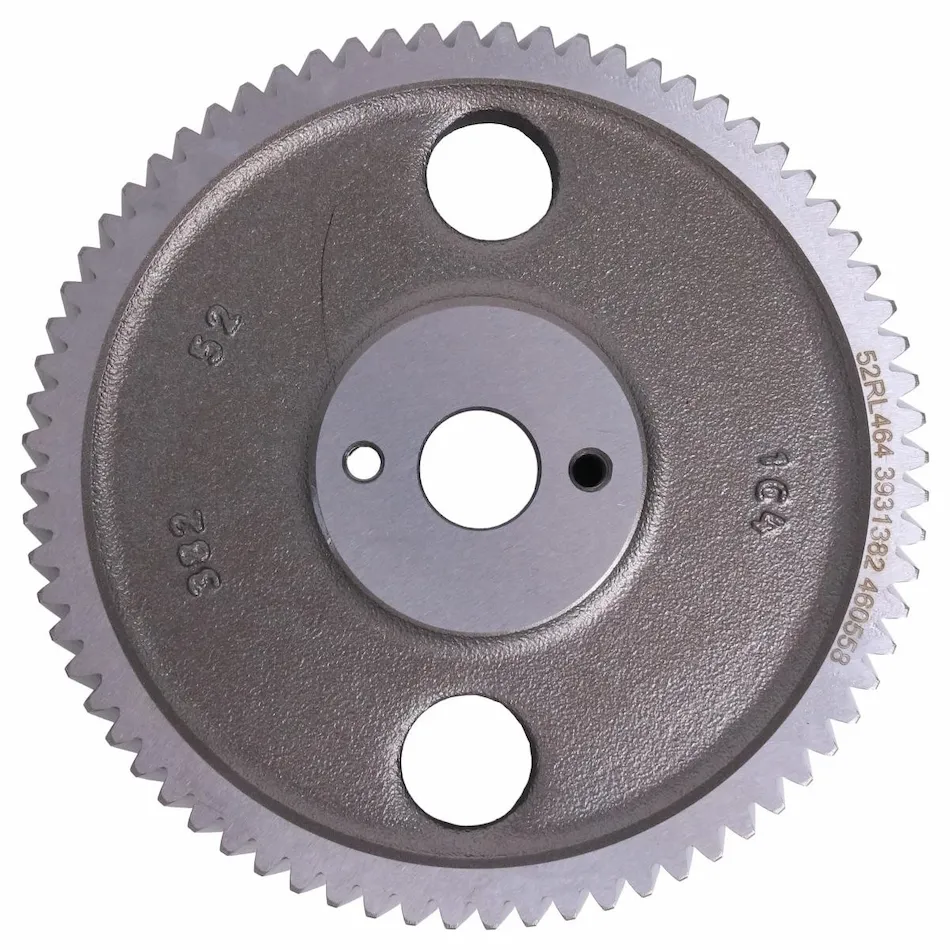
The most commonly omitted idler parts are the supporting components
Many idler-gear inquiries provide only:
Cummins idler gear, XX teeth.
The supplier matches a similar-looking gear by tooth count and photos. After disassembly, the customer discovers that the repair also requires:
- Idler shaft;
- Idler pin;
- Bushing;
- Bearing;
- Thrust washer;
- Thrust plate;
- Retainer;
- Related locating or lubrication parts.
This is one of the most common scope gaps in timing gear purchasing.
It would also be incorrect to assume that every idler is always a fixed three-piece combination of gear, shaft and bushing.
Depending on the Cummins platform, the design may use:
- A bushing installed in the gear;
- A separately replaceable bushing;
- A gear-and-bearing combination;
- A separate idler shaft or pin;
- Different shaft-to-housing arrangements;
- An idler gear assembly;
- A compound idler gear;
- Separate thrust or retaining parts.
In the actual BOM, the idler gear, bushing, bearing, shaft and thrust parts may be supplied at different levels. Whether they are separate service parts or one assembly must be confirmed through the ESN and parts records.
For quotation scope, at least three questions should be answered:
- Is the quotation for the gear only or a complete assembly?
- Are the shaft, bushing or bearing included?
- Are thrust and locating parts ordered separately?
Clear answers greatly reduce omitted items, but final applicability still requires ESN and formal part-number verification.
The same tooth count and outside diameter do not guarantee correct fit
Tooth count is the most obvious timing-gear measurement, but it describes only one feature.
Two gears can have a similar tooth count and outside diameter and still be incompatible because of differences in:
- Tooth profile;
- Gear width;
- Bore;
- Keyway;
- Bolt pattern;
- Hub offset;
- Shoulder position;
- Front-to-rear orientation;
- Spur or helical design;
- Helix direction;
- Large- and small-gear combination in a compound gear;
- Center distance and axial position relative to adjacent gears.
Hub offset and gear width are especially easy to miss when the inquiry is based only on photos.
A gear may physically fit the shaft, but its tooth ring may sit farther forward or backward than the original part. It will then fail to align with the adjacent gear in the same meshing plane.
The same timing mark does not make two gears interchangeable
A timing mark identifies a relative assembly position. It is not a complete compatibility reference.
The same dot, letter, number or symbol may appear on different gears. A superseded gear may also use a different marking method.
Numbers visible on an old gear may represent:
- Service part number;
- Casting number;
- Forging number;
- Supplier code;
- Production code;
- Material or batch mark;
- Timing mark;
- Manufacturing-process mark.
Visible markings are identification clues only. The final match should be cross-checked through the ESN, formal part number and the specific parts record rather than ordered from appearance alone.
The housing is not just a cover—it controls where the idler gear operates
A gear housing is often described simply as the casing around the gears.
In configurations where the housing supports the idler gear, it may also establish:
- Idler-shaft or pin location;
- Gear center distance;
- Axial gear position;
- Support-bore and locating-surface references;
- Oil-passage layout;
- Mounting references for the front cover and related front-end parts.
If the idler support bore, pin location or mounting surface is worn, distorted or machined incorrectly, the actual center and axial position of the new gear may no longer meet the intended design.
This can lead to:
- Changed gear backlash;
- Shifted tooth contact;
- Abnormal meshing noise;
- Accelerated wear of new and existing gears;
- Repeat noise after repair.
That is why a new gear that still makes noise is not automatically a defective gear.
The problem may also involve:
- Idler shaft or pin;
- Bushing or bearing;
- Housing locating features;
- Adjacent gears;
- Housing-to-block location;
- Previous repair machining.
The phrase “front engine housing” may also refer to several different parts:
- Gear housing;
- Front cover;
- Timing cover;
- Gear case;
- Rear gear housing.
These names are sometimes used loosely, but they do not necessarily identify the same structure.
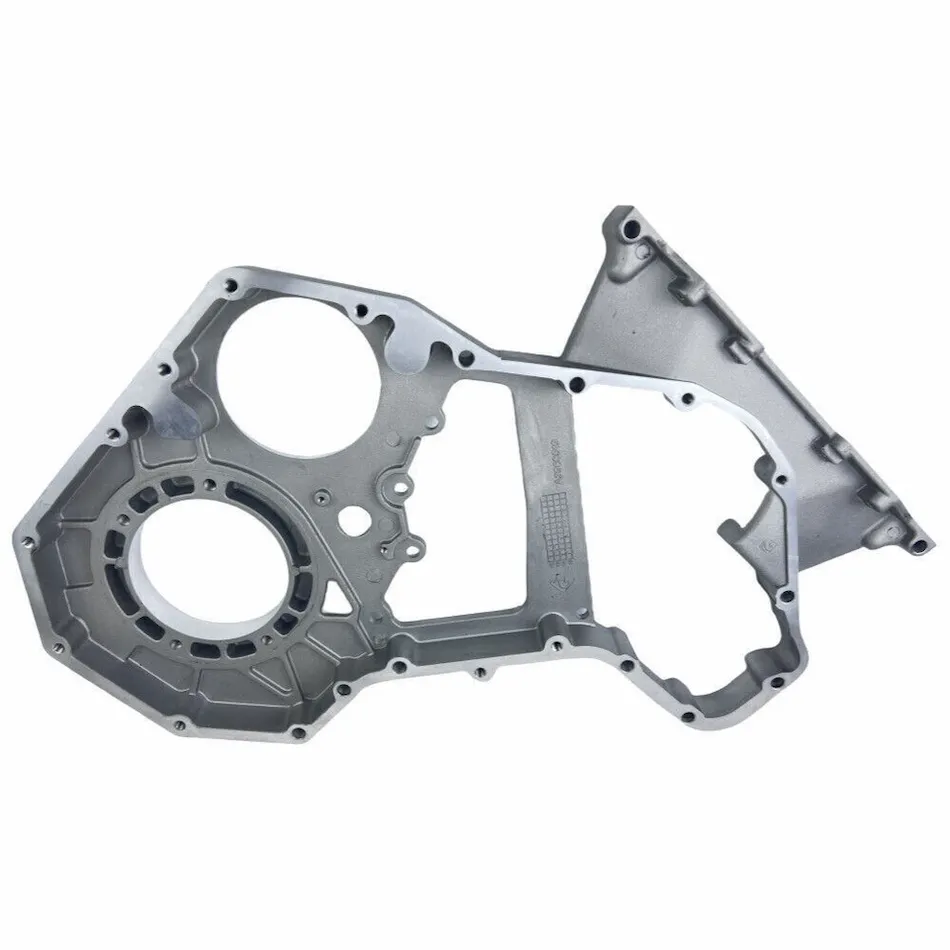
A front cover normally focuses on closing and sealing the front area. A gear housing may also locate and support the timing gear train. The actual function and supply level must be confirmed for the engine configuration.
Accessory drive gears are configuration-specific, not universal by engine family
In addition to the crankshaft, camshaft and idler gears, some Cummins engines use the gear train to drive:
- Fuel injection pump;
- Air compressor;
- Lubricating oil pump;
- Hydraulic pump;
- PTO or another accessory.
These accessory drive gears should not be ordered only by engine family.
The same engine model may have different CPLs, fuel systems and accessory arrangements when used in generator sets, construction equipment or industrial machinery. The corresponding pump gear, compressor gear or accessory drive gear may therefore differ.
A request such as:
We need a fuel-pump gear for this Cummins engine model.
may still be missing:
- ESN;
- CPL;
- Current fuel-pump part number;
- Pump model;
- Whether the pump has been replaced;
- Whether the gear is included in the pump assembly or supplied separately;
- Old pump-gear part number;
- Actual installed accessory configuration.
The CPL can help narrow the engine configuration, but it does not replace the ESN, current fuel-pump or accessory part number, and the actual installed arrangement.
Pump gears, compressor gears and other accessory drive gears should ultimately be cross-checked through the ESN and current accessory part number.
“Timing Gear Set” is not a standardized BOM
Terms such as Timing Gear, Timing Gear Set, Gear Train Kit and Idler Gear Kit do not have a standardized market definition.
One timing gear set may include only:
- Crankshaft gear;
- Camshaft gear.
Another may also include:
- One or more idler gears;
- Compound idler gear;
- Accessory drive gear;
- Idler shaft;
- Bushing or bearing;
- Thrust and retaining parts.
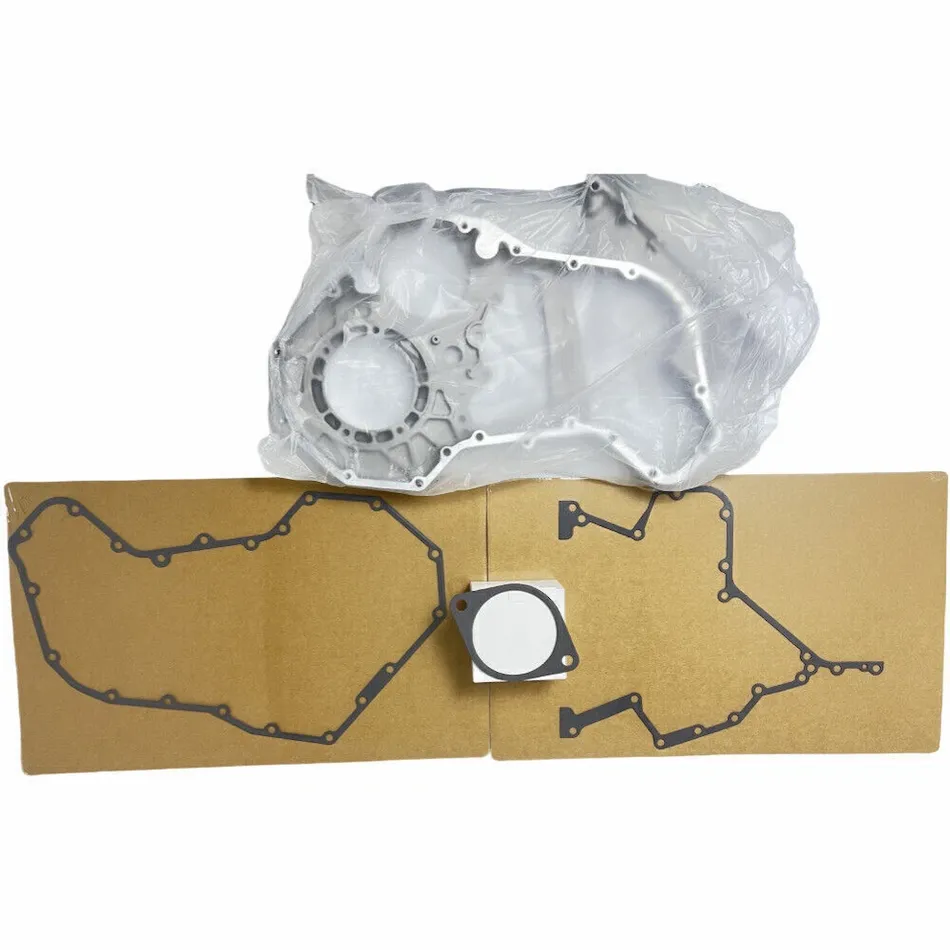
The gear housing, front cover, gasket, O-ring and related oil seals may remain separate supply items.
Before accepting the quotation, do not ask only whether it is a “complete kit.” Confirm each line item:
- Crankshaft gear;
- Camshaft gear;
- Number and position of idler gears;
- Compound idler gear;
- Idler shaft or pin;
- Bushing or bearing;
- Thrust plate, washer and retainer;
- Accessory drive gear;
- Gear housing or front cover;
- Gasket, O-ring and oil seal;
- Part number and quantity for each item;
- Applicable ESN and CPL.
If you already have a timing gear set quotation but are unsure whether it includes the idler shaft, bushing or accessory drive gear, send the quotation together with the ESN and CPL. ZEB Power can help review the BOM before the order is placed.
If one gear is damaged, should the adjacent gears also be replaced?
This cannot be decided remotely by the supplier from a photo alone.
When one gear has a broken tooth, pitting, abnormal contact or severe wear, the repair facility should normally inspect:
- Directly meshing gears;
- Idler shaft or pin;
- Bushing or bearing;
- Thrust and retaining parts;
- Housing support and locating position;
- Lubrication condition.
Continuously meshing gears can influence each other, but that does not mean every damaged gear requires a complete set replacement.
The opposite assumption is also risky:
Finding damage on one gear does not prove that every adjacent gear, support part and housing location is still correct.
Whether the repair requires one gear, several gears or additional shaft, bushing and housing work should be based on the inspection findings, not on a blanket “replace everything” rule.
New genuine and quality alternative gears: material and process evidence matter
Timing gears operate under continuous meshing and repeated load.
Two gears may look the same and share the same tooth count and main dimensions, yet still differ in material, heat treatment and tooth-surface quality. Those differences are not normally visible in photos or basic caliper measurements.
The main advantages of new genuine parts usually include:
- Official service-part-number applicability;
- Formal supersession;
- Material and manufacturing control against the original design;
- Packaging and traceability;
- Test and warranty support.
A quality alternative should not be accepted only because:
- The tooth count matches;
- The outside diameter matches;
- The bore matches;
- The gear can be installed.
Depending on the importance of the part and the supplier’s capability, request the available quality evidence, such as:
- Clear cross-reference;
- Applicable service part number;
- Material specification;
- Heat-treatment type;
- Tooth-surface hardening or finishing information;
- Tooth-profile and gear-width inspection;
- Bore, keyway, hub and bolt-pattern inspection;
- Runout or other critical-dimension records;
- Batch-consistency records;
- Warranty and claim process.
Suppliers may differ in how much detail they can disclose about material grade, effective case depth, hardness or laboratory reports.
The objective is not to demand the same report format for every project. The evidence should correspond to the specific part number and application rather than relying on a statement such as “the tooth count is the same and it fits.”
It should also not be assumed that every Cummins timing gear uses one universal carburizing process.
Different gears may use different heat-treatment methods depending on material, load and design. The key question is whether the alternative controls the material, hardening method, tooth performance and dimensions required for the corresponding original part.
For mining equipment, continuously operating generator sets and repairs with high access cost, gear-train rework can create more downtime cost than the initial price difference between gears.
If you are comparing new genuine and quality alternative options for a specific gear position, provide the ESN, CPL, old gear part number and equipment operating conditions. ZEB Power can help review available options and supporting quality information.
Information to provide before ordering
Engine and configuration: Cummins engine model, ESN, CPL, equipment brand and full model, application, fuel system, and whether the engine has an air compressor or another gear-driven accessory.
Gear information: Crankshaft gear, camshaft gear, idler gear or accessory drive gear; old part number and all visible markings; front, rear and side photos; tooth count, gear width, bore, keyway or bolt pattern; hub design and offset; photos of the damaged teeth; and the gear with which it meshes.
For a compound idler gear, provide the tooth count and width of both the large and small gears together with a clear side photo. One total tooth count or a front-only photo can miss the second gear stage.
Idler and housing information: Gear only or complete assembly; idler shaft or pin part number; bushing or bearing part number; thrust and retaining parts; current gear-housing part number and casting number; known support wear or repair history; and whether the housing is required.
Commercial requirements: New genuine or quality alternative; one gear or complete gear-train scope; quantity per engine; number of engines; destination; required lead time; material, heat-treatment, critical-dimension or batch-inspection requirements; packaging and labeling requirements.
How ZEB Power supplies Cummins timing gear train parts
ZEB Power supplies Cummins timing gear train parts for construction machinery, mining equipment, generator sets and industrial equipment.
Based on the ESN, CPL, current gear-housing configuration, old part numbers and photos, we can help verify:
- Crankshaft gear;
- Camshaft gear;
- Idler gear;
- Compound idler gear;
- Fuel-pump gear;
- Air-compressor gear;
- Accessory drive gear;
- Idler shaft or pin;
- Bushing or bearing;
- Thrust plate and washer;
- Retainer;
- Gear housing;
- Front cover;
- Gasket, O-ring and related oil seal;
- Actual BOM for a timing gear set;
- Supersession;
- New genuine and confirmed quality alternative options;
- Quantity, lead time and quotation scope.
Timing-noise diagnosis, backlash measurement, housing-support inspection, gear installation, timing-mark alignment and reuse decisions should be completed by a qualified repair facility using the applicable service information.
ZEB Power’s role is to verify that the gears, shaft, bushing, housing and accessory-drive configuration belong to the same BOM, reducing incomplete orders and missing supporting parts.
Send the engine ESN, CPL, required gear position, old part number, tooth count, and whether the idler shaft, bushing and housing also need verification. ZEB Power can help confirm candidate part numbers and timing gear set scope.
Frequently asked questions
Does timing gear whine always mean the gear must be replaced?
No. The noise may also involve the idler shaft, bushing, bearing, housing support or lubrication condition. The complete gear train should be inspected first.
Can crankshaft, camshaft and idler gears be matched by tooth count alone?
No. Tooth profile, gear width, bore, keyway or bolt pattern, hub offset, installation orientation and adjacent-gear position must also match.
Does an idler gear quotation always include the shaft and bushing?
No. The idler may be supplied as a gear only, a gear with bushing or a complete assembly. Shaft, bearing, thrust and retaining parts should be confirmed separately.
Do identical timing marks mean two gears are interchangeable?
No. A timing mark identifies a relative assembly position. It does not replace tooth-profile, gear-width, bore, hub-offset, mounting-interface and formal part-number verification.
Can the number on the old gear be used directly as the order part number?
Not always. It may be a service part number, casting number, forging number, supplier code, production mark or timing mark. Verify it against the ESN, gear position, gear construction and formal parts record.
Does a replacement camshaft always include the camshaft gear?
No. One quotation may be for a camshaft assembly with the gear, while another may be for the camshaft only. Confirm the BOM before ordering.
Can the same fuel-pump gear be used across one Cummins engine family?
Not by assumption. Fuel-pump gears may vary with CPL, fuel-pump part number, pump interface and accessory arrangement. Confirm the ESN and current pump configuration.
If one gear is worn, must every adjacent gear be replaced?
No. Adjacent gears and support parts should be inspected, but the replacement scope should be based on actual findings rather than an automatic full-set replacement.
Does a “Timing Gear Set” include every timing and accessory drive gear?
Not necessarily. There is no standardized BOM. Confirm the crank gear, cam gear, idler gears, accessory gears, shaft, bushing and housing line by line.
How should a quality alternative timing gear be evaluated?
In addition to cross-reference and critical dimensions, request the available material, heat-treatment, tooth-finishing, critical-dimension and batch-inspection information according to the importance of the part.
Different gears may use different manufacturing processes. The evidence should correspond to the specific part number rather than relying only on a claim that the tooth count matches and the gear can be installed.