

Cummins Fan Belt & Tensioner: Size, Routing & Part Matching

8303
Table of Contents
Generating table of contents
A Cummins fan belt and belt tensioner may appear to be among the simplest components in an engine accessory drive system. A fan belt looks like a basic rubber drive element, while a tensioner may seem like little more than a spring-loaded arm and pulley assembly. In practice, however, both components are mismatched more often than many buyers expect. The same engine model can require a completely different belt length, rib count, and routing path depending on the accessory drive configuration — whether the alternator, A/C compressor, hydraulic pump, or fan drive are all running off the same belt loop. Tensioners are just as configuration-specific: pulley face type, arm geometry, and mounting structure all need to match the actual belt system, not just "look like the same tensioner."
Two issues come up repeatedly during sourcing. First, belt routing can't be determined from the engine model alone — the same engine installed on different equipment may drive a different number of accessories, so the routing path changes with it. Second, a belt length measured with a tape measure and the length definition used in a manufacturer's catalog are often not the same number, which is why buyers sometimes get quotes that "don't match" what they measured.
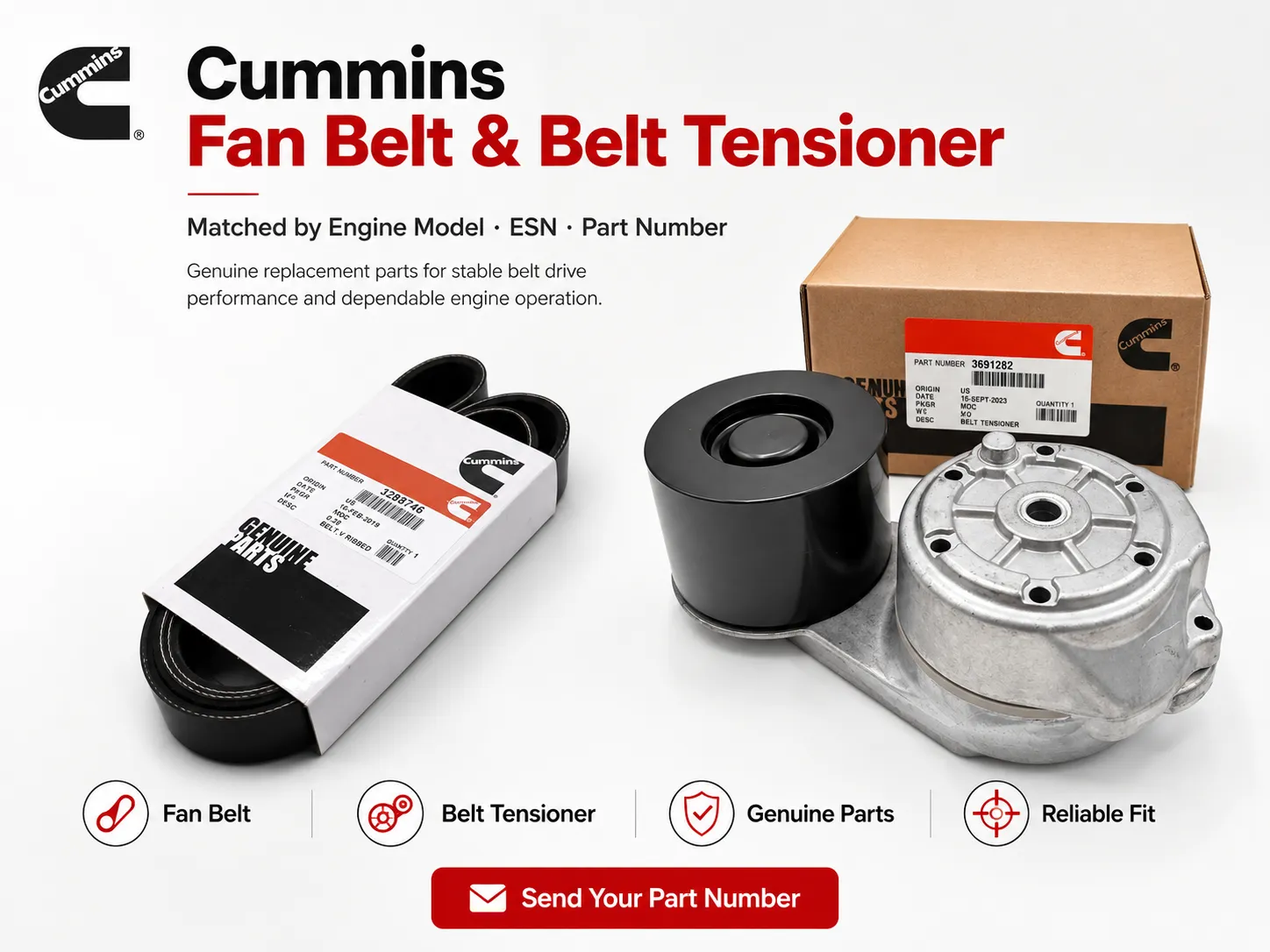
This guide covers four things: what the different belt and tensioner part names actually refer to, which parameters matter when sourcing (size, routing, tensioning method), how to choose between genuine and aftermarket parts, and what to prepare before requesting a quote. Diagnostics — whether belt squeal or slippage is really a belt problem versus a tensioner or pulley problem — are only touched on briefly; that's better handled by a local technician with the right tools. This guide focuses on getting the right part once you've already decided a belt or tensioner needs replacing.
Who this is for: procurement and maintenance staff responsible for construction equipment, mining machinery, and generator sets — particularly teams dealing with an accessory drive issue and trying to confirm the right replacement.
Fan Belt, V-Belt, V-Ribbed Belt, Tensioner — Know What You're Comparing
"Fan belt" is a broad term that doesn't necessarily mean a traditional V-belt — it could refer to a single V-belt or to a V-ribbed belt that drives multiple accessories. Before sourcing, confirm exactly which part each name refers to, so you're not comparing two different things that happen to share a name.
| Term | Common meaning | What to confirm when sourcing |
|---|---|---|
| Fan Belt | Broad, informal term — could mean a V-belt or a V-ribbed belt | The actual belt structure, formal part number, and accessory configuration |
| V-Belt | Trapezoidal cross-section belt, used singly or in matched sets | Belt section, length, quantity, and pulley groove profile |
| V-Ribbed Belt / Serpentine Belt | Belt with multiple longitudinal ribs, capable of routing around several accessories on a single loop | Rib count, length specification, single- or dual-sided ribs, routing path |
| Belt Tensioner Assembly | Complete tensioner unit that maintains belt tension | Mounting bolt pattern, arm orientation, pulley, and working range |
| Tensioner Pulley | The pulley mounted on the tensioner arm | Face type (smooth or grooved), diameter, width, whether it's sold separately |
| Idler Pulley | Fixed or adjustable pulley used to redirect the belt path or add wrap angle | Fixed vs. adjustable, face type, whether the bearing is included |
| Belt Drive Kit | A bundled set of belt, tensioner, idler, and related parts | Exactly what's included and whether it fits the original system |
When requesting a quote, avoid simply writing "Cummins fan belt" or "Cummins tensioner." Confirm first whether you need the belt itself, a complete tensioner assembly, or a specific pulley or bearing within the tensioner.
Why Belts and Tensioners Get Mismatched So Often
Belt and tensioner matching risk comes from several variables existing at once — none of which are visible just by looking at the part:
- Belt type — V-belt or V-ribbed belt; the cross-sections are entirely different and cannot substitute for each other
- Size — length and rib count/section mismatches can prevent installation, cause abnormal tension, or stop the belt from transmitting power properly
- Routing path — the same engine model can use a different routing path depending on accessory configuration; this cannot be assumed from the engine model alone
- Tensioning method — automatic tensioner or manual adjustment; these require entirely different purchasing scopes
- Pulley face type — grooved pulleys (which contact the ribbed side) and smooth pulleys (which contact the back of the belt) are not interchangeable even at the same diameter
Any one of these being wrong can lead to belt slip, noise, premature wear, or a tensioner that can't hold proper tension — which is why belts and tensioners shouldn't be sourced based on engine model alone.
Belt Type: V-Belt or V-Ribbed Belt
This is the first thing to confirm, since the two cross-sections are entirely different and cannot substitute for each other.
V-Belt: Trapezoidal cross-section, transmitting power through contact between the belt's sides and the pulley groove. Common on simpler accessory drive systems. If the original system uses a matched set, drive group, or multiple belts sharing the same load, they should generally be replaced as a full set per the applicable service guidance — don't mix old and new belts or different specifications, since uneven load distribution can overload the new belt or cause the old one to slip.
V-Ribbed Belt (also called Serpentine Belt or Poly-V Belt): Has multiple longitudinal ribs on its surface and can route around several accessories (alternator, A/C compressor, hydraulic pump, power steering pump, fan drive, etc.) on a single loop — common on equipment with more accessories. Two belts of similar length may still be incompatible if the rib count, cross-section, or intended routing layout differs.
The pulley groove profile required for each belt type is different, so confirm which type the original equipment uses rather than sourcing based on the generic word "belt."
Reading Belt Codes: A Screening Tool, Not the Final Answer
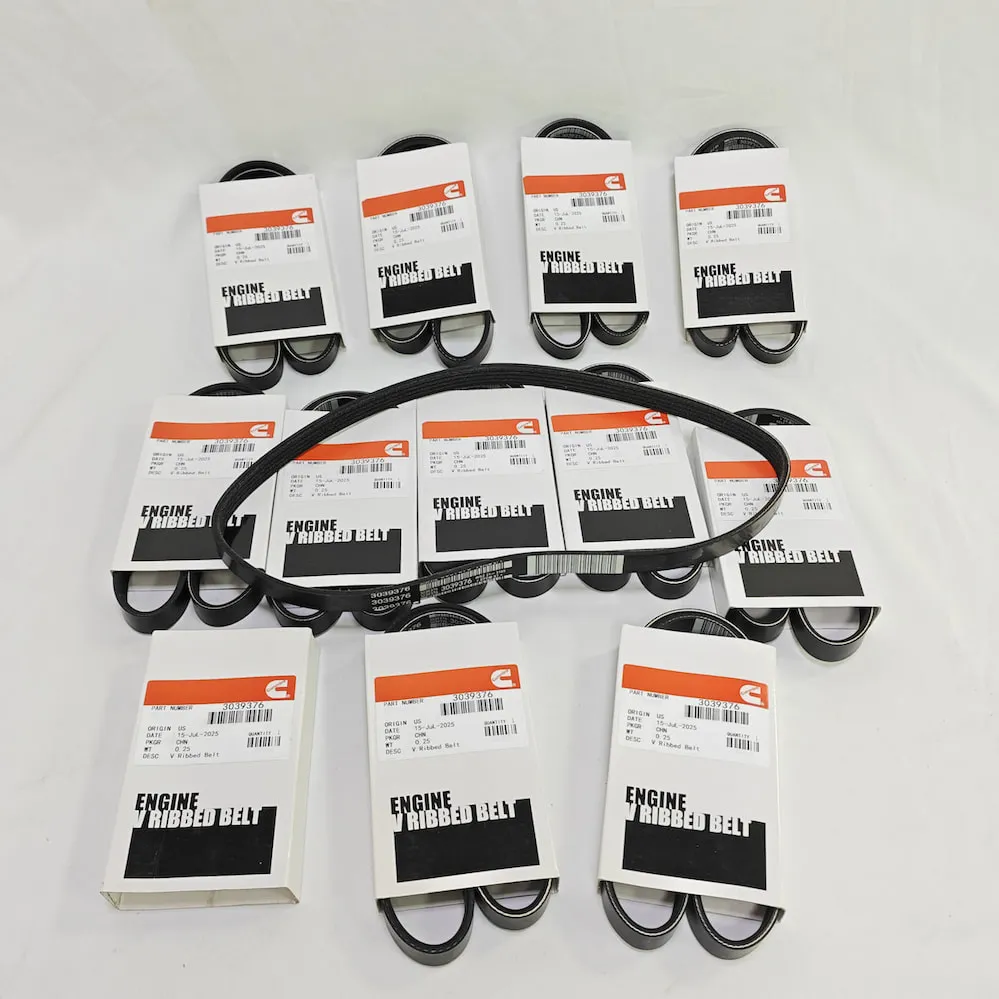
V-ribbed belts are typically stamped with a code such as 6PK1000. In this example, 6 usually indicates 6 ribs, PK indicates the cross-section family, and 1000 usually indicates an approximate length of 1000 mm — described as a reference or nominal length. Different manufacturers may define this number differently (some call it Reference Length, others Effective Length), so the exact definition should be confirmed against the specific brand's catalog rather than assumed to be universal.
This kind of code is useful for initial screening but cannot replace formal part number matching — two belts both marked 6PK1000 may still be incompatible due to differences in rib profile, single- vs. dual-sided ribs, or material construction.
Belt Length: Watch for Mismatched Measurement Standards
Belt length can be specified using different standards — Effective Length, Outside Length, and others — and manufacturers don't always define or report these consistently. When a customer measures an old belt with a tape measure, the result is usually an outside circumference or a flat-laid measurement, which is not the same as the Effective Length used in a manufacturer's catalog. Quoting a self-measured number as if it were a catalog spec is a common source of "the numbers don't line up" confusion.
Worn belts add further uncertainty — stretching, rib wear, and faded part markings can all reduce the accuracy of a manual measurement. For this reason, treat manual measurement as supporting information rather than the primary basis for matching; prioritize any legible part number or marking still on the old belt. If a measurement is unavoidable, note exactly how it was taken (outside circumference, inside circumference, or flat-laid length) so the supplier doesn't mistake it for a catalog Effective Length.
Routing: Can't Be Assumed From the Engine Model
This is the most overlooked step in belt sourcing — and the one with the biggest consequences.
The same Cummins engine installed on different equipment may drive a different set of accessories — some units only drive the fan and alternator, others also drive the A/C compressor, hydraulic pump, or other OEM accessories. A different accessory count and layout means a different routing path (the sequence the belt follows and which idlers it passes), so routing cannot be assumed based on "how this engine model typically routes."
Some equipment includes a routing diagram — printed on a decal, under the hood, on the shroud, or in service literature — and this is the most reliable reference if it's still legible. Construction equipment, mining machinery, and generator sets don't always retain this label, though, so if the original diagram is missing or unreadable, photograph the current routing before removing the old belt (a full front-of-engine shot, the belt's path, and each pulley it contacts). Don't reinstall a snapped or already-removed belt by guessing at "the shortest path" — incorrect routing can result in insufficient wrap angle, a tensioner working outside its designed range, or an accessory that isn't driven properly.
Tensioning Method: Automatic Tensioner or Manual Adjustment
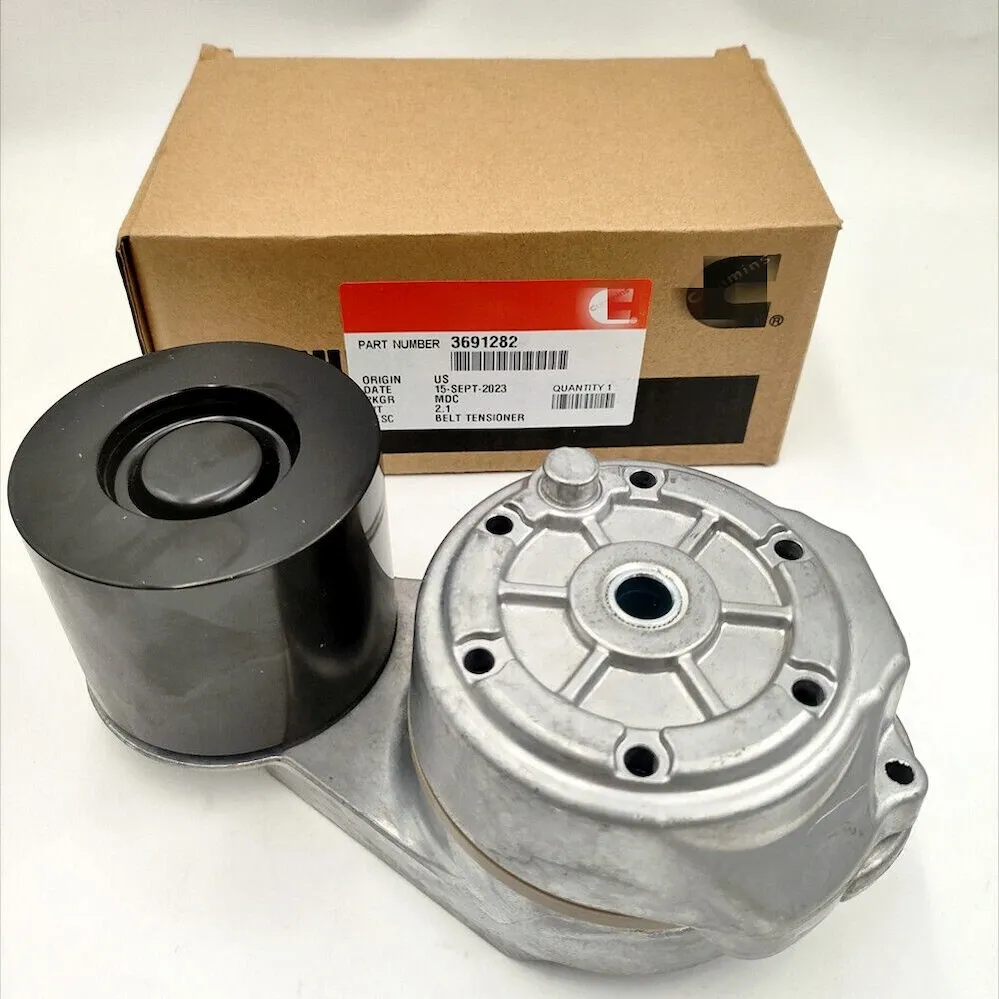
Automatic tensioners use an internal spring and damper to continuously compensate for belt stretch and load changes, and are the more common configuration on newer systems. When sourcing, confirm the formal part number, mounting bolt pattern, arm orientation, pulley specs, and whether it's a complete assembly — spring tension rating isn't something a buyer should try to judge on their own; it's better confirmed through the formal part number and applicable system.
Manual adjustment setups are still found on some V-belt systems — via an alternator slot, adjusting bolt, or adjustable bracket — and don't necessarily use a spring-loaded tensioner. In this case, the purchasing scope may be the belt itself, a bracket, or an adjusting bolt rather than a complete tensioner assembly. If you're not sure which tensioning method the equipment uses, photograph it before requesting a quote rather than guessing.
Regardless of tensioning method, tighter isn't always better: insufficient tension can cause slip, while excessive tension increases the load on accessory bearings and accelerates wear.
Tensioner Pulley vs. Idler Pulley: Different Functions, Not Interchangeable
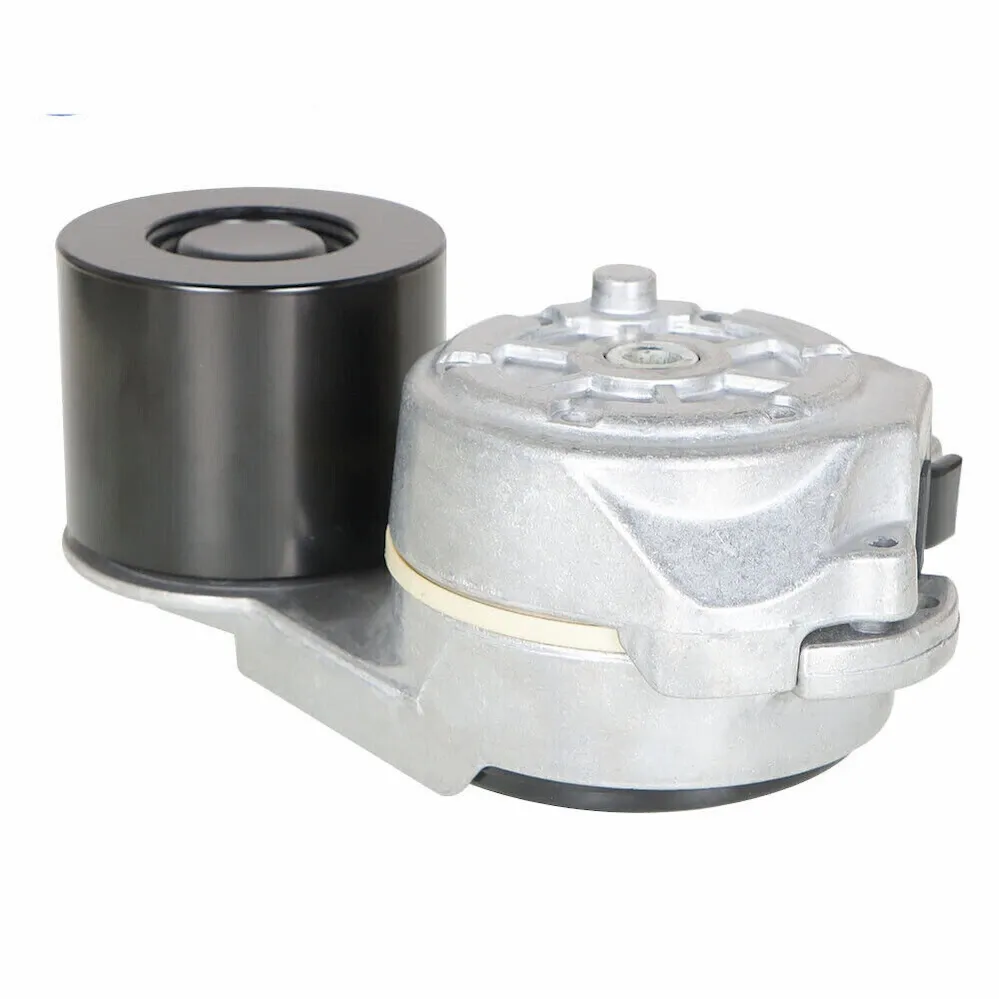
Tensioner Pulley: Mounted on the tensioner arm and moves with it to adjust belt tension. Replacing only this pulley won't solve an underlying problem if the tensioner's spring, damper, or arm is already worn — confirm the tensioner body is in good condition before deciding whether the pulley alone can be swapped.
Idler Pulley: Primarily used to redirect the belt path, add wrap angle on an accessory pulley, or stabilize a longer belt span. It typically doesn't actively adjust tension. Confirm whether it's fixed or adjustable, and whether the bearing is included in the quote.
The two can look similar but serve different functions and mount in different positions — don't assume they're interchangeable just because they "look about the same."
Pulley Face Type: Grooved or Smooth
On V-ribbed belt systems, grooved pulleys typically contact the ribbed side of the belt, while smooth pulleys typically contact the back. Even at the same diameter, these are not interchangeable — installing the wrong type can put the belt's ribs against the wrong contact surface, resulting in fraying, noise, belt walk-off, or abnormal loading on the tensioner arm and bearing.
When sourcing a tensioner pulley or idler pulley, confirm the contact face type in addition to diameter and width.
New Belt Failing Quickly? The Problem Isn't Always the Belt
A new belt developing noise, uneven wear, or failure again within a short time doesn't necessarily mean the belt itself was defective. Common related causes include a failing tensioner spring or damper, a worn or loose tensioner arm, a bad idler bearing, pulleys that aren't coplanar, incorrect routing, contaminated or worn pulley grooves, or even a bearing binding inside an accessory (like the alternator or A/C compressor).
This doesn't mean every belt replacement requires replacing the whole tensioning system — but if the old belt showed clear uneven wear, walked off the pulley, or failed again shortly after replacement, it's worth having a technician check the tensioner, idler, and pulleys at the same time rather than simply installing another new belt.
Belt Only, or Belt Plus Tensioner and Idler?
The purchasing scope should be based on what a physical inspection finds — not a blanket "replace everything" or "only replace what obviously failed" approach:
| Purchasing Scope | When It Applies |
|---|---|
| Belt only | Part number confirmed, and the tensioner, idler, and pulleys are all in good condition |
| Belt + complete tensioner assembly | Tensioner spring, damper, or arm shows signs of failure |
| Belt + idler pulley | Idler bearing or pulley surface is damaged |
| Tensioner pulley only | Tensioner body is fine and the specific model supports replacing the pulley separately |
| Complete tensioner assembly | Spring, arm, damper, or base are showing wear beyond just the pulley |
For equipment where downtime is costly, it's worth having a technician check the pulleys, bearings, arm, and spring together before deciding between a standalone part and a complete assembly.
Choosing Between Genuine and Aftermarket Parts
| Product Type | Characteristics | Key Things to Confirm |
|---|---|---|
| Genuine new part | Part number, application, and sourcing are typically well-defined | Engine ESN, part number, packaging, and cross-reference relationship |
| High-quality aftermarket with a documented cross-reference | Can balance budget and lead time | Rib count/belt section, length spec, pulley interface, material, batch traceability, and warranty |
| Parts with unverified sourcing or specs | Difficult to confirm fit and consistency | Not recommended for equipment where downtime is costly |
For aftermarket belts, confirm rib count or belt section, length specification, single- vs. dual-sided ribs, material construction, a documented cross-reference number, and compatibility with the intended routing. For aftermarket tensioners, confirm mounting bolt pattern, arm orientation, pulley size and face type, working range, and whether it's a complete assembly — don't assume every model supports replacing the bearing or pulley separately.
For belts that are part of the same drive group, even if only one shows obvious wear, replacing the full set is generally advisable to avoid uneven load from mixing old and new belts.
Pre-Order Checklist
| Information | Priority | Purpose |
|---|---|---|
| Old belt or tensioner formal part number | Highest | The most direct basis for matching |
| Belt type (V-belt / V-ribbed) | Highest | Wrong type can't substitute for the other |
| Routing path photo (taken before removal) | Highest | Accessory configuration varies, so routing can't be assumed from engine model alone |
| Engine model and ESN | High | Helps confirm engine and accessory configuration |
| Equipment make and model | High | Accessory drive configuration can vary by equipment |
| Old belt marking / cross-section photo | High | Helps confirm rib count and belt section |
| Tensioning method (automatic / manual) | High | Determines whether the scope is a tensioner assembly or a belt/bracket |
| Tensioner or idler photo | High | Helps confirm structure and whether it needs replacing alongside the belt |
| Accessory list (A/C compressor, power steering pump, etc. present or not) | High | Directly affects routing path and belt length |
| CPL | Auxiliary | Helps confirm engine configuration, but can't confirm the part number on its own |
| Application (construction / mining / generator, etc.) | Auxiliary | Helps determine an appropriate sourcing approach |
| Symptom description | Auxiliary | Useful as background context, not sufficient to determine the part |
Request-for-Quote Format
You don't need every detail up front — this can be handled in two steps.
Step 1: Basic information (enough to start the review)
- Engine Model:
- ESN (if available):
- Equipment Make and Model:
- Required Product: Belt / Complete Tensioner / Tensioner Pulley / Idler Pulley / Kit / Unsure
- Belt Type (V-belt / V-ribbed, if known):
- Application:
- Quantity:
- Destination Country:
Step 2: Add the following information where available to improve matching accuracy
- Old Part Number:
- Old Belt Photo (cross-section and any markings):
- Belt Measurement (please note the method used — outside circumference, inside circumference, or flat-laid length; manual measurement is a supporting reference only and is not the same as a catalog Effective Length):
- Routing Diagram Photo (taken before removal):
- Tensioner/Idler Photo:
Not sure about your belt type or routing? Send us the engine model and equipment model first — you don't need every detail up front, and we can help confirm the rest step by step. It's also worth photographing the routing path before removing the old belt.
Comparing Quotes From Different Suppliers
Prices are only directly comparable when belt type, length standard, tensioning method, and purchasing scope all match.
| Comparison Point | What to Confirm |
|---|---|
| Final part number | Whether the old number, cross-reference, and quoted number correspond |
| Belt type | V-belt or V-ribbed |
| Size standard | Effective length vs. outside circumference; whether rib count/belt section matches |
| Routing compatibility | Whether it fits the original accessory layout |
| Tensioning method | Automatic tensioner or manual adjustment |
| Purchasing scope | Belt, tensioner pulley, complete tensioner assembly, or idler |
| Pulley face type | Grooved or smooth, and whether it matches the original equipment |
| Bearing/bracket inclusion | A common source of price differences between quotes |
| Warranty | Duration, coverage, and claim conditions |
| Quote unit | Per belt, or as a matched set (relevant for parallel V-belt configurations) |
If two quotes differ significantly, first confirm they're for the same scope (for example, one being a complete tensioner assembly and the other just a pulley) rather than assuming the price difference reflects quality alone.
How ZEB Power Supplies Cummins Fan Belts and Tensioners
ZEB Power supplies Cummins fan belts and tensioners for diesel engines used in construction equipment, mining machinery, and generator sets. Based on the engine model, equipment model, and old part information you provide, we help confirm whether belt type, size, routing, and tensioner specs actually match — rather than quoting off the engine model alone.
Depending on the specific part number and current supply channels, we can help verify genuine Cummins parts, parts from the belt or tensioning system manufacturer, high-quality aftermarket parts with a documented cross-reference, and complete tensioner assemblies, tensioner pulleys, idler pulleys, or related service parts — not every model supports replacing the pulley or bearing separately, so the right option depends on your specific configuration and budget.
Please share your application, accessory configuration (A/C compressor, power steering pump, etc.), and sourcing preference so we can help confirm the right quote option.
FAQ
1. Is a "fan belt" the same thing as a serpentine belt?
Not necessarily. "Fan belt" is a broad term that could mean a V-belt or a V-ribbed/serpentine belt — this should be confirmed from the old part's structure and formal part number.
2. What does a code like 6PK1000 mean?
It usually indicates 6 ribs, the PK cross-section family, and a reference or nominal length of about 1000 mm — but different manufacturers may define this length differently, and it's only useful for initial screening. Formal matching should rely on the old part's official part number.
3. Why can't belt routing be determined just from the engine model?
The same engine model installed on different equipment may have a different accessory configuration (A/C compressor, power steering pump, etc. present or not), which changes the routing path. Use the equipment's own routing diagram, or a photo taken before removal, as the reference.
4. I measured the belt with a tape measure — why doesn't the number match what the supplier quoted?
This is likely a measurement-standard mismatch. A catalog may use Effective Length, Reference Length, Outside Length, or another defined specification, while a tape measurement usually gives an outside circumference or flat-laid length. These numbers are not automatically interchangeable. Note exactly how the measurement was taken, and prioritize any formal part number or marking still legible on the old belt.
5. Can I replace just one of several parallel V-belts?
If the belts are part of the same drive group carrying a shared load, they should generally be replaced as a full set. Mixing old and new belts can cause uneven length and tension, leading to uneven load distribution.
6. Are tensioner pulleys and idler pulleys interchangeable?
Not based on appearance alone. They serve different functions and mount in different positions — the tensioner pulley sits on the arm and actively adjusts tension, while the idler mainly redirects the belt or adds wrap angle.
7. What's the difference between grooved and smooth pulleys, and can they be mixed?
No. Grooved pulleys typically contact the ribbed side of the belt, while smooth pulleys contact the back. Even at the same diameter, using the wrong type can cause noise, belt walk-off, or fraying at the edges.
8. My new belt failed again quickly — is that always a quality problem?
Not necessarily. It could also be related to a failing tensioner spring or damper, misaligned pulleys, incorrect routing, or a problem with an accessory bearing. It's worth having a technician check the rest of the tensioning system at the same time.
9. Can I request a quote without the old part number?
Yes — start by providing the engine model, equipment model, and accessory configuration, and the supplier can help confirm from there. Photos of the old belt and the routing path will make the match more accurate.
10. What information do I need to get an accurate quote?
At minimum, the engine model, equipment model, application, and the type of product needed (belt / complete tensioner / idler). Photos of the old part, the routing path, and any belt markings will make the match more accurate and speed up the quote.
Summary: Confirm Accessory Configuration and Routing First, Then Size and Tensioning Method
Belt and tensioner sourcing risk comes from belt type, size standard, routing path, tensioning method, and pulley face type all being in play at once — several of which cannot be confirmed from external appearance alone. Routing in particular can't be assumed from the engine model; it depends on the equipment's actual configuration. Belt length also needs care, since a self-measured number and a catalog spec aren't always the same thing. Before ordering, work through accessory configuration, old part information, and a routing photo item by item — rather than ordering from visual similarity or approximate dimensions alone.
Ready to source a Cummins fan belt or belt tensioner? Send ZEB Power the old part number, belt marking or tensioner photos, engine ESN, equipment make and model, and a front-of-engine or routing photo. If the specifications or routing are still unclear, we can review the available information step by step and provide a clearly defined quotation scope.