

Cummins Fuel Filter: Primary, Secondary or Water Separator?

7349
Table of Contents
Generating table of contents
Selecting the wrong Cummins fuel filter can allow particles or water to reach the fuel injection pump and injectors. On common rail engines, these downstream components are precision parts with relatively high repair costs, so a fuel filter should not be selected only by appearance, thread size or the lowest price.
This guide explains the factors that determine whether a Cummins fuel filter will fit the actual system and provide the required protection.
Primary and Secondary Filters: Different Roles and Different Positions
Many Cummins diesel engines use multi-stage fuel filtration. A common arrangement includes a primary filter, also called a pre-filter, and a secondary filter, also called a final filter.
The primary filter is usually located closer to the fuel tank. It removes larger contaminants during the first filtration stage, and some systems also use it for water separation.
The secondary filter is usually positioned further downstream, closer to the injection pump or high-pressure fuel system. It provides finer filtration before the fuel reaches critical injection components.
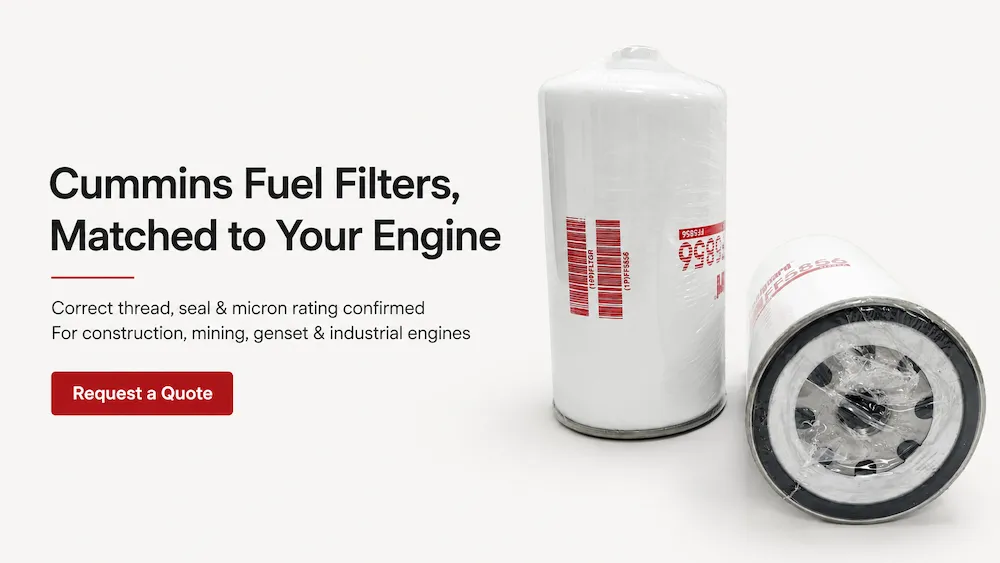
However, the actual number of filtration stages, the number of filters, their installation positions and whether the system includes a separate fuel/water separator all depend on the engine platform and equipment configuration.
A two-stage, two-filter arrangement should not be treated as a universal Cummins configuration.
Primary and secondary filters may differ in:
- Filtration performance;
- Media construction;
- Rated flow;
- Water-separation function;
- Filter-head design;
- Installation position;
- Formal part number;
- Maintenance interval.
They should not be interchanged unless a verified application or cross-reference confirms that the substitution is correct.
If different filtration stages are installed in the wrong positions, or a filter required by the current maintenance scope is omitted, the system may not provide the protection specified by the engine or equipment manufacturer.
Primary and secondary filters may also have different service intervals. Two filters installed on the same engine do not necessarily need to be replaced at exactly the same time. The applicable maintenance schedule should come from the engine or equipment service information.
An inquiry that only says “Cummins fuel filter” does not tell the supplier:
- Which filtration stage is required;
- Where the filter is installed;
- How many filters are used per engine;
- Whether a separate water separator is present;
- Whether all installed filters use the same part number.
Provide the old filter photos, installation positions and complete quantity per engine whenever possible.
Fuel/Water Separators: Water Collection Depends on the Product Design
A fuel/water separator performs more than particle filtration. It also separates and collects water from the fuel.
It remains a type of fuel filtration product, but its system role, internal construction and performance requirements differ from a fuel filter designed only for particle removal.
Separated water may be collected:
- Inside the filter;
- Inside the filter head or housing;
- In a separate collection area;
- In an attached bowl;
- In another part of an integrated fuel module.
Not every fuel/water separator includes an external transparent bowl.
Whether the product includes a separate bowl, drain valve, sensor port or other water-management component depends on the specific filter and housing design. These components should not be assumed to be included simply because the quotation says “fuel/water separator.”
Free Water and Emulsified Water
Water does not always exist in diesel fuel in the same form.
Free water has already formed visible droplets or a separate water layer. It is generally easier to separate.
Emulsified water consists of much smaller water droplets suspended throughout the fuel. It is normally more difficult to remove.
Two products may both be described as having water-separation capability while providing different performance against free water and emulsified water.
When technical data are available, buyers should compare:
- Free-water separation;
- Emulsified-water separation;
- Test method;
- Rated flow;
- Fuel-system application;
- Filter-media technology.
Not every product document will publish all of these values, but they are useful points to raise when comparing alternatives.
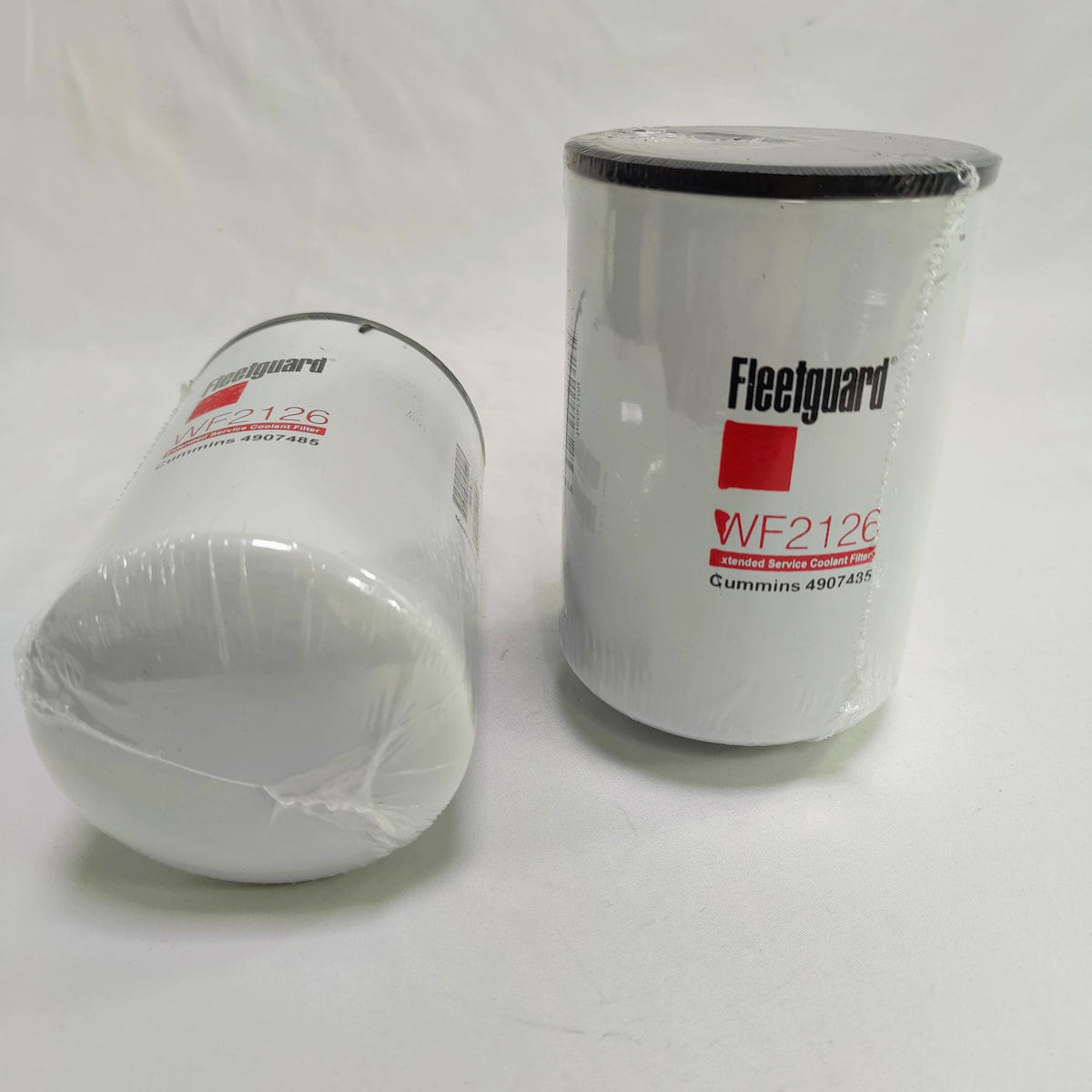
Spin-On and Cartridge Filters Are Different Structures
Cummins fuel filters, including fuel/water separators, may use a spin-on or cartridge design.
Spin-On Fuel Filter
A spin-on filter includes its own outer shell and threads directly onto the filter head.
Important checks include:
- Thread diameter;
- Thread pitch;
- Gasket outside diameter;
- Gasket inside diameter;
- Overall length;
- Maximum outside diameter;
- Installation clearance;
- Whether a bowl is included;
- Whether a drain valve is included;
- Whether a sensor port is present;
- Primary, secondary or water-separation function.
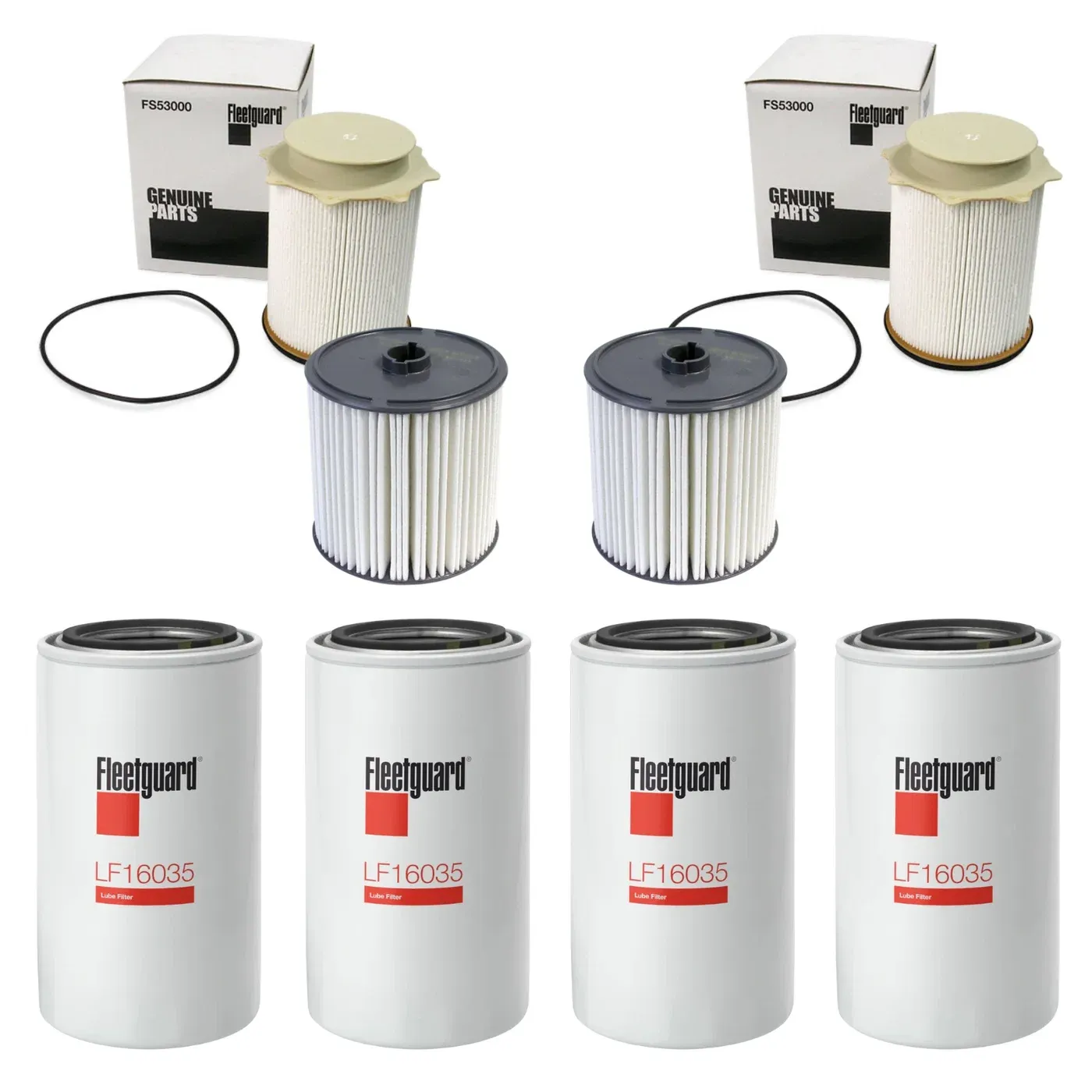
Cartridge / Element Filter
A cartridge system keeps the housing and cap in service while only the internal element and applicable seals are replaced.
Important checks include:
- Element outside diameter;
- Element length;
- Upper and lower end structure;
- Center-hole design;
- O-ring position;
- Seal dimensions;
- Housing compatibility;
- Internal locating structure;
- Whether service seals are included.
Spin-on and cartridge filters are not interchangeable.
Even within the same structural category, two filters may use different dimensions, seals, internal supports and housing interfaces.
The Same Product Name May Cover Different Quotation Scopes
Different suppliers may use “fuel filter” for different products.
| Quotation term | Common supply scope | What to confirm |
|---|---|---|
| Fuel Filter | One fuel-filter unit | Primary or secondary, spin-on or cartridge |
| Fuel/Water Separator | Particle filtration plus water separation | Whether bowl, drain and sensor are included |
| Filter Element | Internal replacement element | Whether O-rings and service seals are included |
| Filter Head / Housing | Mounts the filter and connects the fuel lines | Fittings, bracket, sensor and heater interface |
| Fuel Filter Assembly | A relatively complete assembly | Exact included-parts list |
Before comparing prices, ask what is physically included.
A product called an “assembly” does not automatically include every bowl, sensor, drain valve, heater, bracket, fitting or harness.
Part Number Comes Before Position and Appearance
When the existing filter has a readable Cummins, filter-manufacturer or equipment-OEM part number, matching should begin with that number.
Descriptions such as “primary filter,” “secondary filter” and appearance photos are useful for verification, but they should not replace formal part-number confirmation.
A practical matching framework is:
Formal Part Number + Engine ESN/CPL + Equipment Model + Installation Position + Quantity per Engine + Photos
Part-number relationships also need to be interpreted correctly.
Replaces / Supersedes
This usually indicates a formal catalog replacement relationship, but buyers should still confirm application restrictions, gasket differences and current equipment fitment.
Upgrade Version
An upgrade may use different media or construction.
It does not necessarily mean every application must be upgraded, and it should not automatically be treated as a reverse interchange.
Filter Used With
This can indicate that two filters are used together in the same system rather than replacing one another.
For example, a primary filter and a secondary filter may both be required for one engine.
This point is especially important for wholesalers and traders managing multiple SKUs.
Filtration Performance Cannot Be Judged by One Micron Number
Buyers often ask:
What micron rating does this filter have?
The number is useful, but one isolated micron value does not describe actual filtration performance.
Two products may both be advertised with the same micron value while providing different:
- Capture efficiency at that particle size;
- Test conditions;
- Rated flow;
- Pressure-drop characteristics;
- Filter-media construction;
- Dirt-holding capacity;
- Water-separation performance.
For a meaningful comparison, review:
- Particle size;
- Efficiency at that particle size;
- Test standard;
- Rated flow;
- Filter-media type;
- Dirt-holding capacity, if available;
- Free-water separation, where applicable;
- Emulsified-water separation, where applicable.
This is why this article does not give a universal micron value for Cummins primary or secondary filters.
A micron number without efficiency and test conditions can be misleading.
Water-in-Fuel Sensor, Drain Valve and Fuel Heater
Fuel/water separator systems may include several accessories that are easy to overlook during sourcing.
Water-in-Fuel Sensor
A water-in-fuel sensor may be installed in the bowl, housing, drain assembly or another water-collection position.
It monitors accumulated water and sends a signal to the instrument panel or control system.
Confirm:
- Whether the sensor is included;
- Sensor mounting location;
- Connector type;
- Pin configuration;
- Whether the old sensor must be reused;
- Whether a harness or adapter is required.
Drain Valve
The drain valve is used to remove collected water and contamination.
It may be:
- Included with the filter;
- Included with the bowl;
- Included with the housing;
- Supplied separately;
- Reused from the old assembly.
Confirm the thread, seal and compatibility with the existing bowl or housing.
Fuel Heater
Some low-temperature applications use a fuel heater to support fuel flow under cold conditions.
Confirm:
- Whether the heater is included;
- System voltage;
- Connector type;
- Housing compatibility;
- Installation position;
- Whether the old heater is reused.
When requesting a quotation, clarify whether the water-in-fuel sensor, drain valve and fuel heater must be included, reused from the existing system, or only supported by a compatible housing interface.
A New Filter Does Not Mean the Engine Will Restart Immediately
After a fuel filter is replaced, some fuel systems require priming or air removal according to the applicable engine or equipment service information.
If air remains in the fuel system, the engine may show:
- Hard starting;
- Unstable operation;
- Interrupted fuel supply;
- Abnormal fuel pressure;
- Stalling.
The exact priming or air-removal procedure depends on the system configuration.
Qualified service personnel should complete the work using the correct maintenance information.
This article does not provide priming, bleeding or starting instructions.
Equipment-OEM Filter-Head Configurations May Differ
The same Cummins engine can be installed in equipment from different manufacturers.
The actual machine may use:
- An equipment-OEM-specified filter head;
- A remote-mounted pre-filter;
- A separate fuel processor;
- A specific fuel-line connection;
- A specific mounting arrangement;
- A different number of filters.
This does not necessarily mean the equipment manufacturer designed or manufactured the filter head. It means the complete filtration system must be confirmed against the actual equipment configuration.
Provide:
- Equipment manufacturer;
- Complete equipment model;
- Machine serial number, when available;
- Filter-head or housing photos;
- Old filter photos;
- Installation positions;
- Number of filters per engine.
The engine model alone may not be enough.
Fuel-Quality Problems Are Not Always Filter Problems
Symptoms such as low power, hard starting or repeated filter blockage may involve the filter, but they may also result from:
- Water-contaminated fuel;
- High particle contamination;
- Dirty storage tanks;
- Rust or debris inside the fuel tank;
- Contaminated transfer equipment;
- Fuel-line problems;
- Injection-pump problems;
- Injector problems;
- Other fuel-system faults.
If filters repeatedly block or collect excessive water, installing another new filter may not solve the root cause.
The source of contamination or water ingress should be identified by qualified service personnel.
Genuine and High-Quality Aftermarket Filters
For common rail engines, mining equipment, continuously operated generator sets and other high-downtime-cost applications, fuel-filtration failure may directly affect the high-pressure pump and injectors.
The lowest price should not be the only selection criterion.
When evaluating an aftermarket filter, confirm:
- Formal cross-reference;
- Primary or secondary position;
- Spin-on or cartridge design;
- Water-separation function;
- Particle-efficiency data;
- Rated flow;
- Water-in-fuel sensor compatibility;
- Drain-valve compatibility;
- Fuel-heater compatibility;
- Included O-rings and seals;
- Batch traceability;
- Warranty.
Broad claims such as “fits Cummins engines” are not sufficient.
For products supplied as genuine or under a recognized brand name, bulk buyers should not rely on packaging appearance alone.
Also verify:
- Supply channel;
- Formal part number;
- Production batch;
- Outer-carton label;
- Included accessories;
- Traceability documentation;
- Thread consistency;
- Gasket consistency;
- Internal construction consistency across batches.
Information to Provide Before Ordering
Engine Information
- Cummins engine model;
- ESN;
- CPL, when available;
- Engine-nameplate photo.
Equipment Information
- Equipment manufacturer;
- Complete equipment model;
- Machine serial number, when available;
- Application type.
Existing Filter-System Information
- Total number of fuel filters per engine;
- Installation position of each filter;
- Whether each position is primary, secondary or a separate water separator;
- Part number used at each position;
- Whether the system uses a remote-mounted filter;
- Whether a separate fuel processor is installed.
Existing Part Numbers
- Cummins filter part number;
- Fleetguard or other filter-manufacturer number;
- Equipment-OEM part number;
- Filter-head or housing number, if visible;
- Fuel-module number, if applicable.
Product Configuration
- Spin-on or cartridge design;
- Water-separation function;
- Bowl configuration;
- Water-in-fuel sensor requirement;
- Drain-valve requirement;
- Fuel-heater requirement;
- Whether existing accessories will be reused;
- Whether a formal supersession or upgrade number is acceptable.
Photos
- Complete filter photo;
- Label and part-number photo;
- Thread or sealing-face photo;
- Filter-head or housing photo;
- Bowl and drain photo;
- Sensor and heater connector photo;
- Installation-position photo.
Commercial Requirements
- Genuine or aftermarket preference;
- Quantity per engine;
- Total order quantity;
- Destination;
- Required lead time;
- Packaging and labeling requirements;
- Traceability or inspection-document requirements.
How ZEB Power Supports Cummins Fuel-Filter Sourcing
ZEB Power supplies Cummins engine fuel filters and related filtration components for:
- Construction machinery;
- Mining equipment;
- Generator sets;
- Industrial equipment;
- Repair and overhaul projects;
- Wholesale and inventory orders.
Using the engine ESN, equipment model, existing part numbers and filter-system information, we can assist with verifying:
- Primary or secondary filtration position;
- Spin-on or cartridge construction;
- Water-separation function;
- Filter-head compatibility;
- Water-in-fuel sensor compatibility;
- Drain-valve compatibility;
- Fuel-heater compatibility;
- Quantity per engine;
- Formal supersession;
- Genuine and aftermarket supply options;
- Quotation scope.
Available options depend on the formal part number and current supply channel.

Frequently Asked Questions
Can Primary and Secondary Fuel Filters Be Interchanged?
Not by default.
Their positions, filtration roles and required performance may differ. Confirm the formal part number and original system configuration rather than relying only on thread size or appearance.
Do All Fuel Filters Separate Water?
No.
Only specific products are designed for water separation. Confirm whether the original product has a water-separation function and whether the bowl, drain valve and sensor are included or must be reused.
Does Hard Starting After Filter Replacement Mean the New Filter Is Defective?
Not necessarily.
The cause may involve filter matching, seal installation, air entering the fuel system, the filter head or other fuel-supply components. Qualified service personnel should inspect the system.
Does Repeated Filter Blockage Mean I Need a Better Filter?
Not necessarily.
Repeated blockage or water accumulation may indicate contaminated fuel, tank contamination or another source of water ingress. The contamination source should be identified rather than only replacing the filter with a more expensive product.
Can I Request a Quotation Using Only the Engine Model?
An initial search may be possible, but final confirmation should also use the ESN, CPL, equipment model, filter-head configuration, installation position and old-part photos.
Can I Request a Quotation Without the Old Filter Part Number?
Yes, an initial check may still be possible.
Provide the engine ESN, CPL, equipment model, filter-head photos, old-filter photos, installation positions and quantity per engine.
Conclusion
A Cummins fuel filter should not be selected only by engine family, appearance, thread or micron claim.
The correct matching process should confirm:
Filtration Stage + Water-Separation Function + Part Number + Filter Structure + Filter Head + Accessories + Quantity per Engine
When contacting ZEB Power, provide the engine ESN, CPL, equipment model, old filter number or photos, and the number of filters used per engine.
We can assist with verifying the applicable part number, filtration stage, water-separation configuration, system fitment and quotation scope.