

Cummins Cylinder Head: How to Match the Correct Head

4790
Table of Contents
Generating table of contents
A cracked, leaking or distorted Cummins cylinder head costs more than the price of the part itself. It can also mean missed delivery schedules, idle construction equipment, interrupted generator operation and additional workshop time.
However, another expensive problem often appears before installation even begins:
The buyer and the supplier both say “complete cylinder head,” but they may be referring to two different products.
A buyer may expect rocker arms, valve crossheads, injectors, the head gasket and cylinder head bolts to be included. The supplier may be quoting a cylinder head fitted with valves, valve guides, springs and injector sleeves—and may still consider that a complete head.
This is not always intentional misrepresentation. Terms such as Bare, Assembled, Loaded and Complete do not have one universally accepted bill of materials across every supplier and engine family.
Before ordering a Cummins cylinder head, buyers should confirm:
- The formal part number;
- Product condition;
- Actual included components;
- Casting number and machining configuration;
- Injector and valvetrain arrangement;
- Installation parts;
- Core-charge requirements;
- Warranty scope.
This guide is written for parts wholesalers, importers, repair workshops, fleet operators and engine rebuilders sourcing Cummins cylinder heads for on-highway vehicles, construction machinery, mining equipment, marine engines, generator sets and industrial applications.
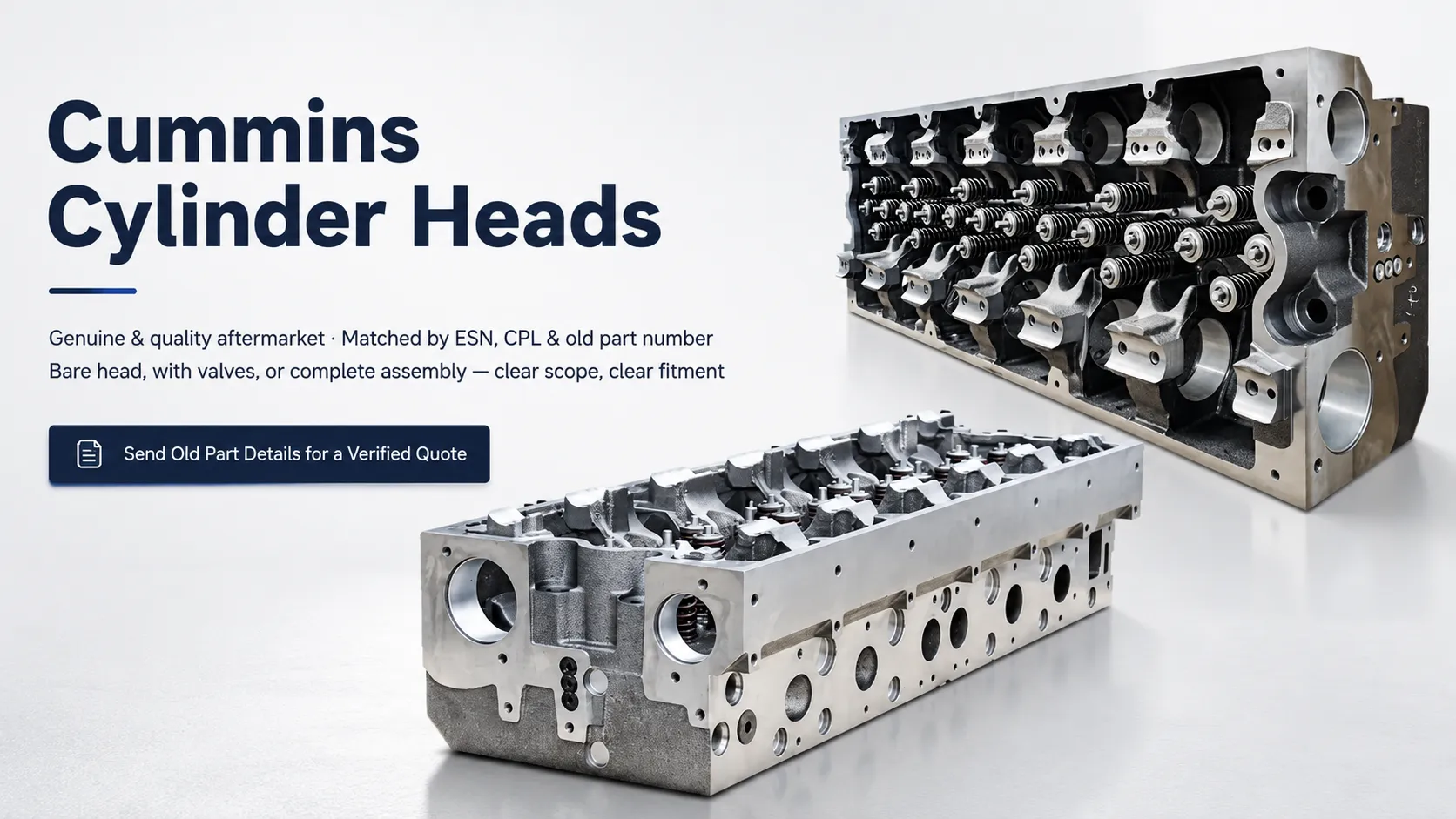
“Cylinder Head” Can Mean Different Products in Different Quotations
Before comparing prices, confirm what the supplier means by each product description.
| Market term | Common meaning | What must be confirmed |
|---|---|---|
| Bare Cylinder Head | A machined cylinder-head body, normally without the complete valvetrain | Whether valve guides, valve seats, injector sleeves and plugs are installed |
| Cylinder Head Casting | A cylinder-head body identified by a casting number | Whether it is an unfinished casting, a semi-machined component or a machined head ready for assembly |
| Assembled Cylinder Head | A cylinder head fitted with some or most valvetrain components | Which valves, guides, seats, springs, retainers and collets are included |
| Loaded / Complete Cylinder Head | A market term normally used for a more fully equipped assembly | Whether rocker arms, crossheads, injectors, gasket and bolts are included |
| Cylinder Head Assembly | A formal product-category description | The exact supply scope still depends on the individual part number |
| Cylinder Head Rebuild Kit | A parts package for rebuilding an existing head | Whether valves, guides, seats, springs and injector sleeves are included |
For some high-horsepower engines, Cummins offers separate New Assembly, ReCon Assembly and Rebuild Kit options. This is a useful reminder that a new assembly, a remanufactured assembly and a rebuild kit are intentionally different supply solutions.
Before accepting a quotation, ask:
Is this a Bare Cylinder Head, an Assembled Cylinder Head, a Complete Assembly or a Cylinder Head Rebuild Kit? Please provide the included-parts list for the quoted part number.
Even when the quotation says “Complete,” do not assume that it automatically includes:
- Rocker arms or rocker lever assemblies;
- Valve crossheads;
- Pushrods and tappets;
- Injectors;
- Intake and exhaust manifolds;
- EGR-related components;
- Sensors;
- Thermostat housing;
- Cylinder head gasket;
- Cylinder head bolts;
- Valve cover;
- Installation seals.
The most useful comparison is not the product label. It is the formal part number, bill of materials, inclusions and exclusions.
Cylinder Head Damage Depends on Operating Conditions, but Application Type Alone Is Not a Diagnosis
Load cycles, cooling conditions, maintenance practices and previous repairs can influence how a cylinder head becomes damaged.
Related factors may include:
- Poor cooling-system maintenance;
- Incorrect coolant;
- Engine overheating;
- Frequent or severe thermal cycling;
- Combustion leakage;
- Injector-sleeve or sealing problems;
- Valve, valve-guide or valve-seat wear;
- Corrosion or deposits in coolant passages;
- Incorrect machining, repair or assembly;
- Extended high-load operation;
- Previous casting condition and repair history.
However, a specific crack location or failure mode should not be predicted only because an engine is used in a truck, mine, generator set or marine application.
The actual damage and repairability should be confirmed by a qualified workshop using the engine model, CPL, failed component and inspection results.
The Same Displacement or Engine Family Does Not Guarantee Cylinder-Head Interchangeability
Cummins cylinder heads are used across multiple engine families, including:
- B Series platforms such as 4BT and 6BT;
- C Series and 6CT-related platforms;
- ISB, ISC and ISL;
- QSB, QSC and QSL;
- M11, ISM and N14;
- ISX and QSX;
- QSK and other high-horsepower engines.
Two engines with the same nominal displacement may still require different cylinder heads because of differences in:
- 12-valve or 24-valve architecture;
- Production year and CPL;
- Power and speed rating;
- Mechanical or electronically controlled fuel system;
- Injector bore and hold-down arrangement;
- Injector-sleeve configuration;
- Fuel passages;
- Intake-heater configuration;
- Valvetrain design;
- EGR and emissions interfaces;
- Equipment-OEM machining;
- Part-number supersession.
For this reason, descriptions such as “5.9L,” “6.7L,” “B Series” or “ISX” are not sufficient to confirm interchangeability.
When the engine has previously received a replacement cylinder head, compare:
- The original build configuration identified by ESN;
- The currently installed component;
- The existing cylinder-head part number;
- The casting number;
- Previous modification and repair records.
The currently installed head may no longer match the engine’s original factory configuration.
A Casting Number Can Narrow the Search, but It Cannot Confirm the Final Part
The original label on an older cylinder head may be damaged or missing. In these cases, buyers often provide a raised, stamped or cast-in number found on the body.
That number may be:
- A casting number;
- A casting-family number;
- A mold number;
- A production mark;
- A base-casting identifier;
- A pre-machining blank number;
- A supplier’s internal reference.
A casting number usually identifies the base casting. It does not necessarily represent the final machined and assembled service part.
The same base casting may be machined into configurations with different:
- Injector bores;
- Injector sleeves;
- Valve seats;
- Coolant passages;
- Oil passages;
- Fuel passages;
- Sensor ports;
- Intake and exhaust interfaces;
- Plug locations;
- OEM-specific mounting features.
Two cylinder heads with the same casting number may therefore still be different final parts.
Use the following verification order:
- Formal cylinder-head part number;
- Engine ESN and CPL;
- Current installed-part configuration;
- Casting number;
- Photos of interfaces and machined features.
A practical RFQ framework is:
Part Number + ESN + CPL + Casting Number + Photos
When only the casting number is available, also provide:
- Equipment manufacturer and complete model;
- Vehicle VIN or generator-set model / GSN;
- Top and combustion-face photos;
- Intake-side and exhaust-side photos;
- Front and rear views;
- Injector installation area;
- Coolant, oil and fuel interface photos.
A 12-valve or 24-valve description is only an initial filter. Valve diameter, stem size, guides, seats, springs, crossheads and injector layout may still differ.
Confirm Product Condition Before Comparing Prices
Common cylinder-head supply conditions include:
- Genuine Cummins New;
- OEM or Manufacturer New;
- Aftermarket New;
- Cummins ReCon;
- Formal Third-Party Remanufactured;
- Rebuilt or Refurbished;
- Used.
These options do not have the same source, process, testing or warranty.
Genuine Cummins New
A Genuine Cummins New cylinder head should have:
- A clear Cummins part number;
- Product identification;
- Traceability;
- Defined supply scope;
- Applicable warranty terms.
OEM or Manufacturer New
When a product is supplied by an actual original manufacturer or recognized manufacturing source, the quotation should identify:
- The brand;
- The manufacturer;
- The formal part number;
- The warranty.
The term “OEM Quality” alone does not define product condition or origin.
Aftermarket New
Aftermarket New refers to a newly manufactured part supplied under an independent or non-Cummins brand.
Confirm:
- Manufacturer;
- Cross-reference part number;
- Material and machining controls;
- Included components;
- Test scope;
- Batch traceability;
- Warranty.
Cummins ReCon
Cummins ReCon is Cummins’ own remanufacturing system.
Relevant components are disassembled, cleaned, inspected, restored and tested to meet Cummins original specifications and performance requirements, with applicable engineering updates incorporated.
Published Cummins ReCon cylinder-head processes may include:
- Replacement of valve guides, injector sleeves, collets and spring retainers as required;
- Machining of the combustion surface;
- Injector-sleeve installation;
- Pressure testing;
- Valve vacuum testing.
These requirements apply to the Cummins ReCon system. They should not be assumed for every third-party remanufactured product.
Formal Third-Party Remanufactured
A credible third-party remanufacturer should be able to explain:
- Core source;
- Disassembly and cleaning scope;
- Crack inspection or applicable NDT;
- Pressure or leak testing;
- Flatness and critical-dimension checks;
- Valve-seat and guide procedures;
- Injector-sleeve procedures;
- Mandatory replacement components;
- Final testing;
- Warranty;
- Core-return conditions.
Rebuilt or Refurbished
The scope of Rebuilt and Refurbished products can vary significantly.
Some are fully machined and tested. Others may receive only localized repairs. Without a defined process, bill of materials, test records and warranty, external appearance is not enough to judge quality.
Used Cylinder Head
A Used Cylinder Head normally carries a high level of uncertainty.
For equipment with high downtime costs, avoid using a used head without information on:
- Crack inspection;
- Pressure or leak testing;
- Sealing-surface condition;
- Valve and guide condition;
- Injector-sleeve condition;
- Previous machining;
- Warranty.
Core Charge Can Change the Real Purchase Cost
Some ReCon and third-party remanufactured cylinder heads are sold on an exchange basis.
A quotation may include:
- Product price;
- Core charge;
- Core deposit;
- Core-return deadline;
- Core-acceptance standard;
- Deductions for missing or damaged parts;
- Return freight;
- Customs and return-shipping responsibility.
Before comparing quotations, confirm:
Does the quoted price include the core charge?
Also ask:
What condition must the returned core meet to receive full core credit?
For international orders, return freight, customs procedures and timing may materially increase the landed cost.
When the old core cannot be returned, treat the complete core charge as a permanent purchasing cost.
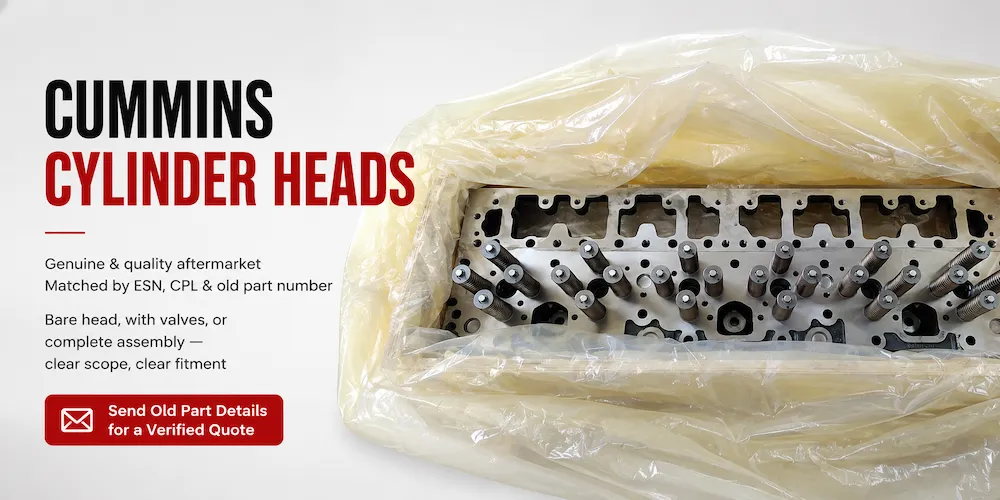
Information to Provide Before Requesting a Quotation
Engine Information
- Cummins engine model;
- ESN;
- CPL;
- Rated power;
- Rated speed;
- Engine-nameplate photo;
- Application type.
Equipment Information
- Equipment manufacturer;
- Complete equipment model;
- Machine serial number;
- Vehicle VIN;
- Generator-set model or GSN;
- Whether the engine or cylinder head has previously been replaced.
Existing Cylinder-Head Information
- Formal part number;
- Casting number;
- Manufacturer mark;
- Top view;
- Combustion-face photo;
- Intake-side and exhaust-side photos;
- Front and rear views;
- Injector installation area;
- Coolant, oil and fuel passage photos.
Required Supply Scope
- Bare Cylinder Head;
- Machined Bare Head;
- Assembled Cylinder Head;
- Loaded or Complete Assembly;
- Cylinder Head Rebuild Kit;
- Individual valves, guides, seats or injector sleeves;
- Cylinder Head Gasket;
- Head Bolts;
- Upper Gasket Kit;
- Rocker Components;
- Injectors.
Product Condition and Commercial Requirements
- Genuine Cummins New;
- OEM or Manufacturer New;
- Aftermarket New;
- Cummins ReCon;
- Third-Party Remanufactured;
- Rebuilt or Refurbished;
- Core-return acceptance;
- Quantity per engine;
- Total order quantity;
- Destination;
- Required lead time;
- Documentation and test-record requirements.
Overheating, White Smoke or Coolant Loss Does Not Automatically Mean the Cylinder Head Must Be Replaced
The following symptoms may involve the cylinder head:
- Coolant loss;
- White smoke;
- Oil and coolant contamination;
- Abnormal compression;
- Excessive cooling-system pressure;
- Combustion leakage.
However, similar symptoms may also come from:
- Cylinder head gasket;
- Block sealing surface;
- Liner installation or liner protrusion;
- Injector sleeve;
- Oil cooler;
- EGR cooler;
- Injector;
- Piston, ring or liner;
- Other cooling-system components.
A qualified workshop should use the applicable service information to complete the necessary inspection, which may include:
- Compression or leak-down testing;
- Crack inspection;
- Pressure or leak testing;
- Flatness inspection;
- Valve and valve-seat inspection;
- Injector-sleeve inspection;
- Block and liner checks.
This article does not provide diagnostic procedures, repair dimensions, machining instructions or installation torque values.
ZEB Power’s role is to help verify the applicable part number, product condition and supply scope after the repair requirement has been confirmed. We do not determine that a cylinder head must be replaced based on one reported symptom.
Can the Existing Head Be Repaired, or Should a Replacement Assembly Be Evaluated?
The decision should be made by a workshop with the required inspection and machining capability.
Repair May Be Considered When
- The casting passes the applicable crack and leakage inspections;
- The sealing surface has sufficient allowable machining margin;
- Valve seats, guides and sleeves can be repaired or replaced correctly;
- Critical dimensions can be restored;
- Repair cost and lead time are acceptable;
- The workshop has the required processing and test capability.
Replacement May Be Evaluated First When
- The casting has an unacceptable crack;
- Internal leakage cannot be repaired economically;
- Corrosion is severe;
- A critical interface is damaged;
- Previous machining prevents restoration to specification;
- Repair cost approaches the cost of a complete assembly;
- The project requires more consistent product condition and warranty;
- Local repair capability is insufficient.
A repaired original casting may continue to provide reliable service, but its remaining life should not be assumed to equal a New or Cummins ReCon Assembly only because the casting was originally genuine.
Durability depends on:
- Existing-part condition;
- Remaining machining allowance;
- Repair process;
- Replacement components;
- Machining and assembly control;
- Final testing;
- Warranty scope.
What Should a Serious Wholesale Buyer Verify Before a Bulk Order?
For mixed-SKU or container-volume orders, unit price should not be the only comparison.
Inspection Program
Ask how the supplier checks:
- Cracks;
- Internal leakage;
- Sealing surfaces;
- Flatness;
- Critical dimensions;
- Valve sealing.
For Third-Party Remanufactured, Rebuilt or Refurbished Cylinder Heads, the inspection program may include:
- NDT appropriate for the material and structure;
- Pressure or leak testing;
- Flatness and critical-dimension inspection;
- Valve-seating checks.
Do not rely only on a general statement such as “100% Inspected.”
For cast-iron heads suitable for Magnetic Particle Inspection, buyers may ask whether this test is performed, but it should not be treated as a universal requirement for every material and model.
Verifiable Application and Cross-Reference Data
Each SKU should record:
- Original part number;
- Superseded number;
- Applicable engine family;
- ESN/CPL verification requirements;
- Product condition;
- Configuration differences;
- Data source.
Only information issued by Cummins or the equipment OEM should be described as an OEM cross-reference. Supplier-created interchange lists should identify their actual source.
MOQ, Lead Time and Mixed-Container Capability
Confirm:
- MOQ by SKU;
- Mixed-SKU order requirements;
- Sample and production lead times;
- Whether different engine families can be consolidated;
- Packaging and labeling requirements;
- Batch consistency.
These factors may have a greater effect on landed cost than a small difference in unit price.
Quality System, Traceability and Warranty
Confirm:
- Manufacturer or remanufacturer;
- Quality-management system;
- Batch traceability;
- Inspection and test records;
- Product-condition definition;
- Warranty coverage;
- Exclusions;
- Claim process.
A general certificate cannot replace a specific part number, product-condition statement and test record.

Frequently Asked Questions
Does a Complete Cylinder Head Always Include Injectors and Rocker Arms?
No.
Complete, Loaded and Fully Assembled do not have a universal bill of materials. Confirm the exact part number and included-parts list.
Can I Order a Cylinder Head Using Only the Casting Number?
Usually not.
A casting number can narrow the search, but final verification should also use the part number, ESN, CPL, existing configuration and reference photos.
Do Cummins Engines with the Same Displacement Use the Same Cylinder Head?
Not necessarily.
Production year, CPL, fuel system, valvetrain, injector configuration and emissions interfaces may all change the required head.
What Is the Difference Between Cummins ReCon and an Ordinary Refurbished Cylinder Head?
Cummins ReCon follows Cummins-defined disassembly, cleaning, inspection, restoration and testing processes and is supplied under a formal part number and product specification.
The scope of a third-party Rebuilt or Refurbished product is determined by the supplier. Request the actual process, test records and warranty.
Does a Cylinder-Head Quotation Include the Head Gasket and Bolts?
Not necessarily.
The cylinder head, head gasket, head bolts and upper gasket kit should normally be confirmed separately unless the quotation explicitly includes them.
Can I Request a Quotation Without the Old Cylinder-Head Part Number?
An initial search may still be possible, but more supporting information will be required:
- ESN;
- CPL;
- Equipment model;
- Casting number;
- Photos of the head from all sides;
- Combustion-face photo;
- Injector installation area;
- Interface photos.
The more complete the information, the more reliable the part-number and supply-scope verification.
Should a Wholesaler Stock New or Remanufactured Cylinder Heads?
The choice should reflect customer equipment value, downtime cost, budget, warranty requirements and local repair capability.
A distributor may offer:
- Genuine or OEM New;
- Aftermarket New;
- Formal Remanufactured.
Each tier should have a clear part number, product condition, test scope and warranty. Avoid vague labels such as “premium” or “economy” without supporting specifications.
Conclusion
When purchasing a Cummins Cylinder Head, do not compare only:
- Engine model;
- Casting number;
- Valve count;
- External appearance;
- “Complete Head” price.
The more reliable verification framework is:
Part Number + ESN + CPL + Casting Number + Product Condition + Included Parts + Photos
When contacting ZEB Power, provide the engine ESN, CPL, existing part number or casting number, reference photos and target quantity.
We can help verify the applicable part number, product condition, assembly scope and quotation inclusions.