

How to Find Your Cummins Engine Serial Number and Nameplate

3977
Table of Contents
Generating table of contents
Most Cummins parts inquiries start the same way:
"I need an injector for a 6BT."
"I need an overhaul kit for a KTA19."
"Got a water pump for an NT855?"
That's useful information — but the supplier's next question is usually, "Can you send a photo of the engine nameplate?" or "What's the ESN on this engine?" That's where a lot of people get stuck: where the nameplate actually is, and which number is the ESN versus the CPL.
This isn't about genuine parts, aftermarket, or pricing — it's about a more basic problem first: finding the nameplate, reading the ESN and CPL correctly, and taking a photo that's actually useful to a supplier.
Why This Matters Before You Order
Quick bit of context: Cummins covers a huge range of engine models, and the same model can vary by CPL, production batch, and application — meaning different part versions. The part number, engine model, ESN, and CPL are what a supplier uses to confirm a part actually fits your engine — and most of that information is printed right on the engine nameplate. Finding the right plate and reading it correctly is the first step toward an accurate quote.
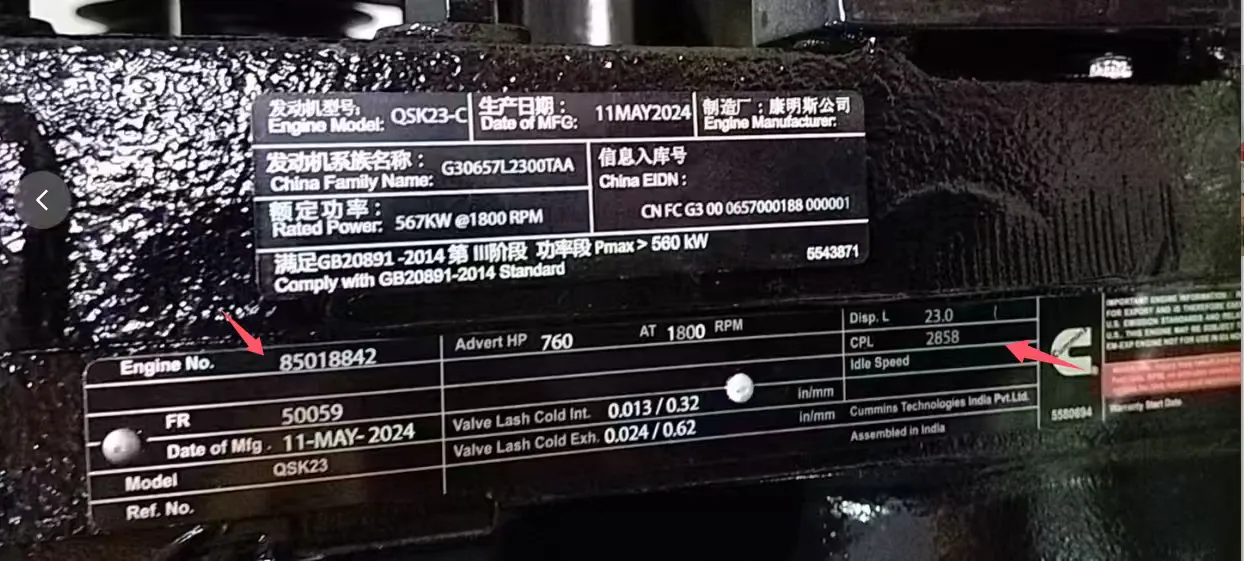
What's Usually on a Cummins Nameplate
A Cummins nameplate typically includes a few fields that are easy to mix up — here's what each one actually means:
- Engine Model — like 6BT, KTA19, NT855, indicating the engine series
- ESN (Engine Serial Number) — a unique number identifying this specific engine, usually a string of digits, commonly 8 digits, though the exact format depends on the nameplate or official record
- CPL Number — identifies the engine's specific configuration; used alongside the model to pin down the exact version
- Rated Power / RPM — some nameplates list power and speed ratings
- Build Date — some nameplates include this, useful for narrowing down the production batch
Of these, ESN and CPL matter most for getting an accurate quote — the model only gets a supplier to a rough starting point; ESN and CPL are what pin down the exact configuration.
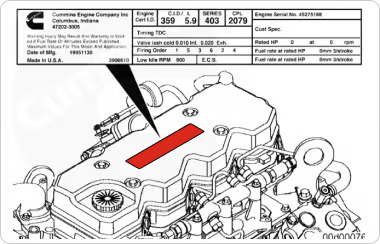
Where the Nameplate and ESN Usually Are, by Engine Type
Nameplate location varies by series and application — here's a general breakdown:
Mid-Range Engines (B Series, C Series, etc.)
Common in construction machinery and smaller gensets. The nameplate is typically located:
- Near the valve cover
- On the side of the block (near the flywheel housing)
- Near the intake manifold on some models
Heavy-Duty Industrial and Mining Engines (KTA, QSK series, etc.)
Common in mining equipment and large gensets. The nameplate is usually mounted somewhere reasonably identifiable on the engine body, but the actual installation varies a lot depending on the equipment — the same engine mounted in a mining truck, a genset, a drill rig, or a crusher can have very different access, so it may take checking from a few angles:
- Side of the engine block (usually the operator's side)
- Near the gear case or front cover
- Near the flywheel housing
- On some installed units, the nameplate can be partially obstructed by equipment structure, requiring a look from the side or underneath
- On genset engines, the nameplate is sometimes mounted near the radiator side
If the nameplate genuinely can't be found or is badly worn, check for a stamped number on the cylinder block — some engines have the engine number stamped directly into the block in addition to (or instead of) a nameplate, which is a useful backup source, especially on older equipment or where the plate itself is missing.
If you still can't locate it, check the equipment's original documentation or the engine manual, or just reach out to a supplier for help — no need to keep hunting on your own.
What to Do If the Nameplate Is Worn, Missing, or Unreadable
On older or long-serving mining equipment, a nameplate covered in grime or worn past legibility is a common situation. If that happens, work through these in order:
- Try cleaning the surface first — often it's not actual wear, just grime or dust buildup; a wipe with a dry cloth can bring the numbers back
- Take photos from multiple angles — even with some numbers unclear, multiple angles and lighting conditions can give a supplier enough to work with
- Check old parts or past purchase records — packaging from a previously replaced part, an old invoice, or service records sometimes retain the part number or model
- Check the equipment's original documentation — purchase paperwork or the engine manual usually records the engine model and serial number
- If none of that works — send equipment photos, the symptoms you're seeing, and a rough age estimate, and let the supplier's experience help narrow things down
How to Photograph It So It's Actually Useful
When you're sending photos for help, the quality of the shot directly affects whether the other side can actually read what matters. A few practical tips:
- Shoot straight-on, not at an angle — an angled shot distorts the numbers and makes them harder to read
- Make sure there's enough light, and avoid glare — nameplates are usually metal, and direct strong light tends to wash everything out in reflection; try lighting from the side or avoiding harsh midday sun
- Take one close-up and one wider shot — the close-up needs to be sharp enough to read the numbers; the wider shot helps confirm exactly where the plate sits on the engine (sometimes position alone helps narrow down the series)
- If the nameplate has multiple lines of information, try to capture all of them in one shot — missing a line means a second round of photos later
Here's a quick reference for what each type of photo is actually for:
| Photo Type | What It's For |
|---|---|
| Nameplate close-up | Reading the Engine Model, ESN, CPL |
| Full engine photo | Confirming engine series, mounting orientation, and nameplate location |
| Equipment nameplate photo | Helping confirm equipment model and application |
| Old part photo | Confirming fitment, shape, and part number |
| Part number close-up | Used directly for parts matching and quoting |
Common Reasons Nameplates Get Misread
A few situations that commonly lead to a wrong number:
- Mixing up the model and the ESN — the model is usually a letter-number combination (like KTA19), while the ESN is usually a plain string of digits; the two are easy to confuse on a worn or poorly printed plate
- Miscounting CPL digits — CPL is usually a numeric code, but the display format can vary by engine series, year, and nameplate style, making it easy to transcribe one digit too many or too few. Try to confirm by photo rather than writing it down by hand
- Worn lettering leading to misread digits — an "8" and a "0," or a "1" and a "7," are easy to confuse once worn. Check from multiple angles, and when you're not sure, send a photo for the supplier to confirm rather than guessing a digit and ordering
Whenever possible, send an actual nameplate photo rather than just writing down the ESN or CPL by hand. Hand-copied numbers are prone to skipped digits, transposed digits, or misreading a worn character — a photo gives the supplier something to double-check against, which is more reliable than a number relayed verbally or in text.
What to Do Once You Have the Information
Once you've got the nameplate photo and confirmed the model, ESN, and CPL, you can send those along with the part name or fault description straight to a supplier for a quote. If you've only managed to get the photo and haven't had a chance to read out the exact numbers yet, that's fine too — send the photo as-is, and the supplier can help identify them.
Send your engine nameplate photo to ZEB Power, and we'll help confirm the model, ESN, and CPL, then match parts or provide a quote based on what you need.
FAQ
1. What's the difference between the ESN and the CPL?
The ESN is the unique serial number identifying this specific engine, usually 8 digits. The CPL identifies the engine's specific configuration. The two work together to confirm the exact part version — neither substitutes for the other.
2. What if there's no CPL on the nameplate?
Not every nameplate lists a CPL — some older or specific models may only show the model and ESN. If you can't find a CPL, provide the model and ESN first; a supplier can usually help narrow it down further from there.
3. Can parts still be confirmed if the nameplate can't be found at all?
Yes, but accuracy drops. Try providing equipment photos, old part photos, a description of the symptoms, or a rough age of the equipment — a supplier can use experience to narrow down the likely match.
4. Does nameplate information differ across different production systems or applications of Cummins engines?
The basic identification fields — engine model, ESN, CPL — are generally consistent, but the nameplate's style, mounting location, and exact content can vary by engine series, production system, production year, and application.
5. Once I have the serial number, can I look up the parts online myself?
The serial number itself just identifies the engine's configuration — figuring out which specific parts apply still requires a supplier to cross-reference the part number, CPL, and parts list. It's not a good idea to determine the exact part version from the serial number alone.
Summary: Finding the Right Nameplate Is the First Step to an Accurate Quote
The engine model, ESN, and CPL can almost always be found on the engine nameplate. Spending a few minutes locating it and getting a clear photo saves a lot more time than dealing with a wrong part later because the information was incomplete. If the nameplate is worn or missing, you don't have to keep searching on your own — send whatever photos and equipment details you have, and a supplier can still help confirm the match.
Not sure if your nameplate photo is clear enough, or can't find the nameplate at all? Send your photos or equipment details to ZEB Power, and we'll help confirm the model, ESN, and CPL.