

Cummins Crankshaft: Part Number, Journal Size & Fitment Checks

1453
Table of Contents
Generating table of contents
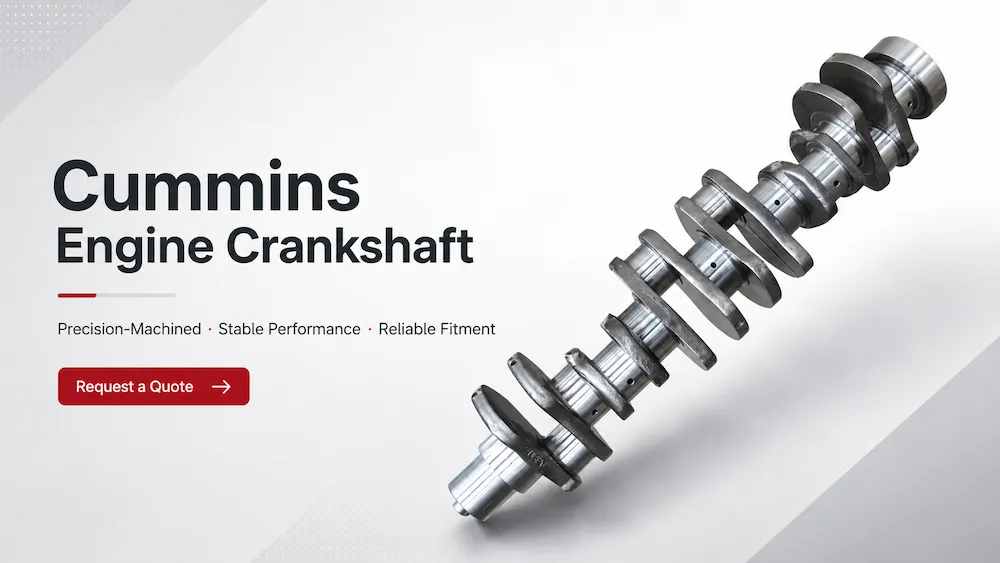
Main-journal and rod-journal dimensions are essential when sourcing a Cummins crankshaft, but correct journal dimensions do not automatically mean that the crankshaft will install correctly or work with the engine’s current configuration.
The most frequently overlooked sourcing risks are often found at the two ends of the crankshaft:
- The front-end interfaces for the vibration damper, pulley, gear and front seal;
- The rear-end interfaces for the flywheel, coupling and rear seal;
- The relationship between the crankshaft counterweight design and the existing damper and flywheel configuration;
- Whether the quotation includes the crankshaft gear, key, plugs, dowels and other locating components.
Two crankshafts may have identical main- and rod-journal dimensions yet remain non-interchangeable because of differences in the front keyway, threads, gear position or flywheel flange. In other cases, a crankshaft may physically install, but an incompatible damper, flywheel or related component may still contribute to abnormal vibration or other operating problems.
This guide is intended for:
- Parts wholesalers and importers purchasing Cummins crankshafts for resale;
- Repair workshops and fleet managers carrying out engine overhauls;
- Engine rebuilders evaluating new sourcing channels;
- Buyers supporting highway trucks, construction machinery, mining equipment, marine engines, generator sets and industrial engines.
First Confirm Whether the Current Crankshaft Is Still the Original Engine Configuration
The ESN and CPL describe the engine’s factory configuration, but after years of service and multiple repairs, the crankshaft currently installed may no longer be the original one.
Common situations include:
- The crankshaft has been replaced;
- Main journals or rod journals have been reground;
- Repair-size bearings have been used;
- A different connecting-rod version has been installed;
- A formal upgrade kit has been applied;
- An alternative crankshaft has been fitted;
- The flywheel, damper or gear system has been modified;
- Repair records are incomplete;
- The markings on the current crankshaft do not match the original engine parts listing.
For this reason, crankshaft sourcing should compare two sets of information.
Factory Engine Information
- Cummins engine model;
- ESN;
- CPL;
- Engine application;
- Power rating and rated speed, where required for matching;
- Engine nameplate.
Current Physical Configuration
- All numbers and markings visible on the old crankshaft;
- Front-end structure;
- Flywheel-end structure;
- Timing-gear or drive-gear configuration;
- Current flywheel and vibration-damper part numbers;
- Main- and rod-journal repair condition;
- Current connecting-rod, main-bearing and rod-bearing part numbers;
- Previous overhaul, modification and parts-replacement history.
The ESN and formal part number should be treated as key matching references. However, if the engine has been modified or upgraded internally, the original factory configuration should not be restored automatically from the ESN alone.
The current crankshaft and internal components must first be identified as one of the following:
- Original factory configuration;
- Formal upgrade configuration;
- Non-standard repair combination.
Service Part Numbers, Casting Numbers and Repair Marks Are Not the Same
An old crankshaft may carry several different groups of numbers and markings.
These may include:
- Service Part Number;
- Casting Number;
- Forging Number;
- Production Batch;
- Material or heat-treatment marking;
- Manufacturer’s internal number;
- Workshop-added marking;
- Journal-grinding size mark;
- Inspection or machining record number.
These markings serve different purposes. Any visible number on the crankshaft should not automatically be treated as the orderable part number.
Service Part Number
The formal Service Part Number is used by parts catalogs and supply channels to identify a specific crankshaft configuration. It should be prioritized for quotation and matching.
Casting or Forging Number
A casting or forging number may help identify the base material, blank or structural family, but it is not necessarily the same as an orderable Service Part Number.
The same basic forging may undergo different:
- Journal machining;
- Oil-passage machining;
- Heat treatment;
- Front-end machining;
- Flywheel-end machining;
- Counterweight configuration;
and become several different crankshaft part numbers.
Repair Marks
A repair facility may add grinding-size marks, inspection-batch references or machining records. These details can help identify the condition of the old crankshaft, but they do not replace the formal part number or measured journal dimensions.
For quotation review, provide:
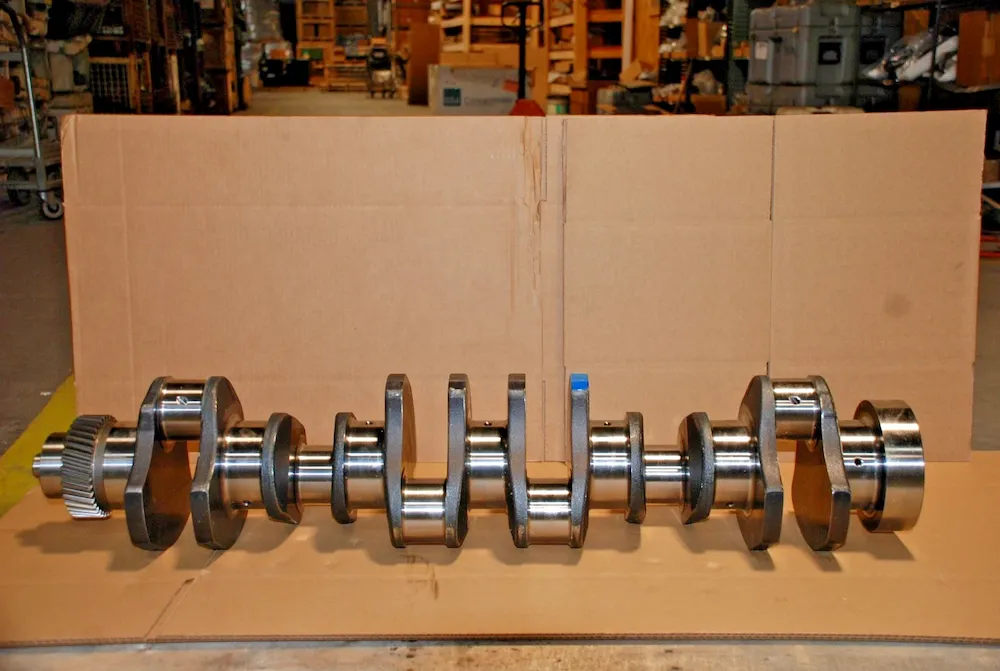
- Clear close-up photos of every visible marking;
- The location of each marking;
- A full-length photo of the crankshaft;
- Front- and rear-end photos;
- Photos of the gear, keyway and threads;
- Photos of the main and rod journals;
- Photos of the thrust surfaces.
The Crankshaft Front End Requires More Than a Diameter Check
The crankshaft front end may connect to or locate several components, including:
- Vibration damper;
- Pulley;
- Hub;
- Crankshaft gear;
- Front seal;
- Key;
- Spacer;
- Other drive or locating components.
Different crankshaft versions may vary in:
- Front-end diameter;
- Front-end length;
- Internal or external thread design;
- Number and position of keyways;
- Spline or other locating structure;
- Gear mounting position;
- Seal-running-surface diameter;
- Damper or pulley interface;
- End-fastening structure.
Even when the journals in the center section are the same size, a different front-end structure may prevent reuse of the original:
- Vibration damper;
- Pulley;
- Hub;
- Gear;
- Front seal.
For quotation review, provide:
- Full front-end photo;
- Close-up of the keyway or spline;
- Close-up of the end threads;
- Photo of the front-seal running surface;
- Original damper or hub part number;
- Original crankshaft-gear photo and part number.
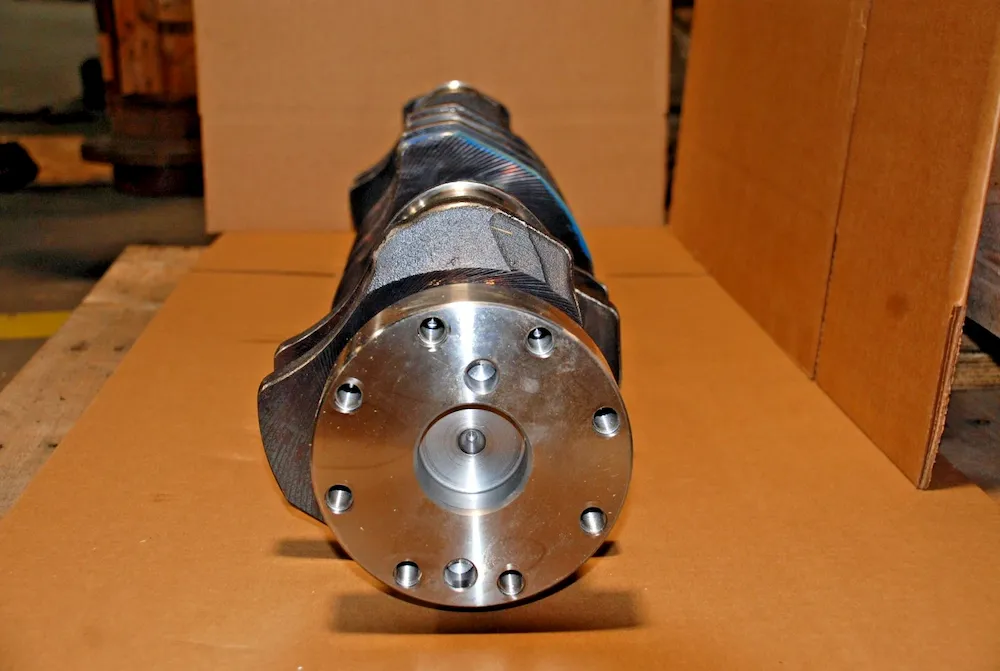
The Flywheel End Determines Whether the Crankshaft Can Connect to the Existing Output System
The rear end of the crankshaft may interface with:
- Flywheel;
- Flexplate;
- Marine gearbox interface;
- Generator coupling;
- Industrial drive plate;
- Rear seal;
- Other output components.
Confirm:
- Flywheel-flange shape;
- Number of bolt holes;
- Bolt-circle pattern;
- Bolt-hole diameter and design;
- Dowel or locating-hole arrangement;
- Rear-end diameter;
- Rear-seal running surface;
- Whether a wear sleeve is installed;
- Current flywheel or output-component part number.
The same base engine family may use different output configurations in highway, construction, generator, marine and industrial applications.
If the equipment has been modified with a different:
- Flywheel housing;
- Coupling;
- Generator drive plate;
- Marine gearbox adapter;
- Industrial output system;
the current physical interface must be supplied for review. The original factory rear-end configuration should not be assumed.
The Crankshaft Gear and Related Hardware Must Be Confirmed Separately
A crankshaft gear may be:
- Already installed on the crankshaft;
- Supplied with the crankshaft but not installed;
- Transferred from the old crankshaft;
- Ordered as a separate part;
- Replaced as part of a formal upgrade.
The term Crankshaft Assembly therefore does not automatically mean that the crankshaft gear is included.
Before accepting a quotation, confirm:
- Crankshaft-gear part number;
- Whether the gear is included;
- Whether the gear is already installed;
- Whether the key, pin or other locating parts are included;
- Whether the old gear belongs to the current crankshaft version;
- Whether the new crankshaft requires a revised gear;
- Whether the gear is part of a formal upgrade combination;
- Whether adjacent timing gears must also be checked.
Where the gear is supplied separately, also confirm:
- Gear part number;
- Tooth count or formal gear-train version;
- Keyway, pin-hole or locating design;
- Compatibility with the camshaft gear and other drive gears.
This article does not provide gear removal, heating, press-fitting, timing alignment or installation specifications.
The Crankshaft, Damper and Flywheel Configuration Should Be Checked Together
The crankshaft counterweight design, vibration-damper configuration and flywheel configuration form part of the same rotating system.
A Cummins crankshaft should not be classified as “internally balanced” or “externally balanced” from appearance alone, and it should not be assumed that a particular crankshaft relies on a specific flywheel weight without formal confirmation.
A more reliable sourcing approach is to verify:
- Crankshaft Part Number;
- Vibration Damper Part Number;
- Flywheel or Flexplate Part Number;
- Hub or Pulley Part Number;
- Formal upgrade or replacement notes;
- Current physical engine configuration.
Confirm:
- Whether the new crankshaft can use the existing damper;
- Whether the new crankshaft can use the existing flywheel;
- Whether the damper and flywheel belong to the same crankshaft configuration;
- Whether the replacement part number includes companion-part requirements;
- Whether old and new versions may be mixed;
- Whether the engine has undergone a power upgrade or output-system modification.
Physical fit alone does not prove that the crankshaft, flywheel and damper combination is correct.
If abnormal vibration appears after crankshaft replacement, the inspection scope may also include:
- Damper condition;
- Flywheel condition and location;
- Engine mounts;
- Connecting-rod and piston configuration;
- Bearings and assembly clearances;
- Other rotating components.
Dynamic-balance inspection and counterweight decisions should be completed by a qualified repair facility.
Main Journals and Rod Journals Must Be Evaluated Separately
A crankshaft has two primary categories of working journals.
Main Journals
The main journals support the crankshaft in the engine block through the main bearings.
Matching may involve:
- Number of main journals;
- Journal diameter;
- Journal width;
- Oil-hole position;
- Thrust surface;
- Main Bearing Part Number;
- Standard or repair-size condition.
Rod Journals
The rod journals work with the connecting-rod big ends through the rod bearings.
Confirm:
- Rod-journal arrangement;
- Journal diameter;
- Journal width;
- Oil-hole configuration;
- Connecting Rod Part Number;
- Rod Bearing Part Number;
- Standard or repair-size condition.
Main journals and rod journals may have undergone different repairs.
For example:
- Main journals remain standard while rod journals have been reground;
- Main and rod journals use different repair grades;
- Only selected journals show repair marks;
- Old main and rod bearings come from different repair batches;
- The crankshaft has been replaced while old bearing numbers were retained.
Descriptions such as the following are not sufficient:
Crankshaft 0.25
First Undersize Crankshaft
Standard Crankshaft with Oversize Bearings
They do not explain:
- Whether the number applies to the main journals or rod journals;
- Whether it describes journal material removal or bearing repair grade;
- Whether the reference is metric or imperial;
- Whether it applies to all journals or only selected journals;
- Whether the crankshaft remains within an approved repair range.
A clearer quotation format is:
Main Journal Condition + Rod Journal Condition + Measured Diameters + Main/Rod Bearing Repair Grades
For more detail on undersize terminology and bearing repair grades, refer to the Cummins main and rod bearing guide.
Whether a Crankshaft Can Be Reground Must Be Decided by the Repair Facility
Common market descriptions may include:
0.25 mm;0.50 mm;0.010";0.020";- Other repair-size references.
These are market size descriptions only. They do not prove that every Cummins crankshaft may be reground to the same repair level.
Different crankshafts may vary in:
- Material;
- Manufacturing method;
- Heat treatment;
- Surface hardening;
- Journal structure;
- Fillet design;
- Formal repair limitations.
The repair facility should review the applicable service information and actual crankshaft condition, including:
- Measured main- and rod-journal diameters;
- Out-of-round condition;
- Taper;
- Surface condition;
- Journal fillet area;
- Thrust surfaces;
- Crankshaft bend;
- Cracks or other defects;
- Previous grinding history;
- Whether further machining is permitted.
A supplier may match crankshaft and bearing options using the formal part number and the repair grade confirmed by the workshop. A supplier should not determine from photos alone whether a crankshaft can be reground again or reused.
Worn Seal Running Surfaces Do Not Always Require a Complete Crankshaft Replacement
The front and rear seals operate against rotating crankshaft surfaces. Over time, the seal-running surfaces may develop:
- Wear;
- Grooves;
- Scoring;
- Corrosion;
- Other sealing-surface damage.
Oil leakage does not always mean that the entire crankshaft must be replaced.
Some applications may have an approved:
- Wear sleeve;
- Seal sleeve;
- Other seal-surface repair solution.
Whether a sleeve is applicable, which part number should be used, and whether the seal must also be changed depend on:
- Crankshaft design;
- Seal-surface condition;
- Formal parts catalog;
- Service information;
- Repair-facility inspection.
This article does not provide wear-sleeve installation, seal installation or seal-surface machining procedures.
New Genuine, ReCon, Reground, Used and Quality Alternative Are Different Product Conditions
The product condition must be stated clearly in the quotation and purchase order. Cummins Crankshaft alone is not enough.
New Genuine
Confirm:
- Formal part number;
- Supersession or upgrade relationship;
- Packaging condition;
- Accessory BOM;
- Warranty scope;
- Current supply channel.
ReCon Crankshaft, Where Available
Some crankshaft part numbers may have a ReCon option, but not every Cummins crankshaft is available as a ReCon product.
Confirm:
- ReCon Part Number;
- Whether a ReCon option currently exists;
- Core-return conditions;
- Core-acceptance criteria;
- Warranty;
- Whether accessories are included;
- Regional and channel availability.
Reground or Reconditioned Crankshaft
These crankshafts may have undergone journal grinding, polishing or other repair work.
Confirm:
- Main-journal repair grade;
- Rod-journal repair grade;
- Whether all journals use the same repair grade;
- Who performed the machining;
- Whether dimensional inspection records are available;
- Whether crack or defect inspection was completed under the applicable requirements;
- Whether the inspection record is available;
- Whether the oil passages were cleaned and checked;
- Warranty scope.
The terms reground or polished do not replace dimensional and defect-inspection records.
Used Crankshaft
A used crankshaft is normally removed from an old engine and may not have undergone a complete remanufacturing or standardized repair process.
Before purchase, confirm:
- Source;
- Original engine application;
- Repair history;
- Journal condition;
- Whether it has been reground;
- Whether defect inspection has been completed;
- Whether a dimensional report is available;
- Whether any warranty is provided.
For mining equipment, continuous-duty generator sets and other projects with high downtime costs, purchasing a used or reground crankshaft with unclear origin and no dimensional or inspection records creates significant sourcing risk.
This is a purchasing-risk recommendation. Final acceptance criteria should be set by the project owner and repair facility.
Quality Alternative
Confirm:
- Clear cross-reference;
- Applicable ESN and CPL;
- Material and manufacturing process;
- Heat-treatment or surface-hardening information;
- Main- and rod-journal dimensional control;
- Front- and rear-end structure;
- Gear interface;
- Oil-hole and passage cleanliness;
- Thrust surfaces;
- Production batch;
- Inspection record;
- Warranty;
- Claim process.
Crankshaft material should be verified from the formal part number and technical information. It should not be judged from color, appearance or weight, and different material versions should not be assumed interchangeable.

The Crankshaft Must Be Checked with the Connecting Rods, Bearings and Piston System
A crankshaft is not a universal component that can be evaluated independently from the other internal engine parts.
Related parts may include:
- Connecting rod;
- Main bearing;
- Connecting-rod bearing;
- Thrust bearing;
- Piston;
- Piston pin;
- Crankshaft gear;
- Other upgrade components.
A crankshaft revision may also affect:
- Connecting-rod part number;
- Rod-bearing version;
- Main-bearing version;
- Thrust design;
- Piston or piston-pin configuration;
- Crankshaft gear;
- Whether old and new versions may be mixed in one engine.
Two crankshafts should not be combined with the same old rods, bearings and pistons simply because their journal diameters are the same.
Use the following matching framework:
Crankshaft Part Number + ESN/CPL + Front/Rear Interface + Gear Configuration + Main/Rod Journal Condition + Rod/Bearing Configuration
For an engine that has been overhauled or upgraded, also provide:
- Connecting Rod Part Number;
- Main Bearing Part Number;
- Rod Bearing Part Number;
- Piston Part Number;
- Piston Pin Part Number;
- Flywheel and Damper Part Number;
- Formal technical bulletin or upgrade BOM, where available.
What Does the Crankshaft Quotation Actually Include?
Different suppliers may use crankshaft product names differently.
| Quotation term | Possible supply scope | What must be confirmed |
|---|---|---|
| Bare Crankshaft | Crankshaft body | Gear, key, plugs, locating parts and removable counterweights |
| Crankshaft | Bare crankshaft or crankshaft with selected accessories | Confirm formal part number and BOM |
| Crankshaft Assembly | Crankshaft with selected pre-installed accessories | Exact gear, key, plug and locating-part list |
| Crankshaft Kit | Crankshaft with selected related parts | Included Parts List and applicable configuration |
| ReCon Crankshaft, where available | Cummins remanufactured crankshaft | ReCon number, core conditions, accessories and warranty |
| Reground Crankshaft | Reground or repaired crankshaft | Main-/rod-journal grades and inspection records |
The quotation should state whether it includes:
- Crankshaft gear;
- Key;
- Pin;
- Oil-passage plugs;
- Dowel;
- Removable counterweights, where applicable;
- Main bearings;
- Rod bearings;
- Thrust components;
- Front seal;
- Rear seal;
- Wear sleeve.
The actual supply scope cannot be determined from Bare Crankshaft, Assembly or Kit alone.
A Complete Overhaul Kit Should Not Be Assumed to Include the Crankshaft
Cummins overhaul kits are normally organized around base-overhaul components, but their BOMs vary.
Depending on the kit, the contents may include:
- Pistons;
- Piston rings;
- Cylinder liners;
- Main bearings;
- Rod bearings;
- Gaskets and seals;
- Other base-overhaul components.
Even when the kit name includes:
- Complete;
- Full;
- Major;
- Overhaul;
- Rebuild;
the crankshaft should not be assumed to be included.
When reviewing an overhaul-kit quotation, confirm the crankshaft as a separate line item:
- Whether it is included;
- Crankshaft part number;
- New, ReCon or other product condition;
- Journal-size condition;
- Gear and accessory scope;
- Whether rods or bearings must also be replaced;
- Whether a formal upgrade combination applies.
A New Part Number May Be More Than a Simple Supersession
A new crankshaft part number may represent:
- Direct replacement;
- Normal supersession;
- Material or manufacturing-process update;
- Heat-treatment update;
- Front-end design change;
- Flywheel-end design change;
- Upgrade linked to a revised gear;
- System upgrade linked to revised rods or bearings;
- ReCon supply number.
Even where the new number is a normal supersession, confirm whether the replacement information includes:
- ESN or CPL range;
- Revised crankshaft gear;
- Different main bearing;
- Different rod bearing;
- Different connecting rod;
- Different damper;
- Different flywheel;
- Different seal;
- Restrictions on mixing old and new versions.
A system upgrade may require several components to be used together under one BOM. The crankshaft should not be removed from the upgrade package and combined with old-version internal parts without formal support.
Replacing the Crankshaft Alone May Not Solve the Root Cause
Crankshaft-related symptoms may include:
- Main- or rod-journal wear;
- Journal scoring;
- Overheating or discoloration;
- Thrust-surface damage;
- Contaminated or blocked oil holes;
- Crankshaft cracks;
- Crankshaft bend;
- Main- or rod-bearing distress;
- Abnormal internal mechanical noise;
- Abnormal vibration;
- Abnormal oil pressure.
The underlying cause may also involve:
- Low oil level;
- Abnormal oil pressure;
- Blocked oil passages;
- Contaminated oil;
- Fuel dilution of the oil;
- Incorrect main- or rod-bearing specification;
- Bearing-fit or assembly problems;
- Connecting-rod damage;
- Piston or cylinder mechanical failure;
- Damper or flywheel configuration problems;
- Engine-mount problems;
- Liquid entering a cylinder;
- Long-term overload;
- Other internal-engine faults.
If the lubrication system, bearings, rods, pistons and related rotating components are not checked, the replacement crankshaft may also be damaged.
Crankshaft measurement, defect inspection, bend checks, grinding decisions, straightening and reuse decisions should be completed by a qualified repair facility or crankshaft specialist.
This article does not provide:
- Journal measurement procedures;
- Permitted grinding sizes;
- Out-of-round or taper limits;
- Surface-roughness requirements;
- Crankshaft-bend limits;
- Crack-inspection methods or acceptance criteria;
- Straightening procedures;
- Dynamic-balance methods or counterweight values;
- Bearing oil clearances;
- Crankshaft end-play limits;
- Gear installation procedures;
- Fastener-tightening specifications;
- Remote decisions on whether an old crankshaft can be reused.
Crankshaft Packaging Is More Than an Outer Box
A crankshaft is long, heavy and contains several precision-machined surfaces. Poor support or protection can damage an otherwise acceptable product during transport or storage.
Bulk buyers should confirm:
- Rust-prevention treatment;
- Individual protection for main and rod journals;
- Protection for front threads and keyways;
- Protection for the flywheel flange;
- Oil-hole sealing and dust protection;
- Crankshaft support points inside the package;
- Prevention of movement inside the crate;
- Wooden crate, frame or other heavy-duty packaging appropriate for the product weight;
- Separate restraint for gears and accessories;
- Production batch;
- Inspection record;
- Outer-carton or crate part-number label;
- Product-condition label;
- Warranty;
- Claim process.
On arrival, inspect:
- Part number against the purchase order;
- Front- and rear-end impact damage;
- Journal rust or scratches;
- Oil-passage contamination;
- Gear and accessory quantity against the BOM;
- New, ReCon, Reground or Used condition against the order;
- Visible package impact or internal movement.
Information to Provide Before Ordering
Engine Information
- Cummins engine model;
- ESN;
- CPL;
- Equipment manufacturer and complete model;
- Highway, construction, mining, marine, generator or industrial application;
- Power rating and speed, where required for matching;
- Engine-nameplate photo.
Existing Crankshaft Information
- Crankshaft Service Part Number;
- All casting, forging, machining and repair markings;
- Location of each marking;
- Full-length crankshaft photo;
- Front-end photo;
- Flywheel-end photo;
- Gear, keyway and thread photos;
- Main- and rod-journal photos;
- Thrust-surface photos;
- Front- and rear-seal-running-surface photos;
- Whether the current crankshaft is original to the engine.
Matching-Component Information
- Connecting Rod Part Number;
- Main Bearing Part Number;
- Rod Bearing Part Number;
- Piston Part Number;
- Piston Pin Part Number;
- Crankshaft Gear Part Number;
- Vibration Damper or Hub Part Number;
- Flywheel or Flexplate Part Number;
- Front Seal and Rear Seal Part Number;
- Wear Sleeve Part Number, where currently used;
- Whether formal upgrade parts are installed.
Measurement and Repair Condition
- Measured main-journal diameter;
- Measured rod-journal diameter;
- Main-bearing standard or repair grade;
- Rod-bearing standard or repair grade;
- Whether the crankshaft has been reground;
- Whether main and rod journals use different repair grades;
- Whether other repair or straightening work has been completed;
- Whether defect inspection has been completed;
- Whether dimensional or inspection records are available;
- Whether a complete-engine overhaul is being carried out;
- Repair-facility conclusion on reuse, machining or replacement;
- Whether a formal supersession or upgrade is acceptable.
Required Supply Scope
- Bare Crankshaft;
- Crankshaft Assembly;
- Crankshaft Kit;
- New Genuine Crankshaft;
- ReCon Crankshaft, where available;
- Reground or Reconditioned Crankshaft;
- Quality Alternative Crankshaft;
- Crankshaft Gear;
- Key, Pin, Plug, Dowel or other accessories;
- Main Bearings;
- Rod Bearings;
- Thrust Components;
- Front/Rear Seals;
- Wear Sleeve;
- Required quantity.
Commercial Requirements
- Preferred product condition;
- Total order quantity;
- Destination;
- Required lead time;
- Packaging and labeling requirements;
- Core-return conditions, where applicable;
- Whether a dimensional report is required;
- Whether a crack or defect inspection record is required;
- Batch, inspection or traceability-document requirements.
How ZEB Power Supports Cummins Crankshaft Sourcing
ZEB Power supplies Cummins crankshafts and related overhaul parts for highway vehicles, construction machinery, mining equipment, marine engines, generator sets and industrial engines.
Using the engine ESN, CPL, old crankshaft part number and markings, front- and rear-end design, gear configuration, existing flywheel and damper information, matching rod and bearing versions, repair-facility measurements and required supply scope, we can assist with confirming:
- Crankshaft Part Number;
- Engine and application configuration;
- Front-end and flywheel-end interfaces;
- Crankshaft gear and accessory scope;
- Damper and flywheel configuration;
- Main- and rod-journal condition;
- Main-bearing, rod-bearing and thrust-component compatibility;
- Connecting-rod and piston configuration;
- Formal supersession or upgrade;
- New Genuine, ReCon, Reground and verified Quality Alternative options;
- BOM, packaging and quotation scope.
Available options depend on the formal part number, actual engine configuration and current supply channel.
Crankshaft measurement, defect inspection, grinding, straightening, dynamic-balance evaluation, oil-passage cleanliness confirmation, assembly specifications and old-part reuse decisions should be handled by a qualified local repair facility or crankshaft specialist.
Frequently Asked Questions
Are All Crankshafts for the Same Engine Model Interchangeable?
Not necessarily.
Even when displacement and cylinder count are the same, the front end, flywheel end, gear, journals, thrust design and matching components may differ. Confirm with the ESN, CPL and formal crankshaft part number.
Can a Casting Number Be Used Directly for Ordering?
Not always.
A casting or forging number may assist identification, but it may not be the formal Service Part Number.
Are Matching Journal Dimensions Enough to Confirm Installation?
No.
The front end, flywheel end, crankshaft gear, seal-running surfaces, thrust structure, connecting rods and bearings must also be checked.
Can the Original Flywheel and Damper Be Reused with a New Crankshaft?
It depends on the formal configuration.
Confirm the new crankshaft, original flywheel and original damper part numbers and replacement notes. Physical fit alone is not sufficient.
Is the Crankshaft Gear Always Included in the Quotation?
No.
The gear may already be installed, supplied separately, transferred from the old crankshaft or ordered separately.
Does One Previous Grinding Automatically Mean 0.25 Repair-Size Bearings?
No.
Main journals and rod journals must be measured separately and matched to the formal repair grades.
Does Seal-Surface Wear Always Require Crankshaft Replacement?
No.
Some applications may have an approved wear sleeve or other seal-surface repair solution. The repair facility should decide based on the crankshaft condition and service information.
Can a Reground Crankshaft Be Purchased?
Yes, as one possible supply option.
Confirm the journal repair grades, dimensional records, machining source, defect-inspection records, oil-passage condition and warranty scope.
Can a Used Crankshaft Be Accepted Without a Crack-Inspection Record?
Appearance alone is not enough.
For high-downtime-cost applications or products with unclear origin, purchasing a Used or Reground crankshaft without adequate dimensional and defect-inspection records is not recommended.
Are Forged and Cast Crankshafts Interchangeable?
Do not decide from the material description or appearance.
Confirm the formal crankshaft part number, applicable configuration and replacement information.
Does a Complete Overhaul Kit Include the Crankshaft?
Do not assume that it does.
The crankshaft should normally be confirmed as a separate BOM and supply item.
Does Abnormal Engine Vibration Always Mean the Crankshaft Is Faulty?
No.
The damper, flywheel, engine mounts, connecting rods, pistons, bearings or assembly condition may also be involved.
Can I Request a Quotation Without the Old Crankshaft Part Number?
An initial check may still be possible.
Provide the ESN, CPL, all crankshaft markings, front- and rear-end photos, gear photos, main- and rod-journal measurements, and the existing flywheel, damper, connecting-rod and bearing information.
Conclusion
A Cummins crankshaft should not be selected by journal size or engine-family name alone.
The matching process should confirm:
Crankshaft Part Number + ESN/CPL + Front/Rear Interface + Gear Configuration + Main/Rod Journal Condition + Rod/Bearing Configuration
When contacting ZEB Power, provide the engine ESN, CPL, old crankshaft part number and markings, front- and rear-end photos, journal measurements, current gear, flywheel, damper, connecting-rod and bearing part numbers, and the required supply scope.
We can assist with confirming the applicable part number and quotation range.