

Cummins Main & Connecting Rod Bearings: How to Choose the Correct Size and Set

2100
Table of Contents
Generating table of contents
Main and connecting rod bearings are among the easiest engine-overhaul parts to misunderstand in terms of quantity, repair size and quotation scope.
When a buyer asks for “one set of Cummins main bearings,” the supplier may quote one bearing shell for one main-bearing position, one upper-and-lower pair, or the complete quantity for every main-bearing position in the engine. The same phrase can therefore refer to very different BOMs.
Connecting rod bearings create the same problem. A Connecting Rod Bearing Set may refer to one shell, one pair, the quantity required for one connecting rod, or the complete set for the entire engine. If the BOM and total piece count are not confirmed during quotation, the shortage may only be discovered after the engine has been dismantled and the workshop is ready to assemble it.
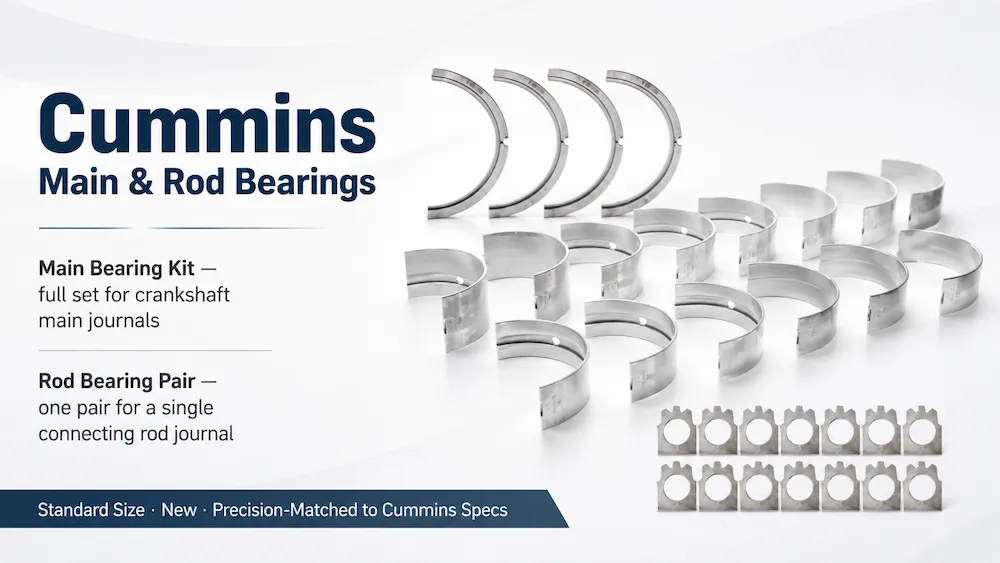
This guide is intended for:
- Wholesalers and importers purchasing Cummins engine bearings for resale;
- Repair workshops and fleet managers carrying out engine overhauls;
- Engine rebuilders evaluating new sourcing channels;
- Buyers supporting construction machinery, mining equipment, generator sets and industrial engines.
Before ordering, confirm:
- Whether main bearings, connecting rod bearings or both are required;
- Formal main-bearing and connecting-rod-bearing part numbers;
- Actual main-journal and rod-journal dimensions;
- Whether the engine requires standard size or an approved repair size;
- Whether the thrust components are included in the main-bearing set;
- Whether the quotation is per shell, per pair, per bearing position, per connecting rod or per complete engine;
- Whether upper and lower shells must be distinguished by position;
- Whether a formal supersession or system-level upgrade applies.
Main Bearings and Connecting Rod Bearings Are Different Parts
A main bearing is installed between the engine-block main-bearing housing, the main-bearing cap and the crankshaft main journal. It supports crankshaft rotation and transfers crankshaft loads into the engine block.
A connecting rod bearing, also called a rod bearing, is installed between the connecting-rod big end, the rod cap and the crankshaft rod journal. It transfers piston and connecting-rod loads to the crankshaft.
The two bearing types may differ in:
- Inside and outside dimensions;
- Bearing-shell thickness;
- Bearing width;
- Oil holes and oil grooves;
- Locating features;
- Surface layers or coatings;
- Thrust design;
- Matching journal dimensions;
- Formal part numbers;
- Repair-size grades.
Even if the shells appear similar in shape or curvature, they must not be purchased as one generic category of “engine bearings.”
Confirm separately:
Main Bearing Part Number + Connecting Rod Bearing Part Number
Do not rely on a general Bearing Set description.
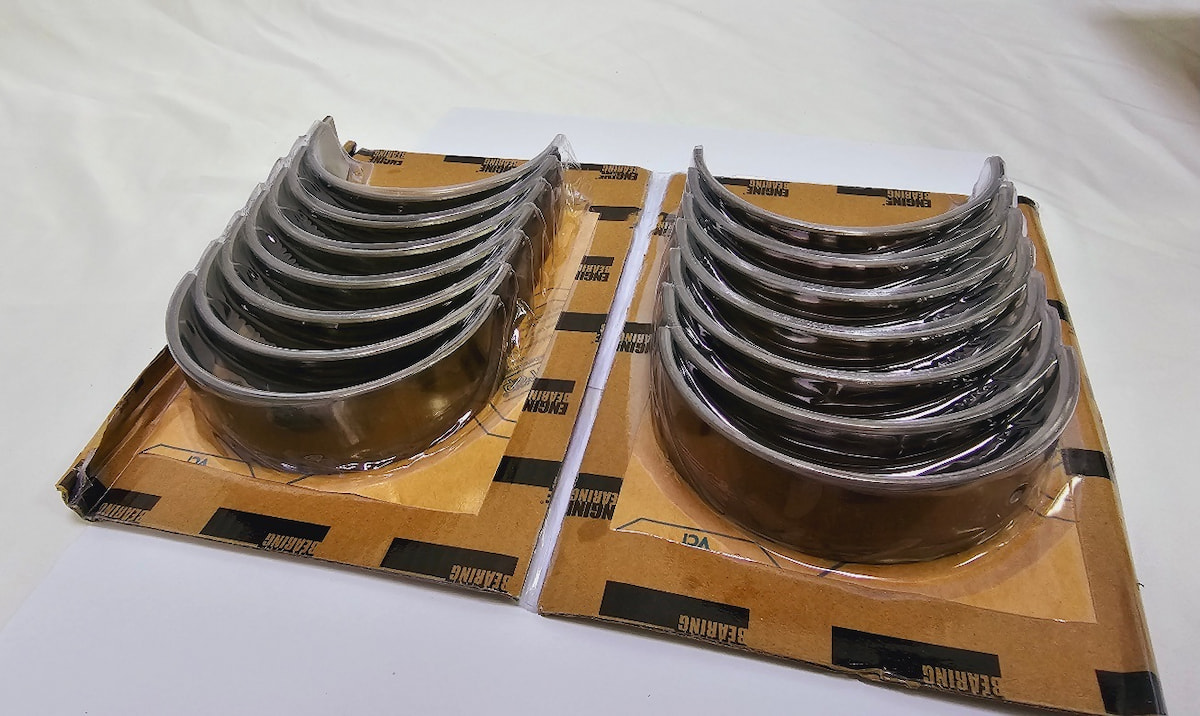
Upper and Lower Bearing Shells Must Be Checked by Application
Main and connecting rod bearings are commonly supplied as two semicircular shells, but the upper and lower shells are not always identical.
In some applications, the two shells may differ in:
- Oil holes;
- Oil grooves;
- Locating features;
- Surface layers or coatings;
- Thrust faces;
- Position markings;
- Formal part numbers.
Other applications may use identical or symmetrical upper and lower shells.
Do not assume that:
- Every upper and lower shell is interchangeable;
- Two visually similar shells may be installed in either position;
- Buying one shell will complete one bearing position;
- Every shell in a main-bearing set has the same design.
Before accepting a quotation, confirm:
- Whether upper and lower shells are supplied as a pair;
- Whether they use different part numbers;
- Whether any shells are position-specific;
- Which shells include oil holes or grooves;
- Whether a special main-bearing shell includes a thrust face;
- Whether all positions are complete in the kit.
Installation position and orientation must be confirmed by the repair facility using the applicable engine service information. This article does not provide installation instructions.
Standard and Undersize Bearings Must Be Selected from Crankshaft Measurements
The dimensional relationship between a bearing shell and the crankshaft journal is part of the engine design and repair specification.
Common market terms include:
- Standard Size;
- Undersize Bearing;
- Repair Size;
-
0.010",0.020"or0.030"; -
0.25 mm,0.50 mmor another metric repair grade; - Previously ground crankshaft;
- Replaced crankshaft;
- Previously installed non-original bearing size.
These inch and metric values are examples of repair-size terminology found in the market. They do not mean that every Cummins engine or bearing part number is available in all of these grades.
Why “Undersize” Causes Confusion
In bearing sourcing, Undersize may describe the smaller diameter of a crankshaft journal after grinding. Some buyers, however, use “Oversize Bearing” or “thicker bearing” to describe the increased wall thickness of the bearing shell.
The reference point is different:
- One expression describes the reduced crankshaft-journal diameter;
- The other describes the increased bearing-shell thickness;
- Both may refer to the same repair condition while using apparently opposite words.
Do not submit only:
0.25 Bearing
First Undersize
Oversize Main Bearing
These descriptions do not identify:
- Main or connecting rod bearing;
- Journal-grinding amount or catalog repair grade;
- Inch or metric size system;
- Actual measured journal diameter;
- Formal part number.
A clearer RFQ format is:
Main/Rod Position + Measured Journal Diameter + Catalog Repair Grade + Formal Part Number
Repair Size Must Be Confirmed by the Workshop
When crankshaft journals show wear, scoring or irregular damage, the repair facility should inspect them using the applicable service information and actual measurements.
Relevant checks may include:
- Actual journal diameter;
- Out-of-round condition;
- Taper;
- Journal surface condition;
- Previous crankshaft grinding;
- Condition of other crankshaft areas;
- Previous repair history;
- Main-bearing housing condition;
- Connecting-rod big-end condition.
The repair facility then determines:
- Whether the crankshaft can be reused;
- Whether standard bearings remain suitable;
- Whether grinding is permitted;
- Which formal repair grade is required;
- Whether the crankshaft must be repaired or replaced;
- Whether the main-bearing housings or connecting rods require further inspection.
Purchasing personnel should not estimate repair size from the engine model, operating hours or a statement such as “the crankshaft was ground once.”
A supplier also cannot identify the required undersize grade from one crankshaft photo, the color of an old bearing shell or a telephone description.
The purchase should be based on:
- Measured journal data supplied by the repair facility;
- A formal repair grade confirmed by the workshop;
- Verified bearing part numbers;
- Markings on the back of the old bearing shells;
- Crankshaft part number and repair history.
Main and Rod Bearings May Use Different Repair Sizes
A previously repaired engine may not have the same repair condition on its main journals and rod journals.
Possible situations include:
- Main journals remain standard while rod journals have been ground;
- Main and rod journals use different repair grades;
- Only selected journals were repaired;
- The crankshaft has been replaced, while the old bearing shells still show a previous repair grade;
- The current crankshaft is not the original factory-installed crankshaft;
- The old main and rod bearings came from different repair periods.
A 0.25 mm marking on a rod bearing does not prove that the main bearings use the same size.
Provide the following separately:
- Main-journal measured diameter;
- Rod-journal measured diameter;
- Main-bearing repair grade;
- Rod-bearing repair grade;
- Crankshaft part number;
- Complete markings from the old main bearings;
- Complete markings from the old rod bearings.
Do not combine these into one general Bearing Size field.
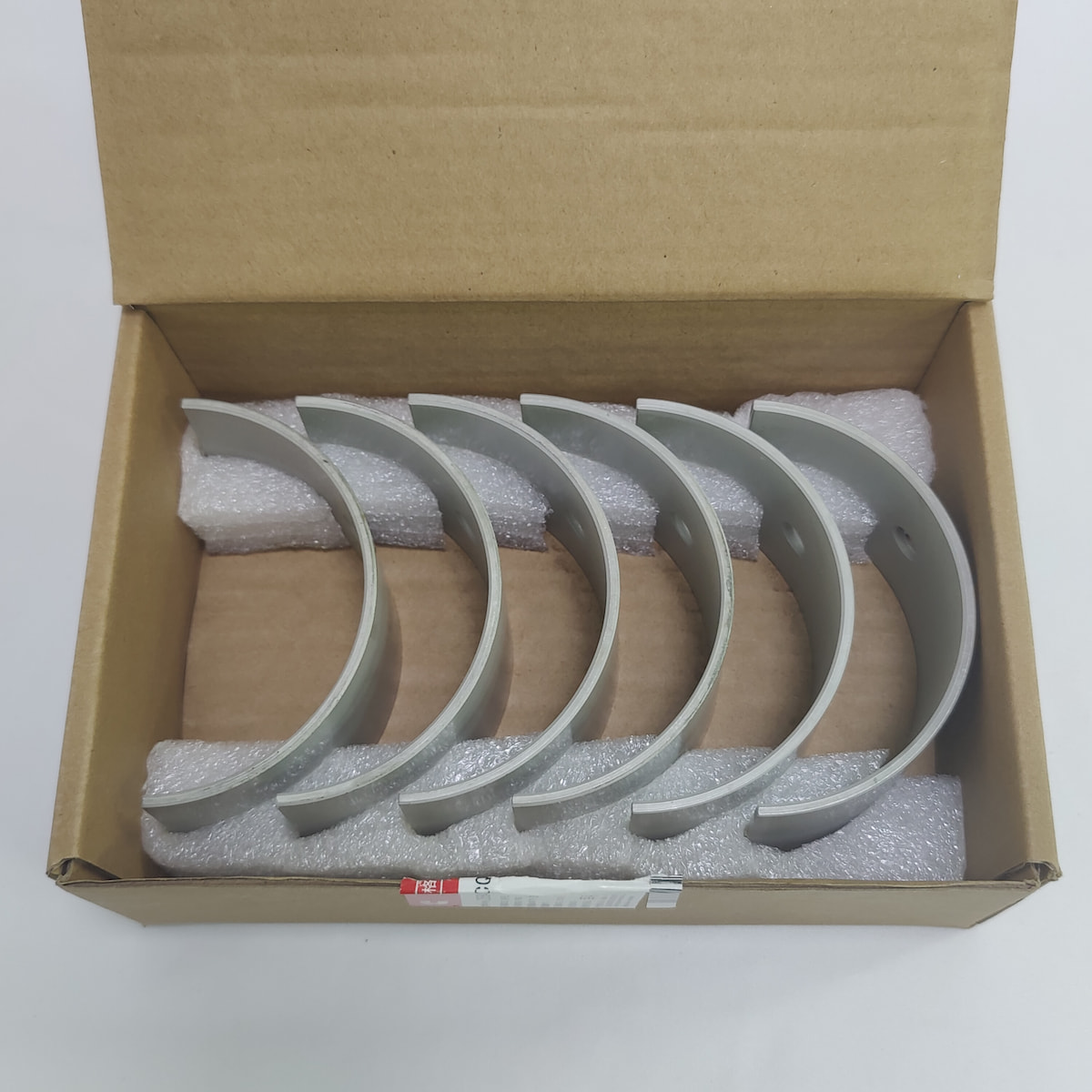
Thrust Design Must Be Confirmed Separately
Thrust bearings limit crankshaft axial movement. The thrust location, component design and required quantity depend on the specific engine configuration.
Do not apply the thrust location or quantity from another Cummins engine to the engine being repaired.
Possible supply or structural formats include:
- Main-bearing shells with integrated thrust faces;
- Separately supplied thrust washers;
- Separately supplied thrust plates;
- Main and thrust bearing sets;
- Thrust components included in a main-bearing set;
- Thrust bearings that must be ordered separately.
Confirm:
- Which main-bearing position carries the thrust function;
- Whether the thrust design is integrated or separate;
- Whether thrust components are included in the quotation;
- Quantity required per engine;
- Whether position-specific part numbers apply;
- Whether a formal repair thickness is offered;
- Whether the thrust part must be used with a specific main-bearing set.
Some thrust designs may have a specified working face, oil-groove direction or installation position. Similar appearance on both sides does not prove that either orientation is acceptable.
Any repair thickness or alternative thrust-repair method must be explicitly supported by the formal parts catalog and service information. Thicker thrust components must not be selected independently as a way to adjust crankshaft end play.
Thrust position, orientation, axial-clearance limits and installation must be confirmed by the repair facility. This article does not provide those values or procedures.
Bearing-Set Names Do Not Replace a Formal BOM
Terms such as Bearing Set, Bearing Kit and Overhaul Bearing Set may represent different quantities and supply scopes between suppliers.
| Quotation term | Common supply scope | What must be confirmed |
|---|---|---|
| Main Bearing | One main-bearing shell | Upper or lower shell, position and repair size |
| Main Bearing Pair | Two shells for one main-bearing position | Thrust design and position-specific configuration |
| Main Bearing Set | Multiple positions or complete-engine main bearings | Number of positions, total shells and thrust-component inclusion |
| Main and Thrust Bearing Set | Main bearings plus thrust components | Thrust design, total quantity and applicable position |
| Thrust Washer / Thrust Plate | Separate thrust component | Quantity, position, thickness and matching main-bearing set |
| Rod Bearing | One connecting-rod-bearing shell | Upper or lower shell and repair size |
| Rod Bearing Pair | Two shells for one connecting rod | Number of pairs required per engine |
| Rod Bearing Set | One rod, multiple rods or complete-engine quantity | Total shells, total pairs and number of connecting rods covered |
| Engine Bearing Kit | Combination of main, rod and thrust bearings | Confirm the formal BOM |
| Overhaul Kit | Multi-system engine-overhaul package | Whether main, rod and thrust bearings are included |
Before accepting a quotation, request:
- Formal kit part number;
- Included-parts list or BOM;
- Quotation unit: shell, pair, bearing position, connecting rod or complete engine;
- Total number of main-bearing shells;
- Total number of rod-bearing shells;
- Whether thrust components are included;
- Standard or repair size;
- Any position-specific shells;
- Number of sets required per engine;
- Any parts that must be ordered separately.
Main-Bearing Positions and Connecting-Rod Quantity Determine Total Requirements
The complete quantity of main bearings normally depends on:
- Number of main-bearing positions;
- Upper-and-lower-shell arrangement at each position;
- Thrust design;
- Any position-specific shells.
The complete quantity of connecting rod bearings should be determined from:
- Total number of connecting rods;
- Number of shells required per connecting rod;
- Upper-and-lower-shell configuration;
- Specific engine design;
- Formal kit BOM.
Do not calculate the complete quantity only from:
- “It is a six-cylinder engine”;
- Crankshaft appearance;
- Number of visible crankpins;
- Bearing quantity used in another similar engine.
In some crankshaft arrangements, the number of connecting rods and the visible rod-journal arrangement may not follow a simple one-to-one assumption. Connecting rod bearing quantity should therefore be confirmed from the connecting-rod count and formal BOM rather than calculated from crankpin appearance alone.
Before ordering, confirm:
- Number of main-bearing positions;
- Number of shells required at each main-bearing position;
- Total number of connecting rods;
- Number of shells required per connecting rod;
- Thrust position and thrust-component quantity;
- Exact total represented by the supplier’s definition of “one set.”
Connecting-Rod Version May Affect Bearing Selection
The same engine family may use different connecting-rod structures or part numbers across production periods, CPLs or upgrade packages.
Confirm:
- Connecting rod part number;
- Connecting-rod big-end design;
- Rod-cap design;
- Whether a fracture-split connecting rod is used;
- Matching rod-bearing part number;
- Oil-hole, oil-groove and locating design;
- Formal supersession or upgrade relationship;
- Whether old and new rod and bearing versions may be mixed.
For configurations involving fracture-split connecting rods, provide:
- Connecting rod part number;
- Old rod-bearing part number;
- Complete markings from the old shells;
- ESN and CPL.
Do not purchase rod bearings only by engine-family name.
Without formal technical support, a new rod-bearing version should not be installed in an old connecting-rod version, and different connecting-rod and bearing versions should not be mixed.
Part Number, ESN and CPL Come Before the Engine-Family Name
Descriptions such as:
-
6BT main bearing; -
QSB6.7 rod bearing; -
ISX15 bearing set; -
K19 crankshaft bearing;
are normally insufficient for final confirmation.
One engine family may cover different:
- CPLs;
- Production periods;
- Crankshaft part numbers;
- Connecting rod part numbers;
- Journal dimensions;
- Main-bearing counts;
- Thrust designs;
- Bearing materials or versions;
- Repair sizes;
- Formal supersessions or upgrades.
Use the following matching framework:
Bearing Part Number + ESN/CPL + Journal Diameter + Repair Grade + Thrust Configuration + Quantity
If the crankshaft has already been ground, replaced or used with repair-size bearings, the actual requirement may differ from the engine’s original factory configuration.
Also provide:
- Crankshaft part number;
- Connecting rod part number;
- Old main-bearing part number;
- Old rod-bearing part number;
- All characters marked on the back of the old bearing shells;
- Workshop measurement results;
- Previous repair records;
- Dismantled-part photos.
Markings on the back of an old bearing shell may help identify the brand, part number, standard size or repair grade. They do not replace crankshaft measurements because the old shell may come from a previous incorrect repair, a non-original configuration or an unsuitable replacement.
Formal Supersessions and Upgrade Relationships Must Be Confirmed as a System
A new main-bearing or rod-bearing part number may represent:
- A normal supersession;
- A direct replacement;
- A material or surface-layer update;
- An upgrade linked to a new crankshaft or connecting rod;
- A combination that must be applied across the complete engine.
A normal part-number supersession may not change the matching structure. A system-level upgrade may involve:
- Crankshaft;
- Connecting rods;
- Main bearings;
- Connecting rod bearings;
- Thrust components;
- Other matching parts.
Confirm:
- Whether the new number is a normal supersession or a system upgrade;
- Whether it requires a specific crankshaft part number;
- Whether it requires a specific connecting rod part number;
- Whether old and new bearing versions may be mixed in one engine;
- Whether all positions must use the same version;
- Whether a formal technical bulletin or BOM applies.
Without formal supporting information, an upgrade combination should not be separated or reconstructed from appearance, dimensions or an unofficial cross-reference.
How to Evaluate Bearing Material, Structure and Alternative-Part Quality
Engine bearings normally use a steel backing with one or more bearing-alloy and surface layers.
Requirements may differ by engine and operating condition in areas such as:
- Bearing-shell thickness;
- Inside and outside geometry;
- Bearing-alloy material;
- Surface layer or coating;
- Oil holes and grooves;
- Locating features;
- Thrust faces;
- Batch consistency.
Similar appearance, color and basic dimensions do not prove that two bearing shells use the same material, load capability or application design.
When evaluating a quality alternative, request:
- Clear cross-reference;
- Applicable ESN, CPL and engine configuration;
- Matching crankshaft or connecting-rod range;
- Standard and available repair sizes;
- Shell-thickness and dimensional-consistency controls;
- Oil-hole, oil-groove and locating design;
- Material and coating information;
- Production batch;
- Inspection records;
- Warranty;
- Claim procedure.
Do not judge engine bearings only by packaging, surface color, a general “fits this engine family” statement or the lowest quotation.
For mining equipment, continuously operating generator sets and high-load industrial engines, the cost of reworking the crankshaft system can be much higher than the price of the bearings. Part number, repair size, structural version and batch traceability therefore deserve priority.

Burnt Bearings, Abnormal Wear or Internal Knocking May Have Other Causes
A workshop may find:
- Burnt bearing surfaces;
- Surface flaking;
- Scratches;
- Abnormal wear;
- Heat discoloration;
- Spun or displaced bearings;
- Metallic debris;
- Abnormal oil pressure;
- Knocking from the crankshaft or connecting-rod area.
These conditions may involve the bearing, but they may also be related to:
- Low oil level;
- Abnormal oil pressure;
- Blocked oil passages;
- Oil contamination;
- Incorrect oil specification;
- Fuel dilution of the oil;
- Crankshaft-journal wear or surface damage;
- Bent or misaligned crankshaft;
- Distorted main-bearing housing;
- Abnormal connecting-rod big-end bore;
- Incorrect bearing clearance;
- Incorrect bearing position or orientation;
- Long-term engine overload;
- Other internal engine faults.
Replacing the bearing without identifying the root cause may lead to early failure of the new bearing.
Diagnosis, measurement and reuse decisions should be completed by a qualified repair facility using the applicable engine service information.
This article does not provide:
- Crankshaft-journal measurement procedures;
- Permitted crankshaft-grinding dimensions;
- Bearing-clearance specifications;
- Plastigage procedures;
- Main-bearing-housing measurement methods;
- Connecting-rod big-end measurement methods;
- Crankshaft end-play limits;
- Bearing installation orientation;
- Bolt-tightening torque;
- Crankshaft-grinding procedures;
- Remote decisions on whether an old crankshaft or bearing can be reused.
Bulk Buyers Should Confirm Grouping, Markings and Packaging
Distributors, repair channels and inventory buyers should also confirm:
- Manufacturer and brand;
- Formal part number;
- Kit part number;
- Standard or repair-size marking;
- Main and rod identification;
- Upper and lower identification, where applicable;
- Packaging by shell, pair, connecting rod or complete engine;
- Total number of shells per set;
- Whether thrust components are packed separately;
- Clear identification of position-specific shells;
- Protection against moisture, dust and scratching;
- Production batch;
- Date code;
- Outer-carton label;
- Inspection records;
- Warranty;
- Claim process.
For complete-engine kits, also inspect:
- Part-number consistency within the kit;
- Repair-size marking consistency;
- Complete upper-and-lower pairing;
- Correct oil-hole and groove configuration;
- Presence of all special-position shells;
- Complete thrust-component quantity;
- Agreement between the packaging labels and the BOM.
A missing position-specific main-bearing shell, rod-bearing pair or thrust component can stop an overhaul project. The BOM and total piece count should therefore be confirmed before payment and shipment.
Information to Provide Before Ordering
Engine Information
- Cummins engine model;
- ESN;
- CPL;
- Equipment manufacturer and complete model;
- Engine-nameplate photo.
Crankshaft and Connecting Rod Information
- Crankshaft part number or identifiable marking;
- Connecting rod part number;
- Whether the crankshaft has been ground;
- Whether the crankshaft has been replaced;
- Whether fracture-split connecting rods are involved;
- Whether the engine has been overhauled or internally modified;
- Previous repair records.
Existing Bearing Information
- Main-bearing part number;
- Connecting-rod-bearing part number;
- Thrust-bearing part number, where identifiable;
- All characters on the back of the old main bearings;
- All characters on the back of the old rod bearings;
- STD, repair-size or position markings;
- Clear photos of upper and lower shells separately;
- Photos of the thrust components.
Measurement and Repair Condition
- Measured main-journal diameter;
- Measured rod-journal diameter;
- Repair grade for main and rod journals separately;
- Single-journal repair or complete-engine overhaul;
- Whether the engine has already been dismantled;
- Whether the crankshaft requires grinding, repair or replacement;
- Workshop conclusion based on the applicable service information;
- Whether a formal supersession or upgrade is acceptable.
Required Supply Scope
- Individual main-bearing shell;
- Main-bearing pair;
- Main-bearing set;
- Individual connecting-rod-bearing shell;
- Connecting-rod-bearing pair;
- Connecting-rod-bearing set;
- Thrust washer or thrust plate;
- Main and thrust bearing set;
- Engine bearing kit;
- In-frame kit or overhaul kit;
- Quantity required per engine.
Commercial Requirements
- New genuine or quality alternative preference;
- Total order quantity;
- Destination;
- Required lead time;
- Packaging and labeling requirements;
- Batch, inspection or traceability documentation requirements.
How ZEB Power Supports Cummins Main and Rod Bearing Sourcing
ZEB Power supplies Cummins main bearings, connecting rod bearings, thrust bearings and related overhaul kits for construction machinery, mining equipment, generator sets and industrial engines.
Using the engine ESN, CPL, crankshaft and connecting-rod part numbers, old bearing-shell markings, workshop journal measurements and required kit scope, we can assist with verifying:
- Main-bearing and connecting-rod-bearing part numbers;
- Standard or formal repair size;
- Compatibility between main, rod and thrust bearings;
- Upper, lower and position-specific shell configuration;
- Quantity by shell, pair, connecting rod or complete engine;
- Formal supersession or upgrade relationship;
- New genuine and verified quality alternative supply options;
- Packaging, BOM and quotation scope.
Available options depend on the formal part number, actual crankshaft and connecting-rod configuration, and current supply channel.
Crankshaft measurement, grinding decisions, repair-size selection, bearing clearance, housing condition and old-part reuse decisions should be completed by a qualified local repair facility.
Frequently Asked Questions
Does “Main Bearing Set” Always Mean a Complete Engine Set?
No.
Different suppliers may use Set for one main-bearing position, several positions or the complete engine. Confirm the formal BOM and total number of shells before ordering.
Can Main Bearings and Connecting Rod Bearings Be Interchanged?
No.
They have different positions, load functions, dimensions and structural designs. Confirm each type by formal part number and journal configuration.
Is the Thrust Position the Same on Every Cummins Engine?
No.
Thrust location, design and quantity depend on the specific engine. Confirm them through the ESN, CPL, parts information and service documentation.
Do Thrust Washers Have a Front and Back Side?
It depends on the design.
Some products may have a specified working surface, oil-groove direction or installation position. Confirm the formal part number and service information rather than applying experience from another engine.
How Should Standard and Undersize Bearings Be Selected?
A qualified workshop should select the size using actual crankshaft-journal measurements, repair history and applicable service information.
Not every bearing part number is available in the same repair sizes.
What Does “0.25 Bearing” Mean?
The number alone is insufficient.
Confirm whether it refers to a main or rod bearing, a journal-grinding amount or a catalog repair grade, and whether the unit is inch or metric. The formal part number should also be checked.
Must Main and Rod Bearings Use the Same Repair Size?
No.
Main and rod journals may have undergone different grinding or repair work. Their measurements and repair grades should be provided separately.
Are Upper and Lower Rod-Bearing Shells Interchangeable?
Not always.
Some applications differ in oil holes, grooves, locating features or surface layers, while other designs may use identical shells. Confirm the formal part number and service information.
Does a Connecting Rod Bearing Set Cover One Rod or the Complete Engine?
There is no universal definition.
It may mean one shell, one pair, one connecting rod or the complete engine. Confirm the total shell count, pair count and number of connecting rods covered.
Does Internal Knocking Always Mean the Bearings Have Failed?
No.
Similar symptoms may involve oil pressure, crankshaft journals, connecting rods, bearing housings, clearances or other internal engine components. A qualified repair facility should inspect the engine.
Can I Request a Quotation Without the Old Bearing Part Number?
An initial check may still be possible.
Provide the ESN, CPL, crankshaft and connecting-rod part numbers or markings, all old bearing-shell markings, clear photos and workshop journal measurements.
Can I Order the Original Standard Bearings After the Crankshaft Has Been Ground?
Not automatically.
The current main- and rod-journal dimensions must be measured first, and the correct formal repair grade and part number must then be selected.
Conclusion
Cummins main and connecting rod bearings should not be selected by engine-family name, a general Bearing Set description or an unverified repair-size term.
The matching process should confirm:
Bearing Part Number + ESN/CPL + Journal Diameter + Repair Grade + Thrust Configuration + Quantity
When contacting ZEB Power, provide the engine ESN, CPL, crankshaft and connecting-rod part numbers, all markings from the old bearing shells, measured main- and rod-journal dimensions, repair grades and quantity required per engine.
We can assist with confirming the applicable part numbers and quotation scope.