

Cummins Connecting Rods: How to Match the Correct Rod Assembly

1097
Table of Contents
Generating table of contents
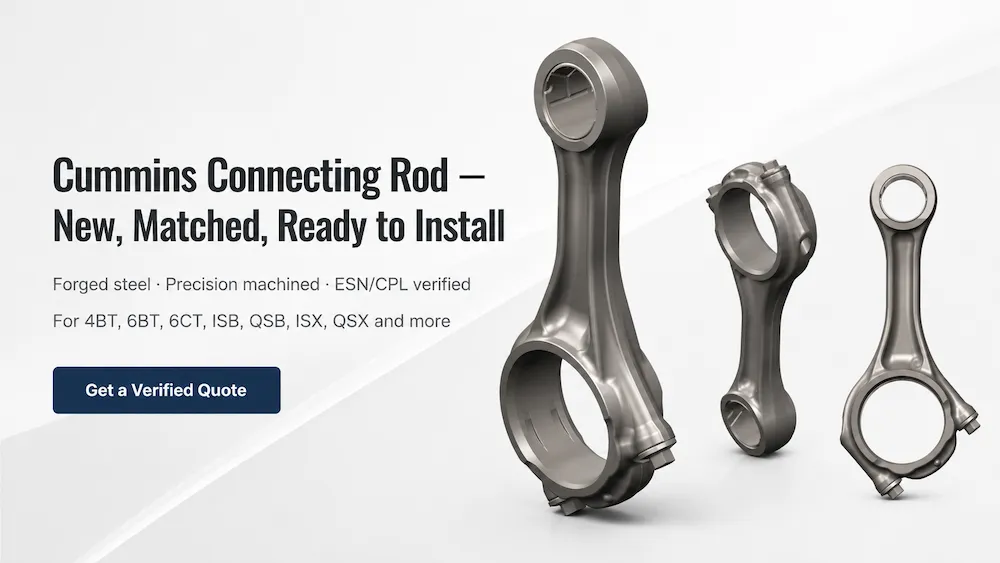
One of the most easily overlooked connecting-rod sourcing risks—and one that can create serious assembly problems—is the loss of the original pairing between the connecting rod body and its rod cap.
Many rod caps must not be treated as universal parts. This is especially important with a fracture-split connecting rod. The big end is manufactured as one piece and then separated along a controlled fracture interface, creating an original locating relationship between the rod body and the cap. Even when two connecting rods carry the same part number, this does not prove that their caps are interchangeable.
If rod bodies and caps are mixed during inventory handling, engine dismantling or used-parts sourcing, the original pairing can be lost. A different cap with the same part number or similar appearance should not be used to recreate the assembly. The correct action must be determined from the applicable service information and the repair facility’s inspection.
This guide is intended for:
- Parts wholesalers and importers purchasing Cummins connecting rods for resale;
- Repair workshops and fleet managers carrying out engine overhauls;
- Engine rebuilders evaluating new sourcing channels;
- Buyers supporting highway trucks, construction machinery, mining equipment, marine engines, generator sets and industrial engines.
Before ordering, confirm:
- Whether the rod uses a fracture-split or machined-cap design;
- Whether the rod body and cap are supplied as a matched assembly;
- Whether the rod cap has a formal part number that can be ordered separately;
- Whether the small end uses a separate bushing and whether it is included;
- The matching piston-pin part number and configuration;
- Whether rod bolts and nuts are included;
- Whether the applicable service information requires rod bolts to be replaced after removal;
- The standard or repair-size rod bearing required for the measured crankshaft rod-journal diameter;
- Whether the quotation is for one rod, multiple rods or a complete-engine quantity;
- Whether a formal upgrade requires the same connecting-rod version to be used throughout the engine.
Connecting-Rod Quotation Names Do Not Replace a Formal BOM
As with cylinder heads, pistons, liners and bearings, the term Connecting Rod may represent different supply scopes in different quotations.
| Quotation term | Common supply scope | What must be confirmed |
|---|---|---|
| Bare Connecting Rod | Connecting-rod body | Whether rod cap, bushing and bolts are included |
| Connecting Rod | May mean the rod body or a rod-and-cap assembly | Confirm the formal part number and BOM |
| Connecting Rod Assembly | Rod body and rod cap, possibly with bushing or bolts | Whether bushing, bolts and rod bearings are included |
| Connecting Rod Kit | Rod plus selected matching components | Confirm the Included Parts List |
| ReCon Connecting Rod, where available | Cummins remanufactured rod or assembly | Part number, current availability, core conditions and warranty |
| Connecting Rod Set | Multiple rods or a complete-engine quantity | Total quantity, design version and included components |
Before accepting a quotation, confirm:
- Formal connecting-rod part number;
- Whether the rod cap is included;
- Whether the small-end bushing is included;
- Whether the bushing is already installed;
- Whether rod bolts and nuts are included;
- Whether rod bearings are included;
- Whether the quotation covers one rod, multiple rods or a complete-engine quantity;
- Whether the product is New Genuine, ReCon or a Quality Alternative;
- Whether a core return applies;
- Whether any related parts must be ordered separately.
Some engine models or supply channels may offer a ReCon connecting-rod option, but not every connecting-rod part number is available as a ReCon product.
Cummins overhaul-kit contents also vary. Some programs mainly include the parts required for the base overhaul, while other components must be evaluated separately. An Overhaul Kit therefore must not be assumed to include connecting rods.
The Rod Body and Rod Cap Must Be Checked as a Matched Assembly
The connecting rod transfers load between the piston and crankshaft.
A connecting-rod assembly may include:
- Small end;
- Rod body;
- Big end;
- Rod cap;
- Small-end bushing, where applicable;
- Rod bolts and nuts;
- Other locating or fastening features.
The rod body and cap are fastened together and jointly form the complete big-end bore.
Two common rod-cap structures are outlined below.
Fracture-Split Connecting Rod
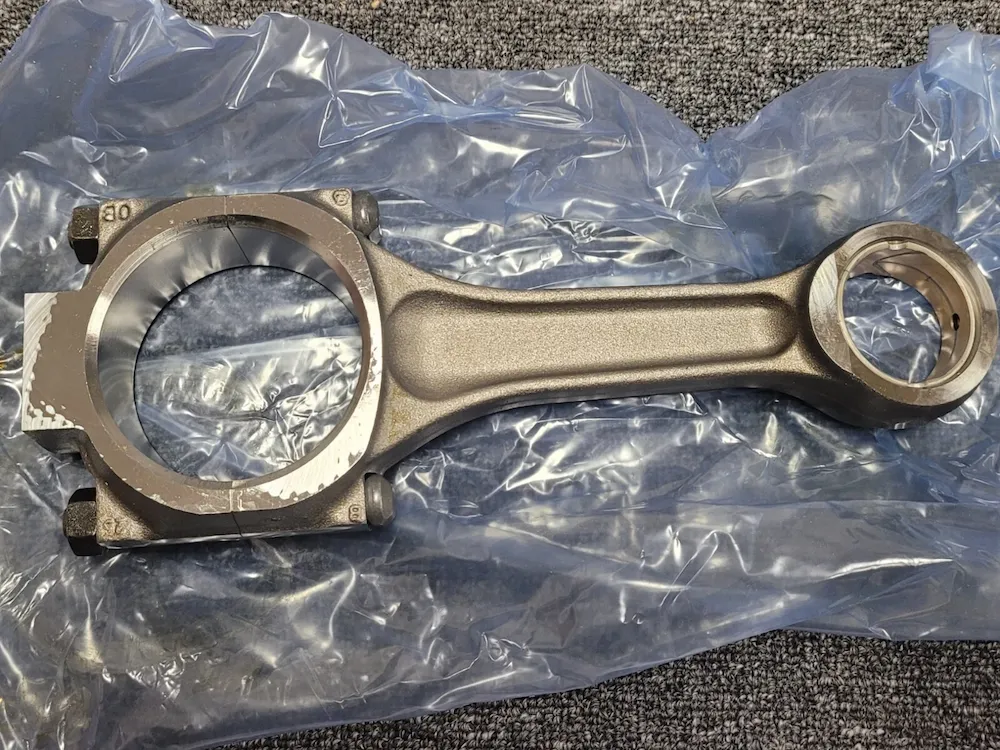
A fracture-split connecting rod, also called a cracked rod, is manufactured with the big end initially formed as one piece. It is then separated along a controlled fracture interface into the rod body and rod cap.
The irregular mating surfaces create an original locating relationship established during manufacturing. The cap should not be removed from its original rod and treated as a universal part that can be exchanged with another rod.
If the original pairing has been lost, a cap with the same part number or similar appearance should not be used to reconstruct the assembly. A complete rod assembly is a common sourcing solution, but the final decision must follow the applicable service information and the repair facility’s inspection.
Machined-Cap Connecting Rod
A machined-cap design uses machined mating surfaces and specific locating features to align the rod body and cap.
Although this interface differs from a fracture-split design, it does not prove that:
- A rod cap can be exchanged with another rod;
- Caps carrying the same part number can be freely mixed;
- The cap can be separated from the rod body and used to restore the big-end bore;
- Similar basic dimensions establish compatibility.
A rod cap should only be treated as a separate service part where the formal parts catalog provides an independent rod-cap part number and the applicable service information permits separate replacement or repair.
Whether a particular Cummins engine uses a fracture-split or machined-cap design should be confirmed by ESN, CPL, connecting-rod part number and formal parts data—not by engine-family name alone.
Situations That Commonly Destroy the Original Pairing
Common risks during purchasing, dismantling and inventory handling include:
- Rod bodies and caps from several engines being dismantled without engine and cylinder-position markings;
- Rod bodies and caps being stored separately;
- Used-parts sellers being unable to prove that the cap is original to the rod;
- A stockist using a cap from another rod with the same part number to complete an order;
- Cleaning, blasting or surface treatment removing or obscuring pairing marks;
- Rods being dismantled and mixed during transportation or inspection.
For fracture-split rods, the rod body and cap should remain clearly matched during dismantling, storage, inspection and shipment.
If the original pairing is lost, stop attempting to combine parts and determine the next step from the applicable service information and workshop inspection.
Confirm Whether the Small End Uses a Separate Bushing
The design of the connection between the small end and piston pin affects the small-end bore, bushing condition, piston-pin configuration and any required follow-up machining.
Diesel engines may use full-floating, fixed-pin or other piston-pin arrangements. The design used by a particular Cummins engine, whether a separate small-end bushing is fitted, and whether the bushing is supplied as a service part must be confirmed from:
- ESN;
- CPL;
- Connecting-rod part number;
- Piston part number;
- Piston-pin part number;
- Formal parts catalog;
- Applicable service information.
Do not determine the configuration solely from appearance or experience with another engine.
Design with a Separate Small-End Bushing
Confirm:
- Connecting-rod-bushing part number;
- Whether the bushing is already installed in the rod;
- Whether it is supplied at finished size;
- Whether approved final machining must be completed by the repair facility;
- Whether the inside diameter matches the current piston pin;
- Oil-hole or groove design, where applicable;
- Whether the bushing is included in the connecting-rod assembly;
- Whether separate bushing replacement is permitted after wear.
Design Without a Separate Bushing
The absence of a separate bushing does not by itself establish the piston-pin retention method or small-end specification.
Confirm through the formal rod, piston and piston-pin configuration:
- Small-end-bore design;
- Piston-pin diameter;
- Piston-pin locating method;
- Any additional matching components;
- Whether the rod and piston are approved for use together.
Different small-end structures may require different bore sizes, bushing conditions, piston-pin configurations and finishing requirements. A rod with a separate bushing must not be treated as equivalent to a rod without one.
Bushing installation, finishing, oil-hole alignment, dimensional inspection and piston-pin clearance should be completed by a qualified repair facility using the applicable service information.
This article does not provide installation or machining specifications.
Rod Bolts and Nuts Must Not Be Assumed to Be Included
Connecting-rod bolts and related nuts fasten the rod body and rod cap together.
A quotation for a Connecting Rod or Connecting Rod Assembly does not necessarily include new bolts and nuts.
Possible supply scopes include:
- Rod body and cap without bolts;
- Rod assembly supplied with bolts;
- Bolts and nuts supplied as separate parts;
- ReCon assembly supplied with fasteners according to a specific BOM;
- Overhaul kit listing fasteners separately.
Some engine service information may require rod bolts to be replaced after removal. Other configurations may permit reuse after specified inspection requirements are satisfied.
The correct requirement must be confirmed using:
- Connecting-rod-bolt part number;
- Engine ESN and CPL;
- Connecting-rod design version;
- Applicable service information;
- Repair-facility inspection conclusion.
The bolt’s appearance is not sufficient evidence.
Before ordering, confirm:
- Whether bolts and nuts are included with the rod;
- Formal bolt and nut part numbers;
- Quantity required per connecting rod;
- Whether the quotation is per fastener, per rod or per complete engine;
- Whether service information requires replacement after removal;
- Whether a formal supersession or upgrade applies.
This article does not provide rod-bolt reuse criteria, length checks, tightening sequence, torque, stretch or angle-tightening specifications.
Rod Bearings Are Not Automatically Included with the Connecting Rod
The connecting rod bearing, or rod bearing, is installed between the rod big end and the crankshaft rod journal. It normally has its own part number and repair-size grade.
Even when purchasing a Connecting Rod Assembly, do not assume that rod bearings are included.
Confirm separately:
- Connecting-rod-bearing part number;
- Standard or formal repair size;
- Whether upper and lower shells are supplied as a pair;
- Number of shells required per connecting rod;
- Complete-engine quantity;
- Compatibility with the current connecting-rod design;
- Compatibility with the measured crankshaft rod-journal diameter.
If the crankshaft has been ground, the connecting-rod body may still be applicable while the required rod-bearing repair grade has changed.
The rod and rod bearing must be checked together, but they are not the same part number and must not be assumed to belong to the same supply scope.
For details on undersize terminology, crankshaft journal dimensions and bearing-set quantities, refer to the Cummins main and rod bearing guide.
Single-Rod or Complete-Engine Replacement Depends on the Repair Condition
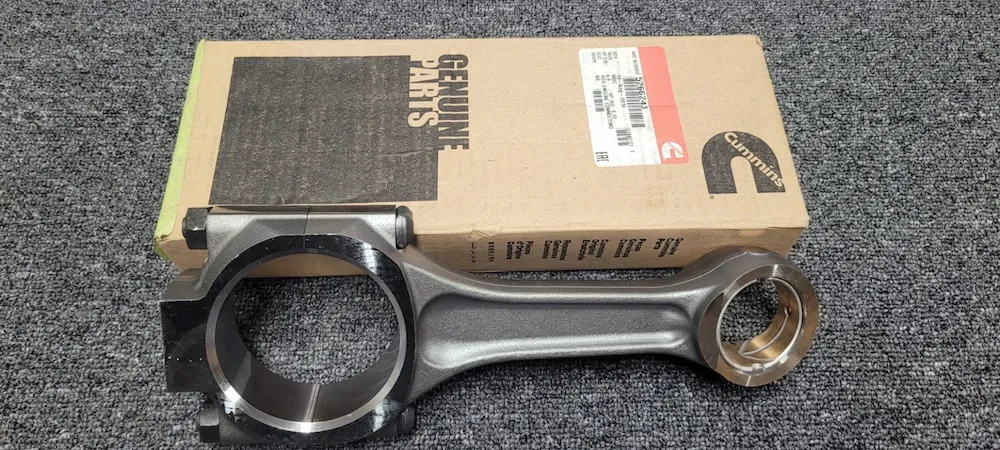
Connecting rods may be supplied individually, in multiple quantities or as a complete-engine set.
Whether only one rod should be replaced depends on:
- Cause of the rod damage;
- Condition of the remaining rods;
- Piston and piston-pin condition;
- Crankshaft rod-journal condition;
- Current connecting-rod design used in the engine;
- Rod-bearing version;
- Whether a full-engine upgrade is required;
- Limits in the applicable service information;
- Complete-engine consistency requirements.
A statement such as “only one cylinder has a problem” is not sufficient to determine that only one rod should be replaced.
For a single-rod purchase, confirm:
- Whether the new rod and existing rods use the same design version;
- Whether they use the same piston-pin configuration;
- Whether the same rod bearing applies;
- Whether the same bolts and small-end bushing are used;
- Whether old and new versions may be used in the same engine;
- Whether a formal weight grade or group marking applies;
- Whether the piston, piston pin or another matching part must also be replaced.
For a single replacement, also verify whether the engine uses a formal weight grade, group mark or complete-engine consistency requirement.
Whether weighing is required, what mass difference is permitted, and whether different groups may be mixed must be determined from the applicable service information and repair-facility conclusion. A universal weight tolerance should not be applied.
Complete-engine consistency, balance and old-part reuse decisions belong to the repair facility.
Formal Supersessions and Upgrade Programs Must Be Checked as a System
A new connecting-rod part number may represent:
- Direct replacement;
- Normal supersession;
- Material or manufacturing revision;
- Upgrade linked to a particular piston or piston pin;
- System upgrade linked to a particular crankshaft or rod bearing;
- ReCon supply number.
A normal supersession and a system-level upgrade do not mean the same thing.
Even where the new number is a part-number supersession, verify whether the formal replacement information includes:
- Matching-part requirements;
- Engine-configuration restrictions;
- Applicable ESN or CPL range;
- Quantity requirements;
- Restrictions on mixing old and new versions.
A system upgrade may involve:
- Connecting rod;
- Rod cap;
- Connecting-rod bolts;
- Piston;
- Piston pin;
- Connecting-rod bearings;
- Crankshaft;
- Other internal engine parts.
Confirm:
- Whether the new number is a normal supersession or a system upgrade;
- Whether a specific piston and piston pin are required;
- Whether a specific crankshaft is required;
- Whether a specific rod bearing is required;
- Whether all cylinders must use the same rod version;
- Whether old and new versions may be used together in one engine;
- Whether a formal technical bulletin or BOM applies.
Without formal support, different rod versions and matching components should not be combined based only on appearance, center-to-center length or basic dimensions.
Connecting-Rod Part Number, ESN and CPL Come Before the Engine-Family Name
Descriptions such as:
-
6BT connecting rod; -
QSB6.7 con rod; -
ISX15 connecting rod; -
K19 rod assembly;
are normally insufficient for final confirmation.
One engine family may cover different:
- CPLs;
- Production periods;
- Power ratings;
- Emissions configurations;
- Connecting-rod design versions;
- Piston and piston-pin versions;
- Small-end-bushing structures;
- Crankshaft versions;
- Rod-bearing versions;
- Connecting-rod bolts;
- Formal supersessions or upgrades.
Use the following matching framework:
Connecting Rod Part Number + ESN/CPL + Rod-Cap Design + Piston Pin Configuration + Crankshaft Part Number + Rod Bearing Part Number + Quantity
If the engine has previously been overhauled, modified or fitted with replacement rods, the parts currently installed may differ from the original factory configuration.
Also provide:
- Current old connecting-rod part number;
- Rod-body and rod-cap markings;
- Crankshaft part number;
- Piston part number;
- Piston-pin part number;
- Connecting-rod-bearing part number;
- Old-part photos;
- Repair history;
- Workshop inspection and measurement conclusions.
Rod Damage or Abnormal Mechanical Noise May Have Other Causes
A repair facility may find:
- Bent connecting rod;
- Twisted connecting rod;
- Abnormal big-end-bore size or shape;
- Worn small-end bushing;
- Damaged rod bearing;
- Abnormal rod-cap fit;
- Damaged fasteners;
- Cracks or surface damage in the rod body;
- Wear around the piston-pin area;
- Abnormal mechanical noise from the engine or crankshaft-and-rod area.
These conditions may involve the connecting rod, but they may also involve:
- Worn or damaged crankshaft rod journal;
- Worn or incorrectly selected rod bearings;
- Piston-pin or small-end-bushing problems;
- Oil-pressure or oil-passage problems;
- Incorrect assembly clearances;
- Liquid entering the cylinder;
- Foreign material entering the cylinder;
- Piston damage;
- Abnormal combustion;
- Engine overload;
- Other internal-engine faults.
Replacing the rod without identifying the cause may lead to another failure of the new rod or related parts.
Inspection, dimensional evaluation, crack testing, straightening, reuse and rejection decisions should be completed by a qualified repair facility using the applicable engine service information.
This article does not provide:
- Connecting-rod bend or twist measurement procedures;
- Center-to-center dimensional limits;
- Big-end- and small-end-bore repair dimensions;
- Small-end-bushing machining specifications;
- Rod-cap repair procedures;
- Rod-bolt tightening specifications;
- Connecting-rod installation orientation;
- Weight-group selection procedures;
- Remote decisions on whether an old connecting rod can be reused.
New Genuine, ReCon and Quality Alternative Connecting Rods
A connecting rod is subjected to repeated tensile, compressive and inertial loads. Its material, manufacturing method, dimensional control and batch consistency affect overhaul reliability.
Market supply options may include:
- New Genuine;
- ReCon, where available;
- Quality Alternative;
- Used or Rebuilt products.
Do not compare only appearance and price. Verify the following.
Structure and Dimensions
- Connecting-rod part number;
- Big-end and small-end dimensions;
- Center-to-center length;
- Rod-body design;
- Rod-cap design;
- Whether the rod body and cap retain their original manufacturing pair;
- Fastener configuration;
- Small-end-bushing configuration;
- Matching piston pin;
- Matching rod bearing;
- Applicable crankshaft range.
Material and Quality Control
- Connecting-rod material;
- Forging and machining process;
- Dimensional consistency;
- Big-end- and small-end-bore control;
- Surface condition;
- Crack or defect inspection, where included in the supply scope;
- Weight or group markings, where applicable in formal information;
- Production batch;
- Inspection record;
- Warranty;
- Claim process.
For a fracture-split design, both genuine and quality alternative rods should retain the original manufacturing pairing between the rod body and cap.
Do not determine suitability only from:
- External appearance;
- Forging or casting color;
- A broad “fits this engine family” claim;
- Lowest price.
Bulk Buyers Should Confirm Pairing, Markings and Packaging
Wholesalers, importers, repair channels and inventory buyers should also confirm:
- Manufacturer and brand;
- Formal part number;
- New Genuine, ReCon or Quality Alternative status;
- Individual, multi-piece or complete-engine packaging;
- Whether the rod body and cap remain paired;
- Whether pairing marks are clear;
- Whether rod bolts and nuts are included;
- Whether the small-end bushing is included;
- Whether the bushing supply condition is clearly stated;
- Whether rod bearings are packed separately;
- Whether different design versions are separated;
- Production batch;
- Date code;
- Inspection record;
- Outer-carton label;
- Warranty;
- Claim process.
For a complete-engine connecting-rod set, also inspect:
- Consistency of all connecting-rod part numbers;
- Consistency of design versions;
- Correct pairing between each rod body and cap;
- Complete fastener quantity;
- Consistent bushing configuration;
- No mixing of different piston-pin configurations;
- No mixing of different rod-bearing versions;
- Agreement between packaging labels and the BOM.
A missing rod cap, bolt, bushing or another matching component can stop the overhaul project. The Included Parts List should therefore be confirmed before payment and shipment.
Information to Provide Before Ordering
Engine Information
- Cummins engine model;
- ESN;
- CPL;
- Equipment manufacturer and complete model;
- Power rating and application, where required for matching;
- Engine-nameplate photo.
Existing Connecting-Rod Information
- Connecting-rod part number;
- All markings on the rod body and rod cap;
- Rod design, such as fracture-split or machined cap;
- Photos of rod-body and rod-cap pairing marks;
- Photos of the big-end mating surface;
- Photos of the big-end and small-end bores;
- Whether a separate small-end bushing is installed;
- Whether the original rod cap is still paired with the rod;
- Overall photos of the old connecting rod.
Matching-Part Information
- Crankshaft part number;
- Piston part number;
- Piston-pin part number;
- Connecting-rod-bearing part number;
- Connecting-rod-bolt part number, where identifiable;
- Standard or repair-size rod bearing;
- Photos of the old piston, piston pin, rod bearings and bolts;
- Whether formal upgrade parts are currently installed.
Measurement and Repair Condition
- Measured crankshaft rod-journal diameter;
- Corresponding rod-bearing repair grade, where confirmed;
- Single-rod replacement or complete-engine overhaul;
- Whether the engine has already been dismantled;
- Cause of rod damage and condition of other internal parts;
- Piston-pin and small-end-bushing condition;
- Crankshaft rod-journal inspection conclusion;
- Previous repairs or modifications;
- Whether the applicable service information requires rod-bolt replacement after removal;
- Whether a formal supersession or upgrade is acceptable.
Required Supply Scope
- Bare Connecting Rod;
- Connecting Rod Assembly;
- Connecting Rod Kit;
- ReCon Connecting Rod, where available;
- Connecting Rod Set;
- Rod Cap, only where the formal catalog permits separate supply;
- Connecting Rod Bushing;
- Connecting Rod Bolts and Nuts;
- Connecting Rod Bearings;
- Individual, multi-piece or complete-engine quantity.
Commercial Requirements
- New Genuine, ReCon or Quality Alternative preference;
- Total order quantity;
- Destination;
- Required lead time;
- Packaging and labeling requirements;
- Core return conditions, where applicable;
- Batch, inspection or traceability-document requirements.
How ZEB Power Supports Cummins Connecting-Rod Sourcing
ZEB Power supplies Cummins connecting rods and related overhaul parts for highway vehicles, construction machinery, mining equipment, marine engines, generator sets and industrial engines.
Using the engine ESN, CPL, old connecting-rod part number and markings, crankshaft and piston configuration, old-part photos and repair scope, we can assist with verifying:
- Connecting-rod part number;
- Fracture-split or machined-cap design;
- Rod-body and rod-cap pairing;
- Piston-pin and small-end-bushing configuration;
- Compatibility between the rod bearing and crankshaft rod journal;
- Rod bolts, nuts and other included accessories;
- Individual, multiple and complete-engine quantities;
- Formal supersession or upgrade relationship;
- New Genuine, ReCon and verified Quality Alternative options;
- BOM, packaging and quotation scope.
Available options depend on the formal part number, actual engine configuration and current supply channel.
Connecting-rod measurement, crack inspection, straightening, bushing installation and machining, fastening specifications, weight grouping and old-part reuse decisions should be completed by a qualified local repair facility.
Frequently Asked Questions
Can a Rod Cap Be Mixed with Another Connecting Rod?
Not by default.
For a fracture-split design, the rod body and cap should retain their original manufacturing pairing. Whether another design permits separate rod-cap replacement must be confirmed through the formal parts catalog and service information.
Are Rod Caps Interchangeable When the Connecting Rods Have the Same Part Number?
The same part number alone is not sufficient evidence.
A fracture-split rod cap must remain paired with its original rod body. Other designs still require confirmation that the rod cap has a separate part number and an approved replacement procedure.
How Can I Confirm Whether the Engine Uses a Fracture-Split or Machined-Cap Rod?
Use the ESN, CPL, connecting-rod part number and formal parts information.
The appearance of the big-end mating surface may help with initial identification, but wear, corrosion, cleaning or surface treatment can make visual inspection unreliable. A photo alone is not enough for final confirmation.
Can a Damaged Small-End Bushing Be Replaced Separately?
It depends on whether a separate bushing part number exists and whether the applicable service information permits replacement and follow-up machining.
The presence of a bushing does not by itself prove that direct replacement is permitted.
Can Connecting-Rod Bolts Be Reused?
It depends on the engine and bolt part number.
Some service information requires replacement after removal. Other configurations may permit reuse after specified inspection conditions are met. Do not decide from appearance or general experience.
Are Bolts and Bushings Always Included with the Connecting Rod?
No.
The BOM for a connecting rod, connecting-rod assembly or connecting-rod kit may differ. Bolts, nuts and bushings may need to be ordered separately.
Are Rod Bearings Included When Purchasing a Connecting Rod?
Not by default.
Rod bearings normally have separate part numbers and repair-size grades. Confirm the BOM and crankshaft-journal compatibility separately.
Does Abnormal Internal Mechanical Noise Always Mean the Connecting Rod Is Damaged?
No.
Similar symptoms may involve the crankshaft journal, rod bearing, piston pin, small-end bushing, oil pressure or another internal-engine component. A qualified repair facility should inspect the engine.
Must Weight Grade Be Checked When Replacing One Connecting Rod?
It depends on whether the engine uses a formal weight grade, group mark or complete-engine consistency requirement.
Follow the applicable service information and repair-facility conclusion rather than a universal weight tolerance.
Is a ReCon Connecting Rod Available for Every Cummins Engine?
No.
ReCon availability depends on the engine, connecting-rod part number, supply channel and current policy. Core return conditions may also apply.
Can I Request a Quotation Without the Old Connecting-Rod Part Number?
An initial check may still be possible.
Provide the ESN, CPL, all markings on the old rod and cap, photos of the mating surface and pairing marks, and the crankshaft, piston and piston-pin information. Final confirmation may still require workshop inspection or measurements.
Conclusion
Cummins connecting rods should not be selected by engine-family name, appearance or center-to-center dimensions alone.
The matching process should confirm:
Connecting Rod Part Number + ESN/CPL + Rod-Cap Design + Piston Pin Configuration + Crankshaft Part Number + Rod Bearing Part Number + Quantity
When contacting ZEB Power, provide the engine ESN, CPL, old connecting-rod part number and markings, crankshaft and piston configuration, rod-bearing part number, repair condition and quantity required per engine.
We can assist with confirming the applicable part number and quotation scope.