

Perkins Cylinder Head: What Should It Include?

4668
Table of Contents
Generating table of contents
When an approved repair procedure allows a crankshaft journal to be ground smaller, an Undersize bearing can restore the required oil-clearance relationship. When a parent bore is machined larger, an approved oversize piston may provide a matching repair route.
Machining a cylinder-head gasket surface is different. Once material is removed, the total cylinder-head height changes permanently. It should not be assumed that one matching part can restore every affected geometric relationship to its pre-machining condition.
Depending on the engine and combustion-system design, cylinder-head resurfacing may affect valve recession or protrusion, piston-to-valve clearance, valve-train geometry, and the position of injectors, pre-combustion components or related interfaces. On many direct-injection engines, for example, a major part of the combustion chamber is formed by the piston bowl rather than by a large recess in the cylinder head. The effect of head machining therefore cannot be reduced to one universal statement about compression ratio, and a thicker head gasket should not be treated as a general-purpose correction.
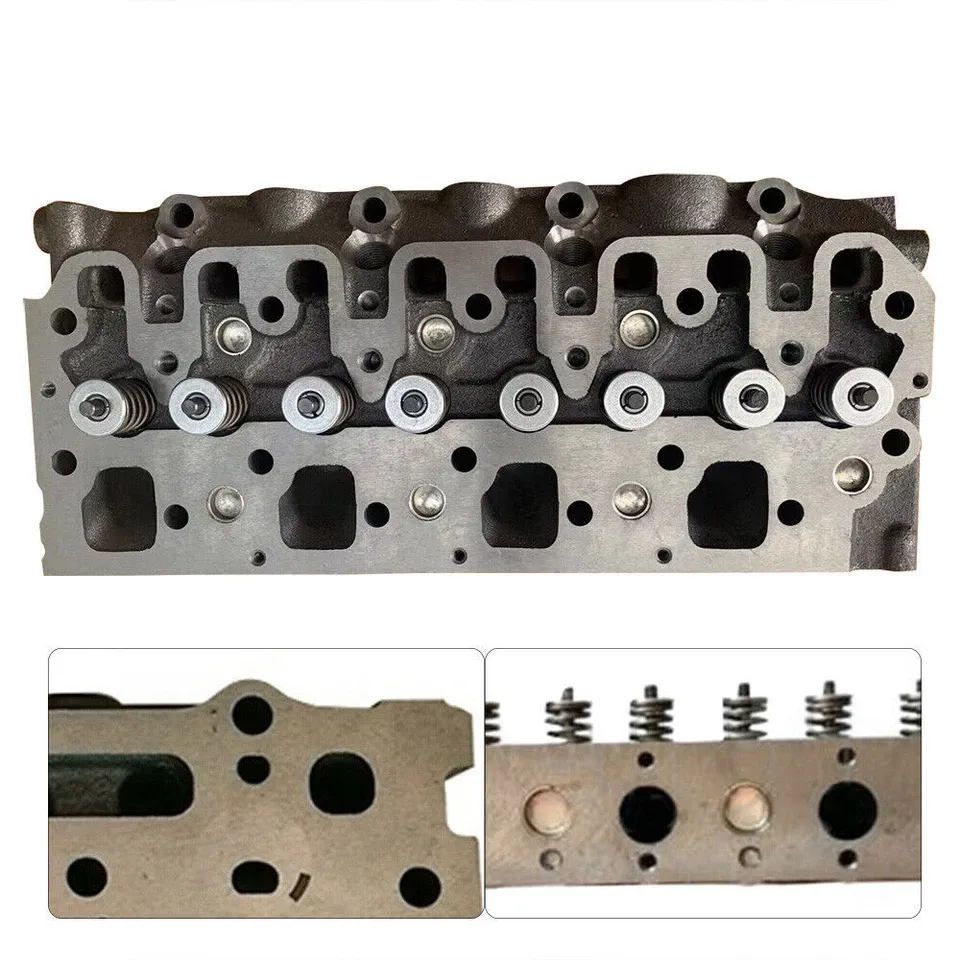
Before purchasing or repairing a Perkins cylinder head, the important questions are not only how much the part costs or whether it includes valves. The buyer also needs to understand how much machining history the head has already consumed, whether it still has an approved repair path, and whether replacement is more appropriate than further machining.
Bare, Assembled and Complete Are Commercial Labels, Not Fixed Bills of Materials
Bare, Assembled and Complete are supplier descriptions of completion level. They do not have one universal cross-supplier bill of materials.
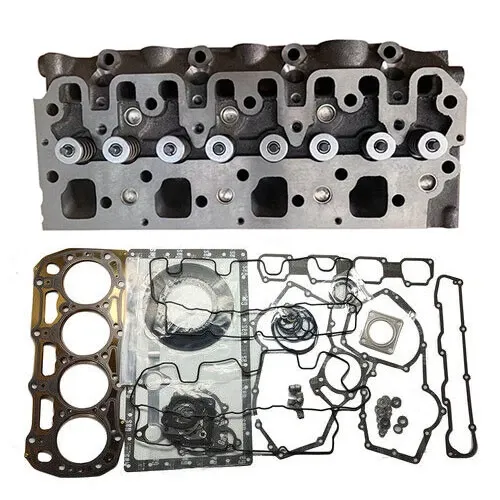
A Bare Head may be a basically machined cylinder-head casting only, or it may already contain valve-seat inserts and guides. An Assembled Head will often include additional components such as valves, springs, collets and stem seals, but the actual completion level and inspection scope vary widely. A Complete Head may add rocker equipment, a camshaft or other cylinder-head components, but it should not automatically be assumed to include intake and exhaust manifolds, injectors, glow plugs or installation bolts.
More attached parts do not necessarily mean that the cylinder-head casting and machining condition are more reliable.
A lower-priced Bare Head may still require valves, guides, seats, springs, seals, machining and assembly. A more expensive Assembled Head may reduce workshop time and uncertainty if the valve system has been correctly fitted and the head has completed the necessary sealing, pressure and dimensional checks.
The useful comparison is therefore not simply which quotation contains more components. It is how much machining, additional material, inspection and responsibility remain before each cylinder head is ready for reliable installation.
A Casting Number Identifies a Family, Not Necessarily the Final Version
An old cylinder head may show casting text, mould references, machining marks and formal service part numbers. These markings do not all serve the same purpose.
A casting number usually helps identify the source or family of the base casting. The same basic casting may undergo different machining operations, hole patterns or assembly configurations and become more than one final service version. Matching casting numbers therefore do not prove that two completed cylinder-head assemblies are interchangeable.
All visible markings on the old head should be photographed, but a casting number alone should not be used to finalise an order. Compatibility should be confirmed through the formal service part relationship, the complete Engine Serial Number and the Build List.
Flatness: Distortion of the Cylinder-Head Sealing Surface
A cylinder head operates under combustion pressure, changing temperature and cylinder-head-bolt clamping force. Normal thermal cycling should not automatically cause cylinder-head failure. Sealing-surface distortion is more commonly associated with conditions such as abnormal overheating, uneven cooling, cooling-system failure, incorrect clamping or tightening procedure, or the effects of previous machining and repair.
This may appear similar to a crankshaft straightness problem, but the causes are different. Crankshaft datum or straightness abnormalities are associated with rotational loading, journal relationships, support conditions or machining. Cylinder-head distortion is more closely related to thermal loading, cooling and clamping conditions exceeding what the structure can tolerate.
The cylinder head should be checked according to the applicable service procedure, using the specified straightedge, feeler gauge or measurement equipment at the required positions and directions. The cylinder-block deck is a separate mating surface and should also be checked; confirming only the cylinder head does not establish that the complete sealing relationship is acceptable.
A flatness result confirms the current geometric condition. It does not, by itself, prove one specific failure cause. Cylinder-head flatness abnormality is also a common hidden contributor to head-gasket sealing problems.
Resurfacing Is Not Simply a Matter of Making the Surface Flatter
When flatness is outside the permitted range, resurfacing may be used to restore the gasket surface where the service procedure allows it. That operation also changes other geometric relationships.
Crankshaft grinding can be paired with an approved bearing repair grade to restore a journal-clearance relationship. Material removed from a cylinder-head gasket surface, however, permanently reduces the cylinder-head height.
After resurfacing, the workshop may need to confirm whether the following have been affected:
- valve recession or protrusion relative to the relevant reference surface;
- piston-to-valve operating clearance;
- valve-train geometry on applicable engines;
- the position of injectors, pre-combustion components or other protruding parts;
- the relative alignment of manifold faces where the engine design makes this relevant.
Which items are affected, and by how much, depends on the cylinder-head and combustion-system design. There is no single rule that applies to every Perkins engine.
A common but unsafe assumption is that excessive head machining can be corrected simply by installing a thicker head gasket. Gasket thickness is an engine-specific service parameter, not a universal method for compensating for cylinder-head material removal.
Before resurfacing, the workshop should confirm that the proposed material removal remains within the allowable machining limit for the actual engine. Once that limit is exceeded, the gasket surface may look flat while valve position, operating clearance or another critical relationship has moved outside the intended range. At that point, the value of continuing to use the head needs to be reconsidered.
Whether a Valve Seat Can Be Repaired Depends on Its Design and the Approved Procedure
A cylinder head may use a valve seat machined directly into the head material, or it may use a separate pressed-in seat insert. These designs can lead to different repair routes, but neither description alone proves that a head must be rejected or that a replacement seat can always be installed.
The feasibility of re-machining, installing a repair seat or using another approved repair size depends on factors such as the remaining material, seat-pocket condition, concentricity, heat-transfer requirements and final valve recession. The answer must also follow the repair procedure for the specific engine.
A supplier can describe the current supply and machining condition of the seat area. It should not promise that a particular head is definitely repairable—or definitely beyond repair—without the relevant measurements and service limits.
The important question is therefore not simply whether the seat is integral or inserted. It is what seat design the actual head uses, what condition it is in, and which repair route is approved for that version.
Valve-Guide Wear and Valve-Seat Wear Are Separate Inspection Lines
The valve guide controls the linear movement and alignment of the valve stem. The valve seat forms the combustion seal when the valve closes. They occupy different locations and fail in different ways, so checking one does not prove that the other is acceptable.
Guide wear increases the clearance between the stem and the guide bore. Excessive clearance can allow abnormal valve movement and may permit oil to enter the combustion area along the guide. Seat wear, burning or distortion primarily affects sealing and can contribute to compression leakage or local overheating.
The inspection methods are also different.
After a guide is pressed into the cylinder head, the interference fit may change its internal diameter. The actual guide-to-stem clearance should therefore be checked after installation and before final valve assembly. A statement such as “the valve system is good” is not a substitute for separate guide, seat and valve measurements.
Crack Inspection Is Especially Important on a Cylinder Head
A cylinder head contains combustion areas and coolant passages separated by limited material thickness. These operating and structural conditions make the head one of the engine components that requires particular attention for cracking during repair assessment.
On some cylinder-head designs, areas between valve seats, around injectors or injector sleeves, near bolt holes and beside coolant passages may deserve special inspection. The actual high-risk locations depend on the head material, combustion-system layout and service information; Perkins cylinder heads should not all be assumed to crack in the same pattern.
Fine cracks may not be visible during a normal visual examination. Crack inspection should be treated as a separate task from flatness measurement, pressure or passage-sealing tests, and valve-system inspection. The method used should be appropriate for the cylinder-head material and structure.
A crack that connects a combustion area with a coolant passage may allow coolant to enter the cylinder or combustion pressure to enter the cooling system. Such leakage may be intermittent, making diagnosis more difficult. A clean external appearance is therefore not evidence that the head is crack-free.

Injector Installation Features Can Make Similar-Looking Heads Incompatible
The cylinder head does more than support the valves. It also locates and seals the fuel injector.
Different fuel-system designs may require different injector-hole angles, seat forms, sealing washers, sleeves, clamping methods or related passage arrangements. The fact that an injector can physically enter the opening does not prove that the cylinder head is correct. Injector type, angle, seating condition and sealing design must correspond to the engine configuration.
If an injector seat, sleeve or bore is damaged, that area may require a specific repair or replacement component. Replacing the injector alone may not correct the head-side problem.
Within the same engine series, or even within one base casting family, production stage and fuel-system version may create differences in features such as:
- injector-hole angle and depth;
- internal intake and exhaust port form;
- glow-plug provision;
- EGR passage or interface provision.
These differences can be difficult to identify from external photographs alone. The complete Engine Serial Number and Build List should be used for confirmation.
Once the formal service part number has been confirmed as identical, major machining features would not normally be expected to vary arbitrarily. The real risks are that one engine series uses several formal head part numbers, that one casting family is machined into different assemblies, or that a shared casting number and broad engine description conceal different service parts.
Cylinder-Head-Bolt Reuse Must Be Confirmed for the Specific Engine
Some Perkins service procedures require cylinder-head bolts to be replaced after removal. This may include fasteners designed to operate under Torque-to-Yield principles. Other engines may allow reuse after specified checks of bolt length, threads and general condition.
The replacement requirement and the use of a yield-based tightening design are related issues, but they are not the same decision. An angle-tightening step alone does not prove that a bolt is automatically a single-use Torque-to-Yield fastener.
Before assembly, the workshop should check the service procedure for the actual Engine Serial Number and confirm whether the bolts must be replaced, whether length or condition limits apply, and what torque, angle and tightening sequence are required.
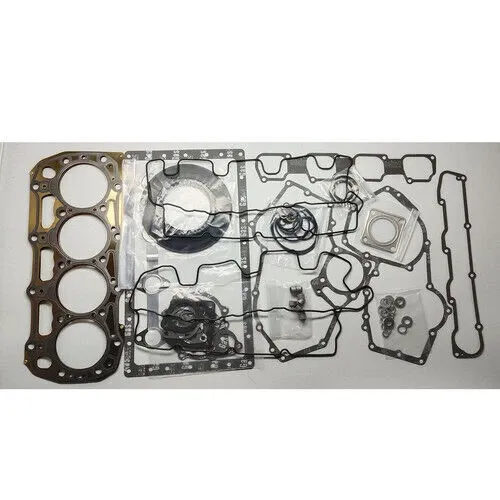
Cylinder-head bolts are easily overlooked when purchasing a head or gasket set. A new cylinder head or gasket kit should not be assumed to include them. Reusing bolts that the service procedure requires to be replaced can reduce or unevenly distribute clamping force, even when the gasket and both sealing surfaces are otherwise acceptable.
Information to Provide for a Cylinder-Head Review
Useful information includes:
- complete engine model, Engine Serial Number and Build List;
- the old head's formal part number, casting number and other visible markings;
- photographs of the gasket surface, top, intake side, exhaust side and injector area;
- records of previous resurfacing, welding, seat replacement or guide repair;
- completed flatness, crack, pressure and valve-system inspection results, where available;
- whether cylinder-head bolts need to be included;
- the required supply state: Bare, Assembled or Complete.
For a Remanufactured or Used cylinder head, request inspection information covering the gasket surface, cracking, valve seats and guides. Descriptions such as “clean” or “good condition” are not sufficient.
When inspection is incomplete, a budgetary quotation may be prepared from the engine identity and original configuration. Final selection should still depend on the actual head version, machining history and measured condition.
ZEB Power can use this information to review the formal cylinder-head version, valve-seat design, supply state and the remaining work between each quotation and final installation.
Whether the gasket surface is outside specification, whether cracks or passage leaks are acceptable, whether the valve seats and guides remain serviceable, and whether the existing head is worth further repair must be established from physical inspection and the service information for the engine.
Provide the Perkins engine data plate, complete serial number, Build List, all visible cylinder-head markings and clear photographs of the gasket surface, top, ports and injector area. ZEB Power can help convert a general cylinder-head inquiry into a defined supply condition that can be compared, quoted and inspected on arrival.
Frequently Asked Questions
Does One Previous Resurfacing Mean the Cylinder Head Is Scrap?
Not necessarily. Resurfacing is an accepted repair method when it remains within the service limit. The important questions are how much material has already been removed and whether valve position, piston-to-valve clearance and other applicable geometric relationships remain within specification.
Are Two Perkins Cylinder Heads with the Same Casting Number Interchangeable?
Not automatically. A casting number usually identifies a base casting family. Different machining or assembly configurations may create different final service versions. Confirm the formal part number, complete Engine Serial Number and Build List.
Can Every Worn Valve Seat Be Replaced with a New Insert?
No universal rule applies. Repairability depends on the seat design, remaining material, seat-pocket condition, concentricity, heat-transfer requirements and the approved repair procedure for the engine.
Can a Thicker Head Gasket Compensate for Cylinder-Head Resurfacing?
It should not be treated as a general solution. Gasket thickness is an engine-specific service parameter, not a universal compensation tool. Any alternative gasket version must be supported by the service information and the actual measurements.
Can the Old Cylinder-Head Bolts Be Reused?
There is no single answer for every Perkins engine. Some procedures require replacement after removal, while others may allow reuse after specified length, thread and condition checks. Follow the service information for the actual engine.