

Cummins Pistons & Cylinder Liners: Repair Size, Kit Contents & Matching

9325
Table of Contents
Generating table of contents
Pistons and cylinder liners are high-load internal engine components. If the structure, repair size or kit scope is matched incorrectly, the parts may not fit, required accessories may be missing, or the mismatch may only be discovered after the engine has already been dismantled. Any of these issues can interrupt an overhaul project and create costs far beyond the price difference between parts.
Pistons and cylinder liners work together inside the cylinder, but they are not the same component and should not automatically be treated as a single bundled purchase. Depending on the engine and overhaul scope, pistons, piston rings, piston pins, cylinder liners and liner seals may be ordered separately, as a single-cylinder kit, or as part of a complete overhaul kit.
Before ordering, confirm:
- Whether the engine uses independently replaceable cylinder liners;
- Whether the piston and liner belong to the same engine configuration;
- Whether the parts are standard size or an approved repair size;
- Whether the quotation is for one piece, one cylinder or a complete engine set;
- Whether piston rings, piston pins, retaining clips and liner seals are included;
- Whether the engine uses a formal upgrade combination that must be installed as a matched set.
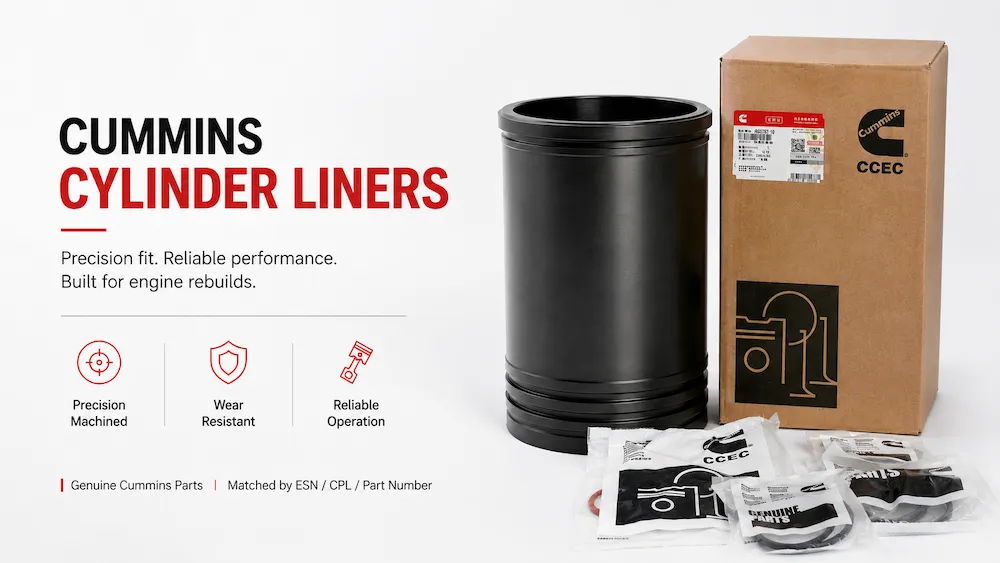
Pistons and Liners Work Together, but They Are Not Always Sold Together
The piston is connected to the connecting rod through the piston pin and moves inside the cylinder under combustion pressure. Piston rings are installed in the piston ring grooves and contribute to combustion sealing, oil control and heat transfer.
The cylinder liner, or the cylinder bore where no separate liner is used, provides the working surface for the piston and piston rings.
The piston, ring pack and liner therefore need to be checked as one cylinder system. Important matching points include:
- Nominal bore;
- Piston crown design;
- Compression height;
- Piston-pin and pin-bore dimensions;
- Number and design of ring grooves;
- Cylinder-liner running surface;
- Engine power and combustion configuration;
- Formal part numbers;
- Approved repair size.
However, “must be checked together” does not mean “must always be purchased in one kit.”
Some Cummins overhaul programs list pistons, piston rings and, where applicable, cylinder liners in the same overhaul scope. Other engines use a different parts structure. The actual content therefore depends on the engine platform and the specific kit.
Not Every Cummins Engine Uses Independently Replaceable Cylinder Liners
Depending on the engine design, the cylinder system may use:
- Independently replaceable wet liners;
- Independently replaceable dry liners;
- Other replaceable liner structures;
- A cylinder running surface formed directly in the engine block;
- A repair sleeve or restoration method allowed by the applicable service information.
It is therefore unsafe to assume that:
- Every Cummins engine has a separate cylinder liner;
- Every piston must be paired with a removable liner;
- Every worn cylinder can be restored simply by replacing a liner;
- Every overhaul kit contains cylinder liners.
Cummins overhaul information for some medium-duty engines uses the qualification “cylinder liners, if applicable,” which shows that separate liners are not a universal feature across all platforms.
Before requesting a quotation, verify the cylinder structure using the ESN, CPL, formal parts information and the actual engine configuration.
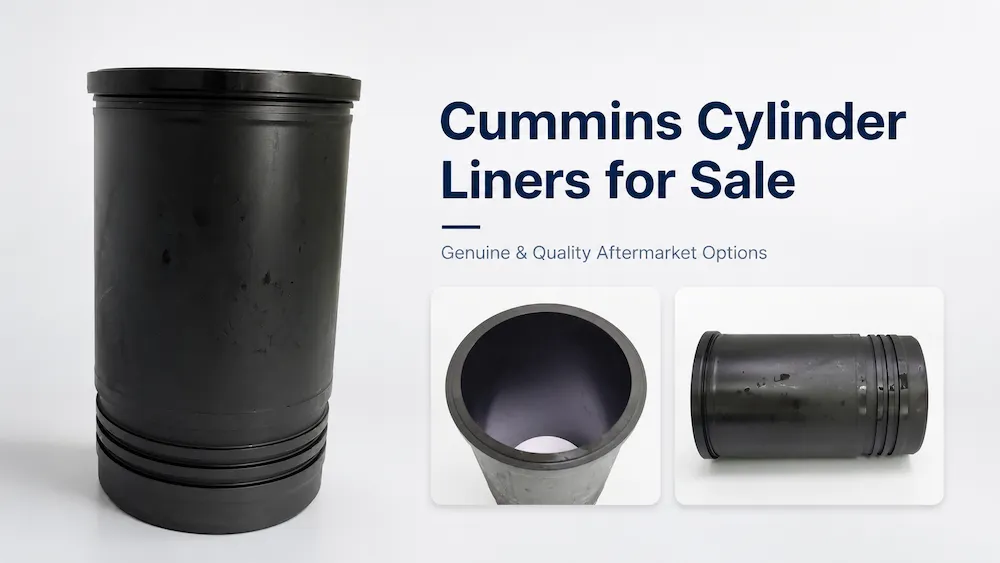
Wet and Dry Liners: Different Designs That Cannot Be Interchanged
Wet and dry liners are common types of independently replaceable cylinder liners in diesel engines. However, whether a particular Cummins engine uses a separate liner, which liner design it uses, and whether another locating or repair structure applies must be confirmed by ESN, CPL and formal parts data.
Wet Cylinder Liner
The outside surface of a wet liner is directly exposed to engine coolant. O-rings or other sealing structures separate the coolant from the crankcase and oil areas.
Important sourcing checks include:
- Inside diameter;
- Outside diameter;
- Overall length;
- Flange or support position;
- Number and location of seal grooves;
- O-ring configuration;
- Whether liner seals are included;
- Whether additional matching rings or components are required.
Dry Cylinder Liner
A dry liner is installed within the cylinder bore of the engine block. Its outer surface normally does not form part of the coolant boundary, and heat is transferred through the surrounding block material.
Important checks include:
- Inside diameter;
- Outside diameter;
- Overall length;
- Relationship with the block bore;
- Upper and lower locating design;
- Whether the liner is supplied as a finished part or requires approved final machining;
- Formal part number;
- Applicable repair procedure.
Wet and dry liners use different block structures, locating systems and sealing methods. They cannot be interchanged simply because the outside diameter or overall length appears similar.
There is no universal cylinder liner for all Cummins engines.
Standard Size and Repair Size Must Not Be Guessed
The dimensional relationship between the piston and the cylinder running surface is part of the engine design and repair specification.
Terms encountered during overhaul may include:
- Standard Size;
- Oversize Piston;
- Repair Size;
- Repair Sleeve;
- Machined Cylinder Bore;
- Previously installed non-original piston or liner size.
Not every Cummins engine permits the same machining process, and not every piston or liner part number is offered in the same repair sizes.
When a cylinder bore or liner is worn, the repair facility should use the applicable service information and actual measurements to determine whether to:
- Reuse the existing components;
- Perform an approved machining process;
- Replace the liner;
- Install an approved repair sleeve;
- Use another authorized repair method.
The decision may depend on:
- Engine design;
- Service limits;
- Actual bore or liner dimensions;
- Roundness and taper;
- Block-bore condition;
- Previous repair history;
- Condition of the old piston and liner.
An oversize piston or another repair-size component should only be used where the engine design and approved repair procedure allow it.
Purchasing personnel should not assume that an engine requires standard or oversize parts based only on the engine model. A supplier also cannot determine the correct repair size from one old-part photo.
The purchasing reference should be a repair size or measurement conclusion confirmed by a qualified workshop using the applicable service information, or a verified formal part number.
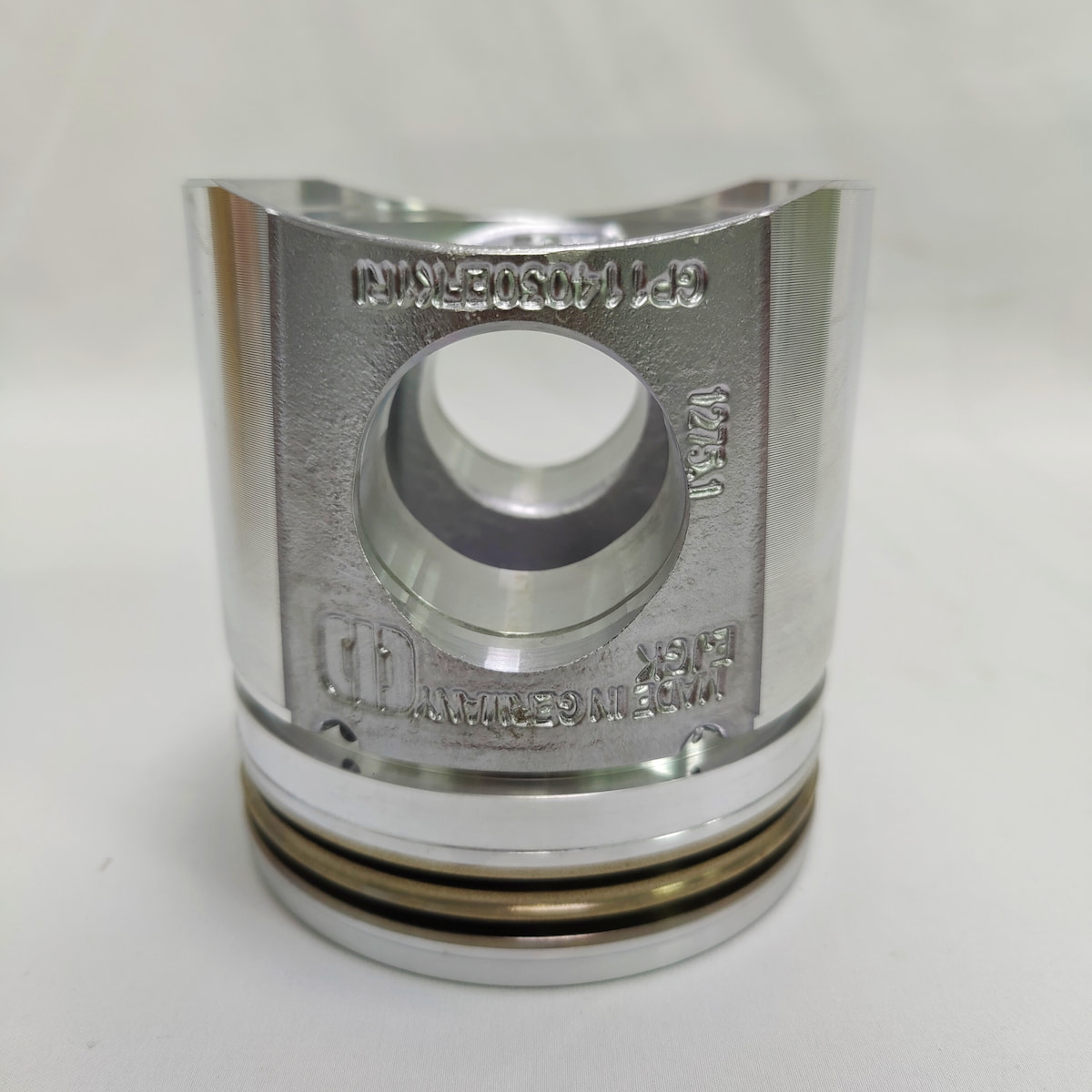
Piston Matching Requires More Than Bore Diameter
Two pistons with the same nominal diameter are not automatically interchangeable.
The following details also need to be checked.
Piston Crown Design
The combustion-bowl or crown shape must match the injector position, spray pattern, compression ratio and combustion system.
Different power ratings, emissions stages or CPLs within the same engine family may use different crown designs.
Compression Height
Compression height is generally related to the distance between the piston-pin centerline and a defined point on the piston crown.
A mismatch can change the piston position near top dead center, so it should not be estimated from appearance.
Piston Pin and Pin Bore
Confirm:
- Piston-pin diameter;
- Piston-pin length;
- Pin-bore structure;
- Whether the piston pin is included;
- Whether retaining clips are included;
- Compatibility with the connecting-rod small end.
Piston Ring Grooves
Confirm:
- Number of ring grooves;
- Width of each groove;
- Compression-ring and oil-ring positions;
- Ring cross-section;
- Matching piston-ring set;
- Whether the ring set is supplied for one cylinder or the complete engine.
Piston Material and Construction
Cummins engines may use different piston materials and structural designs. Even where the external dimensions look similar, the internal cooling structure, skirt design, surface treatment and material may differ.
A practical piston-matching framework is:
Piston Part Number + ESN/CPL + Piston Design + Repair Size
Cylinder-Liner Matching Requires More Than Inside Diameter and Length
A common sourcing mistake is to provide only the bore size or the overall liner length.
A complete check may also require:
- Inside diameter;
- Outside diameter;
- Overall length;
- Flange diameter;
- Flange thickness;
- Upper and lower locating structure;
- Mid-support position, where applicable;
- Number and location of seal grooves;
- O-ring specification;
- Running-surface condition;
- Additional matching rings or components;
- Matching piston and ring version;
- Formal part number.
Even if two liners can physically be inserted into the same block, this does not prove that the flange, support position, sealing arrangement and running surface meet the original engine requirements.
For some ISX and QSX overhaul applications, Cummins requires piston and cylinder-liner compatibility to be checked before an overhaul kit is selected. This demonstrates why an engine-family name alone cannot replace the correct part number and CPL.
Kit BOM, Upgrade Relationship and Quoted Quantity Must Be Checked Together
This is one of the most common areas of misunderstanding in piston and liner sourcing.
A product name is not a bill of materials. An upgrade is not the same as an ordinary replacement. A kit does not necessarily represent a complete engine quantity.
Kit Names Do Not Replace a Formal BOM
Suppliers may use similar kit names for different product scopes.
| Quotation term | Common supply scope | What must be confirmed |
|---|---|---|
| Bare Piston | Piston only | Whether piston pin, clips or other accessories are included |
| Piston Kit | Piston plus selected matching parts | Whether piston rings, pin and retaining clips are included |
| Piston Ring Set | Ring set for one cylinder or complete engine | Cylinder quantity, piston version and groove design |
| Cylinder Liner | Liner only | Whether O-rings or other seals are included |
| Liner Kit | Liner plus selected seals | O-ring quantity, material and installation position |
| Cylinder Kit | May include piston, rings, pin, liner and seals | Confirm the formal BOM |
| Overhaul Kit | Multi-system engine overhaul package | Actual coverage of pistons, liners, bearings and gaskets |
Cummins overhaul programs do not all use the same kit structure. Some list pistons, rings and liners separately, some heavy-duty programs use complete cylinder kits, and some upgrade packages include the piston, pin, ring pack, liner and seals as one compatibility group.
Before accepting a quotation, request:
- Formal kit part number;
- Included-parts list or BOM;
- Quotation unit: one piece, one cylinder or complete engine;
- Whether piston rings are included;
- Whether piston pin and retaining clips are included;
- Whether liner seals are included;
- Number of kits required per engine;
- Any accessories that must be ordered separately.
Formal Supersessions and Upgrade Packages Must Be Verified as a Complete System
Some new piston or liner numbers are direct supersessions. Others belong to a system-level upgrade package.
For an upgrade, confirm:
- Whether it is a single-part or multi-part upgrade;
- Whether the piston rings must also be changed;
- Whether a specific liner must be used;
- Whether a new piston pin is required;
- Whether connecting rods or connecting-rod bearings are involved;
- Whether old and new versions may be mixed in one engine;
- Whether all cylinders must be upgraded together.
Some Cummins ISX and QSX upgrade packages combine a specified piston, pin, ring pack, liner, liner seals and other internal components. In these cases, the upgrade is a compatibility package rather than a single replacement part.
Without a formal supersession or technical document, old and new versions should not be combined based only on appearance or dimensional similarity.
The Quotation Must State One Piece, One Cylinder or Complete Engine
“Piston Kit” and “Cylinder Kit” do not automatically mean a complete engine quantity.
A quotation may cover:
- One piston;
- One single-cylinder piston kit;
- One single-cylinder kit;
- One ring set;
- A four-cylinder engine set;
- A six-cylinder engine set;
- An eight-cylinder or larger engine set.
Before ordering, confirm:
- Whether the quotation is per piece, per cylinder or per engine;
- Number of pistons in each kit;
- Number of liners in each kit;
- Whether the ring set is for one cylinder or the whole engine;
- Quantity of piston pins and retaining clips;
- Number of liners covered by the seal set;
- Whether spare quantities are required.
Cummins heavy-duty overhaul programs may list six pistons and six liners individually in one package, while another program may list six complete cylinder kits. The kit name and quantity must therefore be interpreted through the BOM.
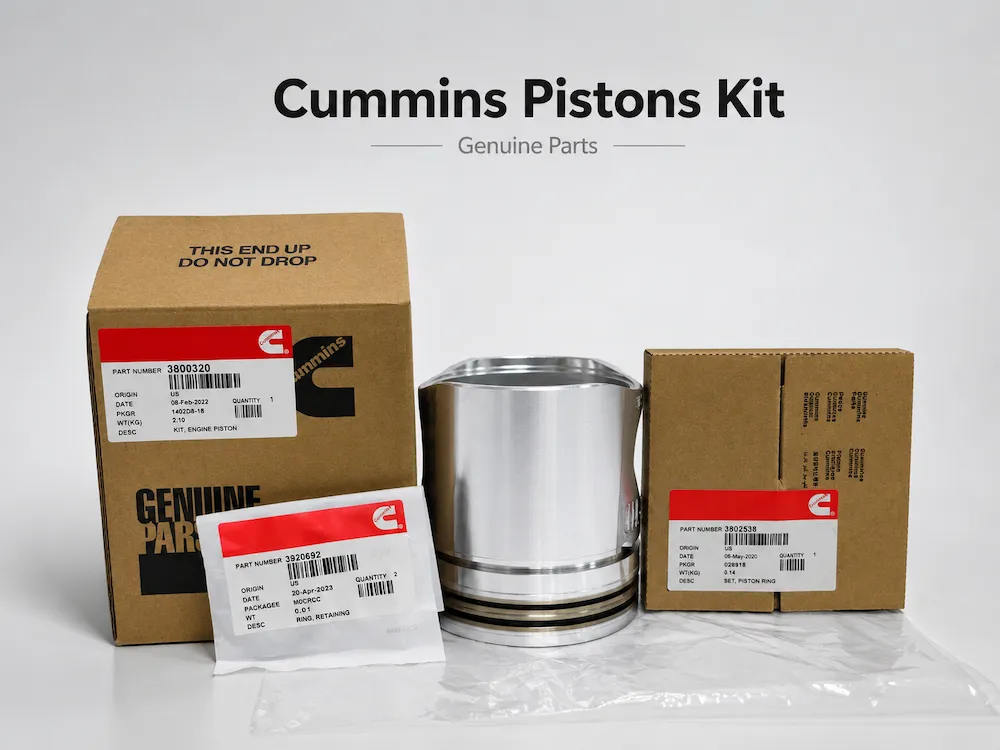
Part Number, ESN and CPL Come Before the Engine-Family Name
Descriptions such as “QSB6.7 piston,” “6CT liner” or “K19 cylinder kit” are normally not enough for final confirmation.
One engine family may cover different:
- CPLs;
- Power ratings;
- Emissions stages;
- Production periods;
- Applications;
- Combustion systems;
- Piston-crown designs;
- Piston materials;
- Liner structures;
- Piston-pin and connecting-rod configurations;
- Formal upgrade packages.
For some Cummins medium-duty overhaul-kit references, the latest piston part number is used first to identify the applicable kit, and CPL is used where the piston number is unavailable. Cummins overhaul-kit lookup tools also use the ESN to identify the CPL and available kit.
That lookup sequence applies to the relevant Cummins overhaul-kit information. It should not be treated as the only possible sequence for every piston or liner purchase. When a cylinder liner is sourced separately, the old liner number, ESN/CPL, actual dismantled configuration and repair condition remain important.
A practical matching framework is:
Piston Part Number + Liner Part Number + ESN/CPL + Cylinder Structure + Repair Size + Kit Contents + Quantity
If the engine has previously been overhauled, bored, sleeved or upgraded, the currently installed parts may differ from the original factory configuration.
In that case, also provide:
- Current old-part numbers;
- Casting or identification marks;
- Repair records;
- Workshop measurement results;
- Dismantled-part photos.
Cavitation, Scoring and High Oil Consumption Are Not Always Caused by Part Quality Alone
The piston, piston rings or cylinder liner may require inspection when the engine shows:
- Increased oil consumption;
- Excessive blow-by;
- Low compression;
- Cylinder-wall scoring;
- Liner cavitation;
- Piston-crown or skirt damage;
- Worn or stuck piston rings.
However, these conditions may also involve:
- Coolant condition;
- Cooling-system maintenance;
- Oil specification and condition;
- Intake contamination;
- Abnormal combustion;
- Fuel-injection problems;
- Assembly clearances;
- Engine-block condition;
- Long-term operating conditions.
Replacing the piston or liner alone may not correct the root cause.
The diagnosis and measurements should be completed by a qualified repair facility using the applicable engine service information.
This article does not provide:
- Cylinder-bore measurement procedures;
- Liner-protrusion specifications;
- Piston-to-liner clearance;
- Piston-ring end-gap specifications;
- Block-machining dimensions;
- Honing procedures;
- Installation orientation;
- Tightening torque;
- Remote decisions on whether old parts can be reused.
Genuine and Quality Alternative Parts
Similar appearance does not prove that pistons, piston rings, piston pins and cylinder liners use the same materials, dimensions or machining controls.
These components operate under high temperature, high pressure and continuous reciprocating friction. Material control, dimensional tolerance and manufacturing consistency can influence service life more than external appearance suggests.
When evaluating a quality alternative, confirm the following.
Piston and Matching Components
- Piston-crown design;
- Piston material;
- Weight consistency;
- Ring-groove dimensions;
- Piston-pin bore;
- Surface treatment;
- Piston-pin and retaining-clip configuration;
- Batch consistency.
Liner and Sealing Components
- Inside and outside diameters;
- Length;
- Flange and support positions;
- Seal grooves;
- Running-surface condition;
- Material and hardness control;
- O-ring material and quantity;
- Rust and impact protection;
- Batch consistency.
For a quality alternative, request:
- Clear cross-reference;
- Applicable ESN, CPL or engine configuration;
- Formal kit BOM;
- Dimensional and material-control information;
- Production batch;
- Inspection records;
- Warranty terms;
- Claim procedure.
Bulk Buyers Should Confirm Kit Completeness and Packaging
Distributors, repair channels and inventory buyers should also confirm:
- Manufacturer and brand;
- Formal part number;
- Kit number;
- Piece, cylinder or complete-engine packaging;
- Whether piston rings are packed by cylinder;
- Whether each piston is grouped with its matching pin;
- Complete quantity of retaining clips;
- Clear identification of O-rings used in different positions;
- Rust protection for liner running surfaces;
- Impact protection for piston crowns and skirts;
- Quantity per carton;
- Production batch and date code;
- Outer-carton label;
- Warranty and claim process.
For complete-engine kits, also verify:
- Piston part-number and version consistency;
- Piston weight consistency;
- Complete ring sets;
- Liner dimensional and version consistency;
- Complete seal quantity;
- Agreement between packaging labels and the BOM.
A missing piston pin, ring set or liner-seal set can stop an overhaul project. The included-parts list should therefore be confirmed before payment and shipment.
Information to Provide Before Ordering
Engine Information
- Cummins engine model;
- ESN;
- CPL;
- Equipment manufacturer and complete model;
- Rated power and speed, where necessary;
- Engine-nameplate photo.
Existing Parts and Part Numbers
- Piston part number;
- Cylinder-liner part number;
- Piston-ring part number;
- Piston-pin part number;
- Cylinder-kit or overhaul-kit number, where available;
- Photos of the old piston crown, side, ring grooves and pin bore;
- Photos of the old liner, flange, support area and seal grooves.
Repair Condition
- Single-cylinder repair or complete-engine overhaul;
- Whether the engine has already been dismantled;
- Standard or approved repair size confirmed by the repair facility using the applicable service information;
- Related measurement results;
- Whether the block has previously been machined or repaired;
- Whether upgraded or non-original parts are currently installed;
- Whether a formal supersession or upgrade package is acceptable.
Required Kit Scope
- Bare Piston;
- Piston Kit;
- Piston Ring Set;
- Cylinder Liner;
- Liner Kit;
- Cylinder Kit;
- In-Frame Kit;
- Complete Overhaul Kit;
- Quantity required per engine.
Commercial Requirements
- New genuine or quality alternative preference;
- Total order quantity;
- Destination;
- Required lead time;
- Packaging and labeling requirements;
- Batch, inspection or traceability documentation requirements.
How ZEB Power Supports Cummins Piston and Cylinder-Liner Sourcing
Using the engine ESN, CPL, old part numbers, workshop repair-size conclusion and required kit scope, we can assist with verifying:
- Piston and liner configuration;
- Kit BOM;
- Formal supersession or upgrade relationship;
- Single-cylinder and complete-engine quantities;
- Genuine and verified quality alternative supply options;
- Packaging and quotation scope.
Available options depend on the formal part number, actual engine configuration and current supply channel.
Cylinder-bore measurement, machining decisions, repair-size selection and old-part reuse decisions should be completed by a qualified local repair facility.
Frequently Asked Questions
Must Pistons and Cylinder Liners Be Purchased Together?
Not always.
They need to be checked as one cylinder system, but they may use separate part numbers and be purchased separately. Whether both should be replaced depends on the engine design, repair scope and inspection results.
Do All Cummins Engines Have Replaceable Cylinder Liners?
No.
Some engines use independently replaceable liners, while others use a different cylinder structure. Confirm the design using the ESN, CPL and formal parts information.
Can Wet and Dry Liners Be Interchanged?
No.
They use different block structures, locating methods and sealing systems. Outside diameter or overall length alone cannot establish interchangeability.
Can Pistons with the Same Bore Diameter Be Interchanged?
Not by default.
Piston-crown design, compression height, pin bore, ring grooves, material, power rating and combustion-system configuration must also be checked.
Does a Piston Kit Always Include Rings, Pin and Cylinder Liner?
No.
The supply scope depends on the formal kit part number. Confirm the BOM rather than relying on the kit name.
How Should Standard and Oversize Pistons Be Selected?
A qualified repair facility should determine the size using the engine design, actual measurements and applicable service information.
Not every engine permits oversize pistons, and not every part number is offered in a repair size.
Can I Request a Quotation Without the Old Part Number?
An initial check may still be possible.
Provide the ESN, CPL, old-part photos, workshop repair-size conclusion, engine repair history and required kit scope. Engines that have already been modified or overhauled may require additional measurement information.
Can an Upgraded Piston Be Used with the Old Cylinder Liner?
Not by default.
Some upgrade programs require the piston, rings, liner and other internal parts to be used as a specified combination. Confirm the formal supersession and technical information before mixing versions.
Conclusion
Cummins pistons and cylinder liners should not be selected by engine-family name, bore size or kit title alone.
The correct matching process should confirm:
Part Numbers + ESN/CPL + Cylinder Structure + Repair Size + Kit BOM + Quantity
When contacting ZEB Power, provide the engine ESN, CPL, old piston and liner part numbers or photos, workshop repair-size conclusion, required kit scope and quantity per engine.
We can assist with verifying the applicable configuration and quotation scope.