

Cummins Oil Filter: Full-Flow vs Bypass, Spin-On vs Cartridge

2189
Table of Contents
Generating table of contents
Cummins oil filters are often ordered incorrectly for one of four reasons:
- The wrong filtration function is selected, such as confusing a full-flow filter with a bypass filter.
- A spin-on filter is mistaken for a cartridge element, or vice versa.
- The thread or sealing-gasket dimensions do not match the existing filter head.
- The engine family appears correct, but the actual equipment uses a different filter-head arrangement or a different number of filters.
This guide explains how to avoid those mistakes and verify the correct Cummins engine oil filter before placing an order.
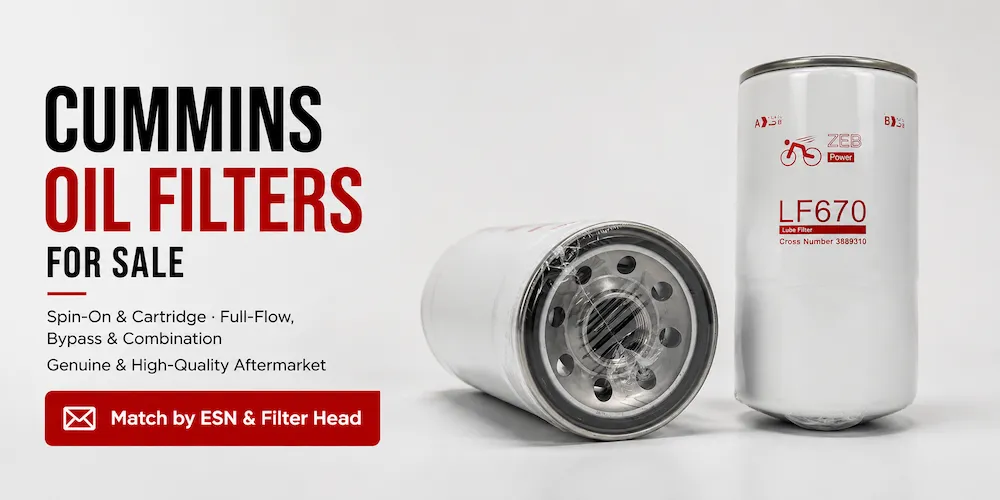
Filtration Function and Filter Construction Are Two Different Things
Oil filters are commonly described in two separate ways, and these classifications should not be mixed together.
By Filtration Function
Full-Flow Filter
A full-flow filter handles the main lubricating-oil flow. Under normal operating conditions, the main oil flow passes through the filter media before entering the engine oil galleries.
A full-flow filter must therefore provide suitable filtration efficiency without creating more restriction than the lubrication system was designed to accept.
Bypass Filter
A bypass filter diverts a smaller portion of the lubricating oil for finer filtration before returning it to the system.
A bypass filter performs a different job from a full-flow filter and should not be treated as a direct substitute for one.
Combination Filter
A combination filter integrates full-flow and bypass filtration paths inside one filter assembly.
A combination filter cannot normally be replaced with an ordinary full-flow filter simply because the thread and external dimensions appear similar.
By Construction
Spin-On Filter
A spin-on filter combines the shell, filter media and internal components into one replaceable unit. It threads directly onto the filter head, and the complete assembly is replaced during service.
Cartridge / Element Filter
A cartridge filter uses a reusable housing and cap. Only the internal filter element and applicable seals are replaced.
These two classifications can overlap. For example, a spin-on filter may also use a combination full-flow and bypass design.
When an inquiry only says “Cummins oil filter,” the supplier may not know:
- Which filtration function is required;
- Whether the design is spin-on or cartridge;
- How many filters are installed per engine;
- Whether each mounting position uses the same part number.
Many engines use more than one oil filter. The required quantity varies by engine platform and filter-system configuration, so buyers should not assume that one engine always uses one filter.
Bypass Filter, Pressure Valve and Anti-Drainback Valve Are Three Different Concepts
These three terms are often confused during sourcing.
Bypass Filter
A bypass filter is a filtration route. It diverts part of the oil flow for finer filtration.
Bypass / Pressure Valve
A bypass valve, also described in some catalogs as a pressure valve, is a pressure-control component.
When the pressure differential across the filter media reaches the designed opening point, the valve may allow oil to bypass the media and continue into the downstream oil circuit. This helps prevent the lubrication supply from being interrupted by excessive filter restriction.
The valve may be located:
- Inside the filter;
- Inside the filter head;
- Inside an engine lubrication module;
- Elsewhere in the original system design.
The oil usually bypasses the filter media, not necessarily the entire filter assembly.
Anti-Drainback Valve
An anti-drainback valve has a different purpose. It helps reduce oil draining out of the filter or related oil passages after the engine is shut down, which may support faster oil-pressure buildup at the next start.
Its function relates mainly to oil draining back during shutdown, while a pressure valve responds to pressure differential during operation.
These are not the same components, and not every oil filter contains both valves.
A filter can contain a pressure valve without being a bypass filter. Likewise, the engine may use an anti-drainback function located in the filter head or another system component rather than inside the filter itself.
When verifying a replacement filter, confirm:
- Whether the original filter contains a pressure valve;
- Whether an anti-drainback valve is required;
- Where each valve is located;
- Whether the replacement follows the same system configuration.
The word “bypass” alone is not enough to identify the correct product.
Matching a Spin-On Filter
For a spin-on oil filter, the main physical checks include:
- Thread diameter;
- Thread pitch;
- Applicable thread form or specification;
- Gasket outside diameter;
- Gasket inside diameter;
- Gasket seating position;
- Overall filter length;
- Maximum outside diameter;
- Available installation clearance.
Two filters may have a similar height and shell diameter but still be incompatible.
An incorrect thread may prevent installation or provide incomplete engagement. An incorrect gasket may fail to seat properly and cause oil leakage.
Some mismatches are obvious immediately. Others may only appear as seepage after the engine has operated for a period of time.
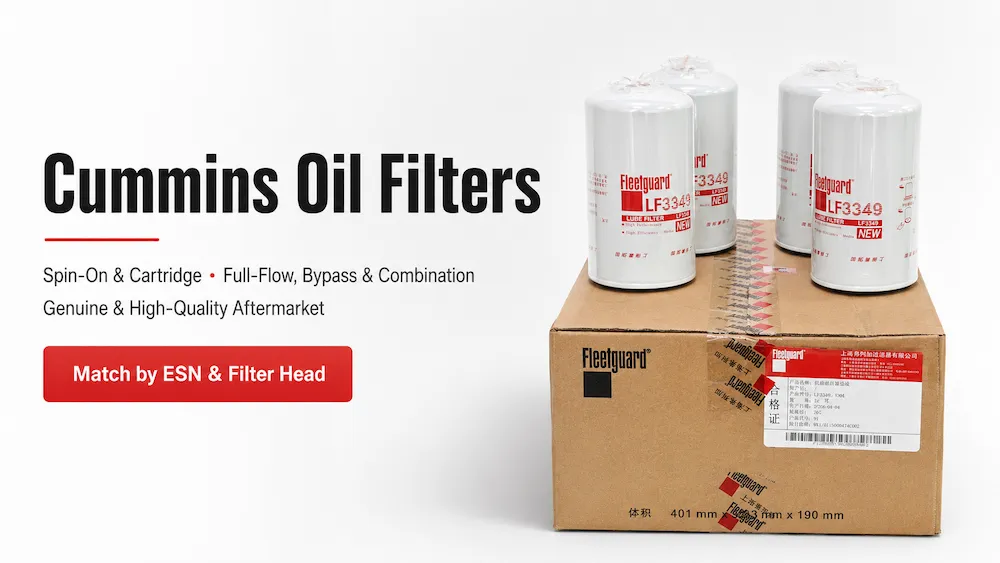
Matching a Cartridge / Element Filter
A cartridge filter should be verified by more than its outside diameter.
Important checks include:
- Element outside diameter;
- Overall element height;
- Center-hole design;
- Upper and lower end structure;
- Seal or O-ring positions;
- Seal dimensions;
- Internal locating-post fit;
- Housing and cap design;
- Whether replacement seals are included.
Two cartridge elements that appear similar may use different end seals, center tubes or positioning features.
Photos of the old element, seals, housing and cap are useful when the formal part number cannot be read clearly.
Part Number Comes Before Dimensional Matching
When the old filter has a readable Cummins, Fleetguard or equipment-OEM part number, sourcing should begin with that number.
Dimensions and photos should be used to verify the application, not to replace a formal cross-reference.
Several different relationships may appear in filter catalogs.
Replaces / Supersedes
A catalog may show that a newer part number replaces or supersedes an older one.
Even then, buyers should confirm:
- That the relationship applies to the current engine and market;
- Whether the gasket arrangement changed;
- Whether any application restrictions are listed;
- Whether the old and new numbers can be mixed in stock;
- Whether the filter-head configuration remains the same.
Upgrade Version
An upgrade may use different media, construction or performance features.
An upgrade recommendation does not necessarily mean that every application must be converted, and it should not automatically be interpreted as a reverse interchange.
Filter Used With
“Filter Used With” does not mean that two filters replace one another.
It may indicate that both filters are required in the same lubrication system—for example, one full-flow filter and one bypass filter installed together.
This relationship is especially important for wholesalers and traders managing multi-SKU stock.
Supplier-Created Cross-Reference Lists
Supplier-created interchange tables can be useful for an initial search, but their source and verification method should be clear.
The most reliable matching process combines:
Formal Part Number + Engine ESN/CPL + Filter-Head Configuration + Installed Quantity + Reference Photos
A Micron Rating Does Not Tell the Whole Story
Buyers often ask:
How many microns does this filter remove?
The question is useful, but one micron number does not fully describe filter performance.
A statement such as “10-micron filtration” may refer to very different:
- Particle-capture efficiencies;
- Test methods;
- Flow conditions;
- Pressure-differential conditions;
- Dirt-holding capacities;
- Media technologies.
For meaningful comparison, ask for:
- Particle size;
- Efficiency at that particle size;
- Test standard;
- Rated flow;
- Filter-media type;
- Dirt-holding capacity, where available;
- Pressure-valve configuration;
- Relevant structural-performance data.
A micron value without its associated efficiency and test conditions can be misleading.
Why the Equipment OEM and Filter Head Must Also Be Verified
The same Cummins engine family may be installed in equipment from different manufacturers.
Depending on the application, the actual machine may use:
- A specific filter head;
- A remote-mounted oil-filter system;
- A lubrication module;
- An equipment-OEM mounting arrangement;
- A different number of filters.
This means an oil filter described as “suitable for the engine” may still fail to match the filter head actually installed on the machine.
When requesting a quotation, provide:
- Equipment manufacturer;
- Complete equipment model;
- Machine serial number, where available;
- Filter-head photos;
- Old filter photos;
- Number of filters installed per engine.
The engine model alone may not be enough.
Abnormal Oil Pressure After Filter Replacement Does Not Automatically Mean the New Filter Is Defective
After an oil-filter replacement, symptoms such as slow pressure buildup, an oil-pressure warning or leakage should not automatically be blamed on filter quality.
Possible causes include:
- Incorrect filter part number;
- Incorrect gasket dimensions;
- Incorrect gasket seating;
- The old gasket remaining on the filter head and creating a double-gasket condition;
- Incomplete thread engagement;
- Incorrect oil specification or viscosity;
- Incorrect oil level;
- Oil-pump problems;
- Oil-cooler problems;
- Restricted oil passages;
- Internal engine wear or clearance problems.
The double-gasket condition is particularly easy to overlook. If the old sealing gasket remains on the filter head and the new filter is installed over it, the seal may fail.
The actual cause should be checked by qualified service personnel using the appropriate engine service information.
This article does not provide installation procedures, tightening torque values or lubrication-system diagnostic instructions.
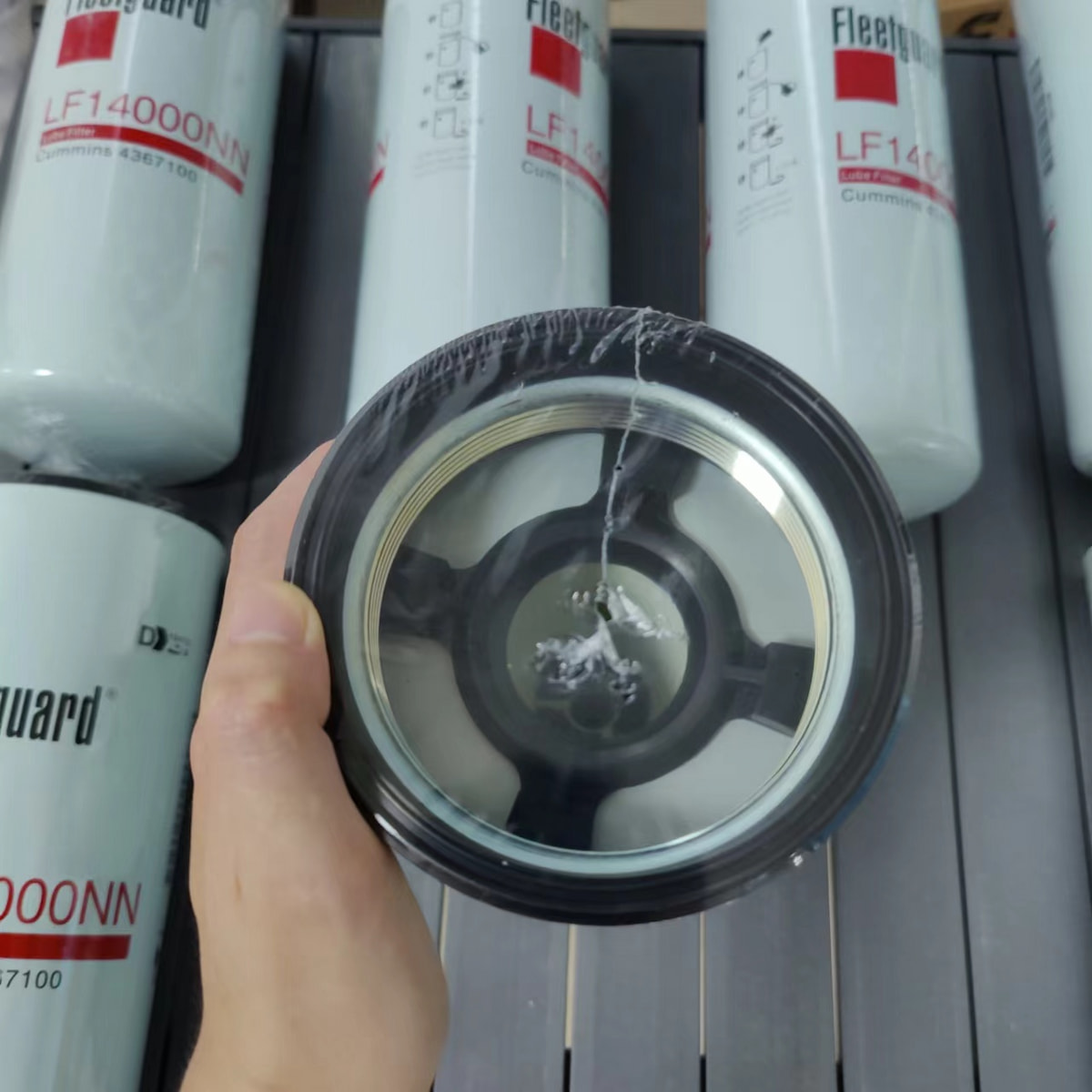
Genuine and High-Quality Aftermarket Filters
Oil-filter performance and service life depend on more than external appearance.
Important internal factors include:
- Filter-media quality;
- Seal quality;
- Valve consistency;
- Internal support structure;
- Shell and seam quality;
- Manufacturing consistency.
When selecting an aftermarket filter, confirm:
- Formal cross-reference;
- Full-flow, bypass or combination function;
- Spin-on or cartridge construction;
- Thread and sealing dimensions;
- Pressure-valve configuration;
- Anti-drainback-valve configuration;
- Application data;
- Batch traceability;
- Warranty.
Avoid relying only on broad claims such as “fits Cummins engines.”
For mining equipment, continuously operated generator sets and other high-downtime-cost applications, the difference between filter prices is usually much smaller than the cost of lubrication damage or equipment downtime.
Price should therefore not be the only purchasing criterion.
Bulk Buyers Should Verify Labeling, Packaging and Traceability
For distributors, repair channels and stock buyers, consistency across multiple batches is as important as the price of one filter.
Confirm:
- Manufacturer and brand;
- Formal part number;
- Production batch or date code;
- Individual packaging;
- Outer-carton labeling;
- Quantity per carton;
- Moisture and dust protection;
- Transport protection;
- Batch inspection records;
- Warranty terms;
- Claim process;
- Thread consistency;
- Gasket consistency;
- Shell and seam consistency;
- Internal valve consistency.
Poor batch consistency can result in differences in gasket dimensions, shell construction or internal valve configuration.
The risk created by one inconsistent batch may be significantly greater than the difference in unit price.
Information to Provide Before Ordering
Engine Information
- Cummins engine model;
- ESN;
- CPL, when available;
- Engine-nameplate photo.
Equipment Information
- Equipment manufacturer;
- Complete equipment model;
- Machine serial number, when available;
- Application type.
Existing Filter-System Information
- Full-flow, bypass or combination design, if known;
- Spin-on or cartridge design;
- Number of filters installed per engine;
- Installation position of each filter;
- Whether all positions use the same part number;
- Filter-head photos;
- Remote-filter arrangement, if present.
Existing Filter Information
- Cummins part number;
- Fleetguard part number;
- Equipment-OEM part number;
- Full filter photo;
- Thread-end or sealing-face photo;
- Cartridge end-structure photo;
- Housing and cap photos, where applicable.
Commercial Requirements
- Genuine or aftermarket preference;
- Quantity per engine;
- Total order quantity;
- Destination;
- Required lead time;
- Packaging and labeling requirements;
- Traceability or inspection-document requirements.
How ZEB Power Supports Cummins Oil-Filter Sourcing
ZEB Power supplies Cummins engine oil filters and related filter elements for:
- Construction machinery;
- Mining equipment;
- Generator sets;
- Industrial equipment;
- Repair and overhaul projects;
- Wholesale and inventory orders.
Using the engine ESN, equipment model, existing filter number and filter-head information, we can assist with verifying:
- Filtration function;
- Spin-on or cartridge design;
- Thread and sealing dimensions;
- Filter-head compatibility;
- Required quantity per engine;
- Part-number supersession;
- Genuine and aftermarket supply options;
- Quotation scope.
Available options depend on the formal part number and current supply channel.
Frequently Asked Questions
Can a Full-Flow Filter and Bypass Filter Be Interchanged?
Not by default.
They perform different filtration tasks and handle different oil-flow conditions. A replacement should only be used when a verified technical or catalog interchange exists.
Is a Bypass Filter the Same as a Filter with a Bypass Valve?
No.
A bypass filter is a filtration route. A bypass or pressure valve is a pressure-control component. The two terms describe different functions.
How Many Oil Filters Does One Cummins Engine Use?
There is no universal quantity.
Depending on the engine and lubrication-system configuration, one engine may use one, two or several filters. Confirm the ESN, CPL, filter-head layout and installed quantity.
Does the Same Thread Mean Two Filters Are Interchangeable?
No.
The filtration function, gasket dimensions, valve configuration, rated flow and formal application must also be verified.
Can I Request a Quotation Without the Old Filter Part Number?
Yes, an initial search may still be possible.
Provide:
- Engine ESN;
- CPL;
- Equipment model;
- Filter-head photos;
- Old filter dimensions;
- Installed quantity;
- Installation-position photos.
Some equipment-OEM configurations may also require the filter-head number or machine serial number.
Does Low Oil Pressure Mean the Filter Is Blocked?
Not necessarily.
Low oil pressure may also involve oil specification, oil level, the oil pump, oil cooler, oil passages or internal engine condition. The cause should be confirmed by qualified service personnel.
Conclusion
A Cummins oil filter should not be selected only by engine family, shell size or thread.
The correct matching process should confirm:
Filtration Function + Construction Type + Part Number + Filter-Head Configuration + Thread and Seal + Valve Configuration + Installed Quantity
When contacting ZEB Power, provide the engine ESN, equipment model, old filter number or photos, and the number of filters used per engine.
We can assist with verifying the applicable part number, filter design, system fitment and quotation scope.