

Cummins Engine Oil Cooler: Core vs Assembly vs Housing

4473
Table of Contents
Generating table of contents
A Cummins engine oil cooler is an important part of the lubrication system. As with many other engine components, one of the most common sourcing problems is that suppliers may quote different product scopes under similar names.
One supplier may quote a separate Oil Cooler Core. Another may quote an Oil Cooler Assembly containing the core and housing. A third quotation may cover only the Oil Cooler Housing, Cover, Filter Head, Repair Kit, or individual seals. The names may appear similar, but the supplied products and prices are not directly comparable until the exact scope has been confirmed.
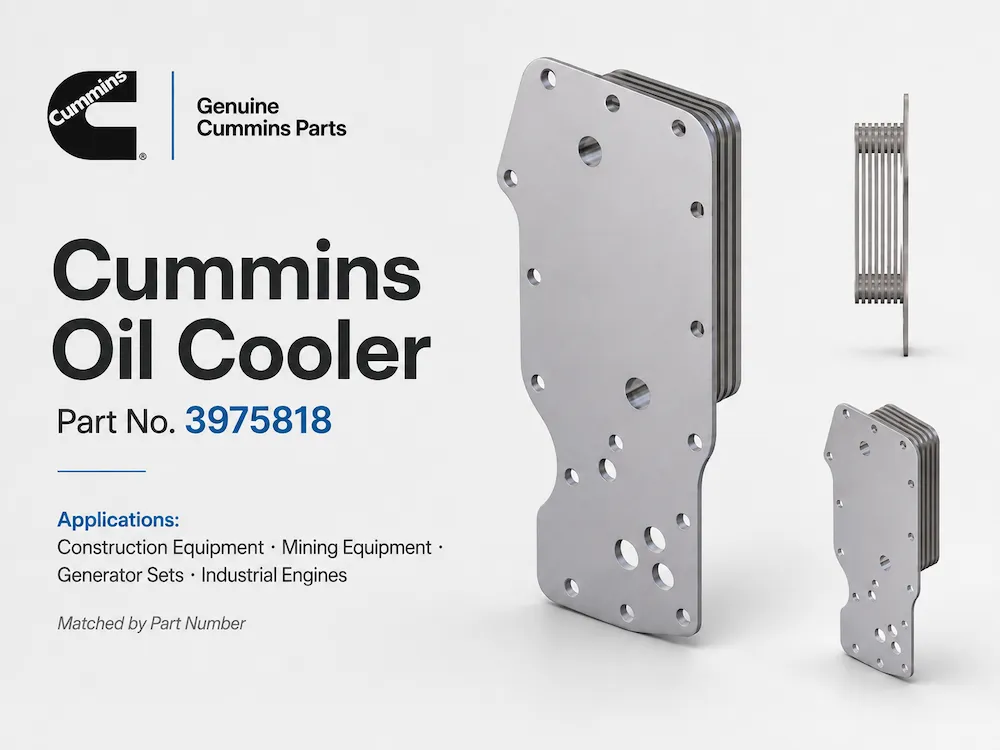
An engine oil cooler also connects the lubrication and cooling systems. Its internal passages, sealing arrangement, and interface configuration are part of the original engine design. Two units may look similar and appear to have matching connections while using different internal flow paths, seal specifications, or pressure capabilities.
An incorrect replacement may cause:
- External oil or coolant leakage
- Internal oil-to-coolant or coolant-to-oil leakage
- Seal failure
- Inadequate oil cooling
- Incorrect fitment
- Lubrication or cooling-system operation outside the intended design
This article explains:
- What Oil Cooler Core, Oil Cooler Assembly, Housing, and Repair Kit normally mean
- How an engine oil cooler differs from an Aftercooler and other cooling components
- What the oil cooler does within the lubrication system
- Why a cooler core cannot be matched by appearance alone
- Why seal material, location, and part number matter
- Why milky oil or discoloured coolant does not automatically prove oil-cooler failure
- Why high oil temperature does not always mean that the Oil Cooler is defective
- The difference between an Oil Cooler and a temperature sensor
- Which oil and coolant passages and external interfaces must be checked
- Why the engine model alone is insufficient for final matching
- How purchasing priorities change across mining, construction, generator-set, and industrial applications
- What information to provide before ordering
- How to compare supplier quotations
Milky engine oil, discoloured coolant, an abnormal oil level, or poor temperature control does not prove by itself that the engine oil cooler has failed. The actual cause should be confirmed by a qualified local workshop.
This article focuses on matching the correct replacement after an oil cooler or related component has been confirmed as the required part. It does not provide internal-leak testing, installation, sealing, flushing, or repair procedures.
Who This Article Is For
- Repair shops and fleet maintenance buyers whose technicians have confirmed that an engine oil cooler requires replacement and who need to verify fitment and quotation scope before ordering
- Parts dealers and distributors building or expanding Cummins oil-cooler inventory
- Engine remanufacturers sourcing Oil Cooler Assemblies, cores, housings, covers, seals, and other confirmed replacement components
- Mining and construction equipment purchasing teams supporting Cummins-powered haul trucks, excavators, loaders, drill rigs, dozers, cranes, and other equipment
- Generator-set and industrial power maintenance teams supporting standby, prime-power, continuous-power, compressor, pump, crusher, drilling, and other stationary-engine applications
Oil Cooler Core, Oil Cooler Assembly, Housing and Repair Kit: What Do They Mean?
The first step is to confirm exactly what the supplier is quoting.
| Product term | Common meaning | What to confirm before ordering |
|---|---|---|
| Oil Cooler | General name for an engine oil-cooling component; the exact scope depends on the part number and quotation | Whether the quotation covers a Core, Assembly, or Housing |
| Oil Cooler Core / Element | Heat-exchanger core through which oil and coolant flow in separate passages | Whether it is a bare core and whether any housing or seals are included |
| Oil Cooler Assembly | Assembled oil-cooler component that may contain the core, housing, cover, or other related parts, depending on the part number and BOM | Whether the Cover, Filter Head, valves, gaskets, O-rings, and installation parts are included |
| Oil Cooler Housing | Housing that contains the core and may form part of the oil or coolant passages; it may be supplied as an empty housing | Whether it includes the Core, Cover, valves, Filter Head, or other internal components |
| Oil Cooler Cover | Cover or plate used to retain or enclose the Oil Cooler Core | Mounting face, hole pattern, passages, orientation, and sealing arrangement |
| Lubricating Oil Filter Head | Component that mounts the oil filter and directs lubricating-oil flow; it may be integrated with the Oil Cooler on some engines | Whether it is integrated with the cooler and whether bypass valves or other components are included |
| Oil Cooler Repair Kit | Service-parts package for a specific oil-cooler configuration | Exact BOM, applicable part number, and whether it contains only seals or additional components |
| Seal Kit / O-ring Kit | Set of seals used at specific locations around the Core, Housing, Cover, Filter Head, or engine mounting face | Formal kit number, material specification, quantity, installation positions, and applicable part numbers |
| Oil Cooler Bypass Valve / Related Lubrication Valve | Cooler-bypass or related lubrication-control valve used in applicable configurations | Formal component name, function, installation location, and whether it belongs to the Housing, Filter Head, or a separate lubrication module |
Housing, Cover, and Filter Head may connect to one another or be integrated into a single module on some engines, but they are not fixed synonyms. They should not all be described simply as an “oil cooler base.” The formal component name and part number should be confirmed separately.
An Oil Cooler Housing and an Oil Cooler Assembly are also not the same product. A Housing may be an empty casting. An Assembly may contain the Core and Housing, the Core and Cover, or a more integrated module including a Filter Head or additional oil passages.
The same engine family may use several oil-cooler, housing, and kit configurations. Final selection should be based on the engine ESN, current part number, and confirmed supersession rather than a description such as “fits this engine series.”
A useful quotation question is:
Is this quotation for a separate Oil Cooler Core, a complete Oil Cooler Assembly, an Oil Cooler Housing, or a Repair Kit? Please confirm whether the Cover, Filter Head, related valves, gaskets, O-rings, and installation parts are included.
What Does an Engine Oil Cooler Do?
An engine oil cooler transfers heat from the lubricating oil to engine coolant or another cooling medium. This helps prevent extended high-temperature operation from accelerating oil oxidation, reducing viscosity, or weakening lubrication performance.
A common design uses separate oil and coolant passages divided by metal plates, fins, or tubes. The exact flow direction, passage arrangement, and construction depend on the engine platform.
Its main functions include:
- Helping control engine-oil temperature
- Supporting oil viscosity within the intended operating range
- Working with the oil pump, filters, galleries, and cooling system to maintain lubrication performance
- Reducing the thermal load placed on the lubricating oil during sustained operation
Some engine lubrication systems also use an oil-cooler bypass, oil-filter bypass, or another pressure-control arrangement. The location, purpose, and supplied scope of these valves vary by engine platform.
A related valve may be installed in:
- Oil Cooler Housing
- Lubricating Oil Filter Head
- Integrated lubrication module
- Another oil passage or control component
It should not automatically be treated as part of the Oil Cooler Assembly. Its function and part number should be confirmed through the applicable engine parts and service information.
The oil cooler is one of the points at which the lubrication and cooling systems are physically adjacent. The integrity of the Core, Housing, Cover, passages, and seals is therefore important in preventing the two fluids from mixing.
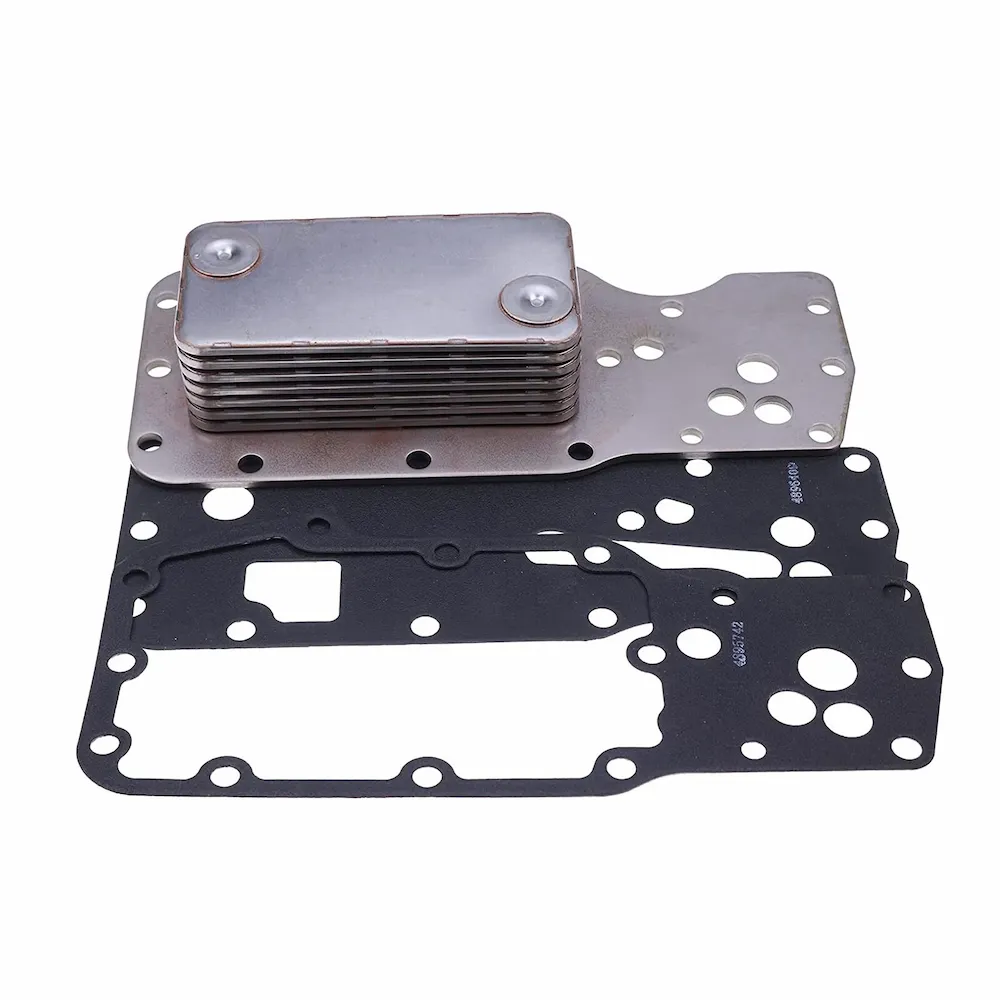
An Engine Oil Cooler Is Not an Aftercooler
“Cooler” is a broad term. A request for a “Cummins cooler” does not identify the required part.
| Component | Medium being cooled | Main purpose |
|---|---|---|
| Engine Oil Cooler / Lube Oil Cooler | Engine lubricating oil | Helps control engine-oil temperature |
| Aftercooler / Charge Air Cooler | Compressed intake air downstream of the turbocharger | Reduces charge-air temperature and increases intake-air density |
| Transmission Oil Cooler | Transmission fluid | Controls transmission lubrication and hydraulic-fluid temperature |
| Hydraulic Oil Cooler | Hydraulic fluid | Controls equipment hydraulic-system temperature |
| Fuel Cooler | Fuel | Controls fuel-supply or return-fuel temperature |
Aftercooler and Charge Air Cooler are terms used for components that cool compressed intake air, although terminology, construction, and installation position can vary by engine and equipment configuration.
They are not engine oil coolers.
When requesting a quotation, provide:
- Complete product name
- Part number
- Engine and equipment application
- Clear component photos
A general description such as “Cummins engine cooler” is not sufficient.
Oil Cooler Core Construction: Why Appearance Is Not Enough
Engine oil coolers may use:
- Plate or stacked-plate cores
- Tube-bundle or shell-and-tube construction
- Other integrated heat-exchanger designs
The exact construction depends on the engine platform and application. A part should not be matched only by describing it as “plate type” or “tube type.”
Two cooler cores that look similar may differ in:
- Internal oil-passage arrangement
- Internal coolant-passage arrangement
- Number and size of flow passages
- Core thickness or length
- Heat-transfer area
- Pressure capability
- Mounting-hole pattern
- Locating features
- Sealing grooves
- Flow-port positions
- Cover and Housing compatibility
They should not be considered interchangeable because the external dimensions or mounting holes look similar.
Even within the same engine family, different power ratings, emissions configurations, production periods, and applications may use different cooler designs.
Confirm fitment using:
- Engine ESN
- Current component part number
- Official supersession
- Core, Housing, Cover, and interface photos
- Equipment application
External dimensions and photos are supporting information, not the primary matching method.
Oil Cooler Seals: Why Material and Position Matter
An oil cooler normally uses several different seals.
Depending on their location, individual seals may contact:
- Engine oil
- Engine coolant
- A Housing-to-block mounting surface
- Core-to-Housing interfaces
- Core-to-Cover interfaces
- Filter Head passages
- External oil or coolant connections
Each seal must match its installation position, fluid exposure, dimensions, hardness, and temperature requirements.
Do not select a replacement merely because a general-purpose O-ring has the same visible diameter.
Unknown or unsuitable material may result in:
- Swelling
- Hardening
- Shrinkage
- Extrusion
- External leakage
- Internal oil-to-coolant or coolant-to-oil leakage
When requesting or replacing seals, confirm:
- Whether seals are supplied with the Core or Assembly
- Whether they must be ordered separately
- Formal seal part numbers
- Seal Kit number and BOM
- Quantity
- Approximate installation location
- Compatibility with the current Core, Housing, and Cover
- Condition of the Housing, seal grooves, and mounting surfaces
A new seal cannot correct a cracked Housing, distorted Cover, damaged sealing groove, or corroded mounting surface.
Seal replacement and installation should be performed by qualified technicians using the applicable service information. This article does not provide tightening torques, sealant instructions, or sealing-surface repair procedures.
Milky Oil or Discoloured Coolant Does Not Automatically Mean Oil-Cooler Failure
Milky engine oil, oil contamination in the coolant, discoloured coolant, or an unexplained increase in oil level may indicate abnormal contamination by oil, coolant, or moisture. These symptoms do not identify the leakage source by themselves.
An oil-cooler fault is only one possible cause.
| Possible area | What may need inspection |
|---|---|
| Oil Cooler seals | Ageing, damage, incorrect installation, or incompatible seals |
| Oil Cooler Core | Internal crack, corrosion, perforation, or passage failure |
| Cylinder-head gasket | Loss of sealing between oil, coolant, and combustion passages |
| Cylinder head | Crack, corrosion, or internal-passage damage |
| Cylinder block | Crack or abnormal communication between oil and coolant passages |
| Wet-liner seals | Seal condition and liner installation |
| Filter Head / integrated lubrication module | Internal passages, Housing, valves, and seals |
| Other fluid heat exchangers | Transmission or hydraulic oil cooler connected to the same coolant circuit |
| Mounting surfaces | Distortion, damage, corrosion, or poor sealing |
| Other engine seals and passages | Other areas where oil and coolant systems are adjacent |
| Residual contamination | Oil or coolant remaining in the system after a previous repair |
| Moisture or condensation | Short operating cycles, extended storage, or environmental moisture |
A local workshop should identify the actual contamination source.
Before purchasing an Oil Cooler, confirm:
- Whether the workshop has identified the Oil Cooler Core, Housing, Cover, or seals as the failed area
- Whether the Housing or Filter Head also requires replacement
- Whether the head gasket, cylinder head, block, wet-liner seals, or another heat exchanger has been ruled out
- Whether old contamination remains in the system
This article does not provide an internal-leak diagnosis or testing method.
High Oil Temperature Does Not Always Mean the Oil Cooler Is Defective
High oil temperature may be related to:
- Restricted Oil Cooler passages
- Reduced heat-transfer performance
- Incorrect or damaged Oil Cooler Core
- Sustained engine overload
- Excessive coolant temperature
- Restricted radiator
- Fan or fan-drive problem
- Reduced water-pump flow
- Thermostat fault
- Incorrect engine-oil grade
- Low or excessive oil level
- Inadequate oil flow
- Lubrication-system restriction
- Poor engine-compartment ventilation
- High ambient temperature
- High-altitude operation
The workshop should verify:
- Actual engine-oil temperature
- Actual coolant temperature
- Engine load
- Cooling-system condition
- Lubrication-system condition
- Sensor accuracy
Do not order an Oil Cooler solely because an oil-temperature indication is high.
An Oil Cooler and a Temperature Sensor Are Different Parts
| Component | Main function |
|---|---|
| Oil Cooler | Transfers heat from the engine oil to the cooling medium |
| Oil Temperature Sensor | Converts actual engine-oil temperature into an electrical signal for the ECM or instrument panel |
| Coolant Temperature Sensor | Converts actual coolant temperature into an electrical signal for the ECM or instrument panel |
An abnormal oil- or coolant-temperature reading may be caused by:
- Oil Cooler condition
- Cooling-system condition
- Sensor fault
- Wiring fault
- Instrument or ECM input problem
- Actual engine operating conditions
A normal temperature reading also does not prove that the Oil Cooler Core and seals are mechanically sound.
Confirm which component is required before requesting a quotation.
Which Oil and Coolant Interfaces Must Be Checked?
An integrated Oil Cooler Core may not have conventional external threaded oil and coolant ports. Oil and coolant may enter the Core through passages and sealed openings inside the Housing.
The Core and the complete Assembly should therefore be checked separately.
Oil Cooler Core
Confirm:
- Oil-passage locations
- Coolant-passage locations
- Locating features
- Mounting holes
- Core thickness and length
- Seal grooves or sealing surfaces
- Flow direction, where specified
- Compatibility with the Housing and Cover
Oil Cooler Housing or Complete Assembly
Confirm:
- External oil connections
- External coolant connections
- Filter Head connection
- Engine-block mounting face
- Cover orientation
- External pipes and hoses
- Sensor or valve ports
- Installation orientation
- Clearance around the component
- Gasket and O-ring positions
The same engine family may use different Housing, Cover, Filter Head, or complete Assembly configurations in different equipment installations.
Provide the equipment type and application instead of only the engine model. Pre-removal installation photos are strongly recommended.
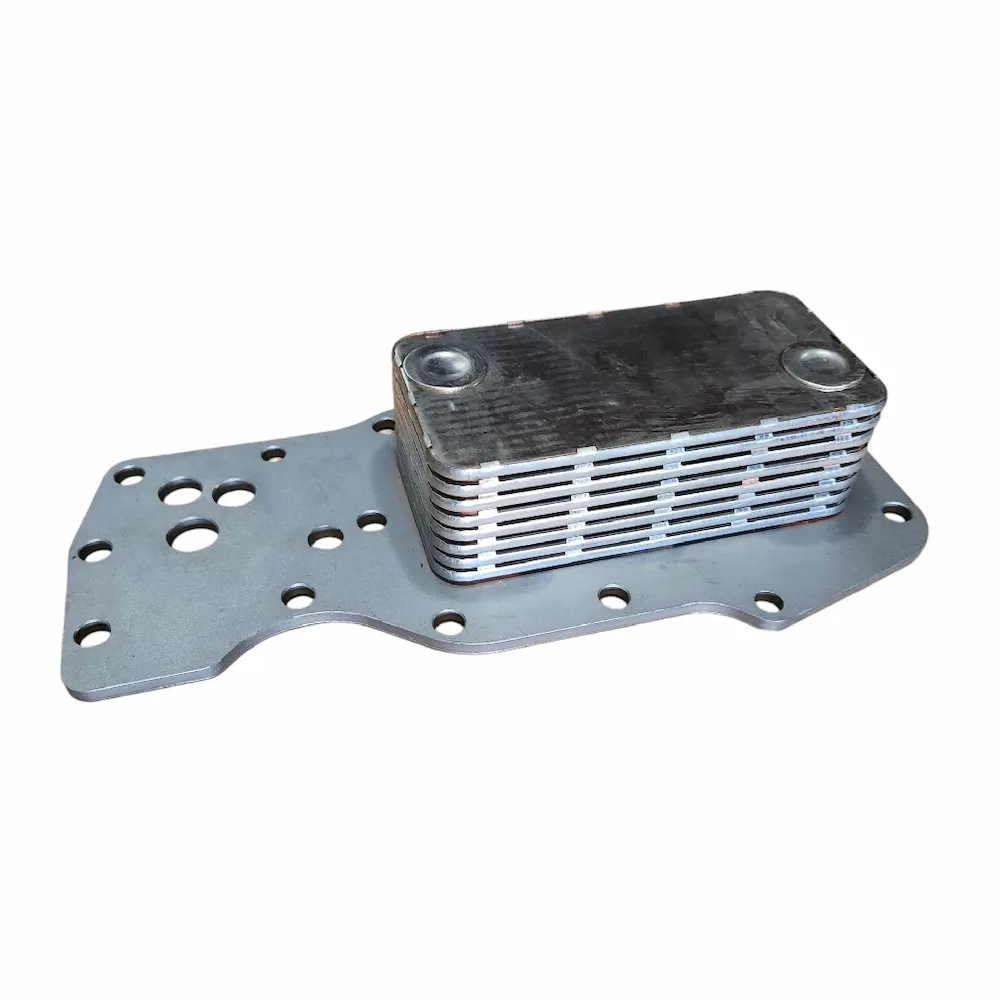
Why the Engine Model Alone Is Not Enough
An engine-family name identifies only the general platform. It does not confirm the exact Oil Cooler part number, Core construction, Housing, or interface configuration.
The same engine family may use different Oil Coolers because of:
- Engine ESN
- CPL
- Rated power
- Rated speed
- Emissions stage
- Production period
- Vehicle, mining, construction, generator, marine, or industrial application
- Core construction
- Housing and Filter Head design
- Oil and coolant passage arrangement
- Cover and sealing configuration
- Bypass or lubrication-control arrangement
- Part-number supersession
- Previous repairs, upgrades, or modifications
Core Matching Information
Use the following together:
- Current Oil Cooler, Housing, or Assembly part number
- Engine ESN
- Engine nameplate
- Current official replacement part number
- Supersession information
- Required product scope
The ESN helps identify the original engine configuration. The current component part number identifies what is installed now.
These may differ if the engine has previously been repaired, modified, or converted. Do not rely on only one source.
Supporting Information
- Oil Cooler overall photos
- Core front, rear, and side photos
- Housing interior
- Housing mounting face
- Cover
- Filter Head
- Oil and coolant passage locations
- External interfaces
- Existing seals
- Equipment make and model
- Application
- CPL
- Rated power and speed
- Emissions configuration
- Installation photos before removal
Oil Cooler Core, Complete Assembly, or Housing and Cover?
Whether a Core can be replaced separately, a Housing can be reused, or a component can be rebuilt should be determined by:
- Applicable engine service information
- Formal service-parts availability
- Current component condition
- Workshop inspection
- Cleaning capability
- Contamination level
- Downtime risk
The purchasing decision should not be based only on the lowest price.
A Separate Oil Cooler Core May Be Appropriate When:
- The applicable service information permits separate Core replacement
- A formal compatible Core part number is available
- The Housing has no crack, major corrosion, or sealing-surface damage
- Housing passages can be correctly cleaned
- Contamination from the original failure has been addressed
- The Cover and Filter Head have no internal corrosion or damage
- The current Housing has a confirmed relationship with the replacement Core
- The correct seals are available
- The workshop can correctly reassemble and inspect the component
A Complete Oil Cooler Assembly May Be More Appropriate When:
- Both the Core and Housing are damaged
- The Housing is cracked, corroded, distorted, or damaged at the sealing face
- The Core is not supplied separately
- The original component is an integrated lubrication module
- Cover, Filter Head, valves, or several related components are also damaged
- Several separate part numbers have been superseded by a complete Assembly
- Downtime and repeat-repair risk justify replacing the complete unit
A Separate Housing or Cover May Be Appropriate When:
- The Core has been inspected and found free of internal leakage, blockage, corrosion, or other disqualifying damage
- The Housing or Cover is damaged externally
- A formal replacement Housing or Cover is available
- Correct seals and related parts are available
- The workshop can correctly clean, reassemble, and test the component
Do not select a separate Core only because it is cheaper.
For mining equipment and continuously operated generator sets, consider:
- Equipment downtime cost
- Risk of repeat disassembly
- Condition of the old Housing and Cover
- Availability of all seals and installation parts
- Workshop capability
- Warranty
- Product traceability
- Lead time
Purchasing Priorities by Application
Mining Equipment
Mining applications commonly involve:
- High load
- Long operating hours
- High ambient temperature
- High dust exposure
- High altitude
- Cooling-system contamination risk
- High downtime cost
Confirm:
- Engine ESN
- Current Oil Cooler and Housing part numbers
- Rated power
- Duty cycle
- Ambient-temperature range
- Operating altitude
- Cooling-system condition
- Whether the Core or complete Assembly is required
- Product traceability
- Warranty
- Lead time
A description such as “N14 mining Oil Cooler” or “KTA19 Oil Cooler” is only a starting point.
Construction Machinery
Excavators, loaders, dozers, rollers, and cranes may use the same base engine with different equipment-OEM layouts.
Confirm:
- Equipment brand
- Complete equipment model
- Engine ESN
- Housing construction
- Filter Head arrangement
- Interface direction
- Installation space
- Oil-filter mounting arrangement
- Pre-removal photos
Generator Sets
Generator-set matching should consider:
- Standby, prime-power, or continuous-power rating
- Engine rated power
- Fixed operating speed
- Ambient temperature
- Altitude
- Radiator and fan configuration
- Generator-set OEM configuration
- Sustained high-load or low-load operation
A vehicle Oil Cooler should not be installed on a generator engine merely because the base engine family is similar.
Industrial Engines
For compressors, pump sets, crushers, drilling equipment, and other industrial applications, confirm:
- Engine duty cycle
- Rated power and speed
- Installation orientation
- External cooling-system configuration
- Equipment-compartment ventilation
- Equipment OEM configuration
These are project conditions to be confirmed. Do not apply universal values based only on past experience.
Genuine New and Qualified Aftermarket Oil Coolers
An engine oil cooler separates two critical fluid circuits. Lowest price should not be the only selection factor.
| Product option | Typical characteristics | What to confirm |
|---|---|---|
| Genuine Cummins New | Clear part-number traceability and original application reference | Correct ESN, part number, packaging, supply channel, and supersession |
| Qualified aftermarket new with a confirmed cross-reference | May provide an alternative for cost or lead time | Cross-reference, Core construction, internal passages, interfaces, Housing compatibility, seal specifications, testing, and warranty |
| Unidentified or incomplete product | Insufficient information about internal passages, materials, cleanliness, pressure capability, or seal compatibility | Generally unsuitable for critical or high-downtime-cost equipment |
For an aftermarket product, request:
- Formal cross-reference
- Exact supplied scope
- Product and interface photos
- Core construction information
- Applicable test information
- Leakage or pressure-test documentation, where available
- Cleanliness and packaging information
- Warranty terms
For mining equipment and continuously operated generator sets, prioritize:
- Accurate part-number matching
- Core-to-Housing compatibility
- Internal cleanliness
- Seal completeness
- Product consistency
- Traceability
- Warranty
- Lead time
Cummins Engine Oil Cooler RFQ Checklist
Engine and Equipment Information
- Engine model
- Engine ESN
- CPL
- Engine nameplate photo
- Rated power
- Rated speed
- Equipment make
- Complete equipment model
- Application
- Duty cycle
- Standby / Prime / Continuous rating, for generator sets
- Required quantity
- Destination country
- Required delivery date
- Genuine / aftermarket preference
Current Component Identification
- Oil Cooler Core part number
- Oil Cooler Assembly part number
- Oil Cooler Housing part number
- Oil Cooler Cover part number
- Lubricating Oil Filter Head part number
- Seal Kit part number
- Construction information, if known
- Previous packaging, invoice, or repair record, if available
Required Product Scope
- Oil Cooler Core
- Complete Oil Cooler Assembly
- Oil Cooler Housing
- Oil Cooler Cover
- Lubricating Oil Filter Head
- Seal Kit
- Gasket
- O-ring
- Related lubrication valve
- Installation Kit
- Not Yet Confirmed
Recommended Photos
- Core front
- Core rear
- Core side
- Housing interior
- Housing mounting face
- Cover
- Filter Head
- Oil-passage locations
- Coolant-passage locations
- External interfaces
- Part-number markings
- Installation condition before removal
Symptoms such as milky oil, discoloured coolant, an abnormal oil level, or poor temperature control may be provided as background information. They cannot identify the correct part number and do not replace local diagnosis.
How to Compare Supplier Quotations
Prices are directly comparable only when the part number, product construction, supplied scope, and included seals are equivalent.
| Comparison item | Supplier A | Supplier B |
|---|---|---|
| Product source: Genuine / Aftermarket | ||
| Formal part number and supersession | ||
| Applicable ESN or configuration | ||
| Complete Oil Cooler Assembly | ||
| Oil Cooler Core included | ||
| Oil Cooler Housing included | ||
| Oil Cooler Cover included | ||
| Lubricating Oil Filter Head included | ||
| Related valves included | ||
| Gaskets included | ||
| O-ring quantity | ||
| Seal Kit number and BOM | ||
| Installation Kit included | ||
| Leakage or pressure-test information | ||
| Quotation unit: individual part / kit / assembly | ||
| Warranty | ||
| Lead time |
If two quotations differ significantly, confirm whether:
- One is a separate Core and the other is a complete Assembly
- One is a Housing and the other is a Cover
- One includes the Filter Head and the other does not
- One includes the Seal Kit and installation parts
- The quoted part numbers or supersessions are different
- One is Genuine and the other is aftermarket
- Testing, packaging, and warranty scopes are different
The price difference may reflect the supplied scope rather than quality alone.
How ZEB Power Supports Cummins Engine Oil Cooler Sourcing
ZEB Power supplies Cummins engine oil coolers and related lubrication-system components for:
- Construction machinery
- Mining equipment
- Generator sets
- Compressors
- Pump sets
- Crushers
- Drilling equipment
- Other industrial engines
Using the engine ESN, current component part number, Core and Housing photos, interface configuration, and equipment application, we can help review the applicable scope for:
- Engine Oil Cooler
- Lubricating Oil Cooler
- Oil Cooler Core
- Complete Oil Cooler Assembly
- Oil Cooler Housing
- Oil Cooler Cover
- Lubricating Oil Filter Head
- Repair Kit
- Seal Kit
- Gaskets
- O-rings
- Related lubrication valves
- Installation parts
Available sourcing options depend on the exact part number, configuration, and current supply channel.
Where possible, our quotation will identify:
- Final part number
- Original and superseded part numbers
- Supplied product scope
- Core, Housing, Cover, and Filter Head inclusion
- Seal Kit and O-ring inclusion
- Product source
- Available test or quality information
- Lead time
- Warranty terms
ZEB Power supports parts matching and quotation confirmation. We do not replace the local workshop’s responsibility for lubrication- or cooling-system diagnosis, identification of the internal-leak source, system cleaning, component installation, or post-installation testing.
Frequently Asked Questions
Is an engine Oil Cooler the same as an oil-temperature sensor?
No. An Oil Cooler transfers heat from the engine oil. A temperature sensor converts the measured temperature into an electrical signal for the ECM or instrument panel.
Is an engine Oil Cooler the same as an Aftercooler?
No. An engine Oil Cooler controls lubricating-oil temperature. Aftercoolers and Charge Air Coolers cool compressed intake air. Terminology, construction, and installation position vary by engine and equipment configuration, but neither is an engine Oil Cooler.
Does milky engine oil always mean that the Oil Cooler has failed?
No. An Oil Cooler fault is one possible cause, but a head-gasket problem, cylinder-head or block damage, wet-liner seals, condensation, or another area where oil and coolant passages are adjacent may produce similar symptoms.
Can plate-type and tube-type Oil Coolers be interchanged?
They should not be treated as direct replacements. A change should be considered only when supported by a formal part-number supersession, a validated complete-assembly replacement, or complete technical confirmation.
Can I replace only the seals instead of replacing the complete Oil Cooler?
Possibly. The Core, Housing, Cover, seal grooves, and mounting surfaces must remain serviceable. If the Core is cracked, perforated, corroded, or blocked, replacing the seals will not correct the problem.
Does an Oil Cooler Assembly always include the seals?
No. Request the formal part number and itemized BOM. Gaskets, O-rings, Seal Kits, and installation parts may be supplied separately.
Can a general-purpose O-ring replace the specified seal?
Do not select an O-ring only by size. Use the specified part number, a confirmed Seal Kit, or an equivalent seal with documented material and operating compatibility.
Can I request a quotation without the old Oil Cooler part number?
Yes. Provide the engine ESN, equipment model, clear photos of the Core, Housing, Cover, Filter Head, flow passages, external interfaces, and installation orientation for an initial review.
What information is most important for an accurate quotation?
Priority information is:
- Engine ESN
- Current formal part number
- Core, Housing, Cover, and Filter Head photos
- Oil and coolant passage and interface photos
- Required product scope
- Construction information, if known
Conclusion
A Cummins engine oil cooler should not be ordered only by engine family, external appearance, dimensions, or mounting-hole pattern.
After replacement has been confirmed, verify:
- Engine ESN and CPL
- Current component part number
- Official supersession
- Oil Cooler Core construction
- Core-to-Housing compatibility
- Housing, Cover, and Filter Head configuration
- Formal seal part numbers and supplied scope
- Oil- and coolant-passage locations
- External oil and coolant interfaces
- Whether the quotation covers a separate Core, Repair Kit, Housing, Cover, or complete Assembly
- Equipment application, rated power, and operating duty
Ready to source a Cummins engine oil cooler? Send the engine ESN, current part number if available, equipment make and model, and clear photos of the Core, Housing, Cover, Filter Head, passages, and interfaces. Include the construction type if known. Our team will help review the applicable component and provide a clearly defined quotation scope.