

Cummins Camshaft: Function, Drive System & Follower Matching

8801
Table of Contents
Generating table of contents
The most common camshaft sourcing problems are usually not caused by journal dimensions alone. They are more often caused by mismatches in camshaft function, drive-end configuration or the follower system used with the camshaft.
A camshaft’s lobe profile, drive structure and related components—including cam followers, tappets, rollers, levers and rocker assemblies—must be evaluated as one motion-control system. Installing a visually similar camshaft may affect valve operation, the mechanical drive of injectors or other fuel-system components on some engines, and engine-brake operation.
Many incompatibility problems do not become obvious until the engine has been assembled and tested, which can create substantial removal, rework and downtime costs.
Another easily overlooked point is that not every engine uses one camshaft for every function. Some engine platforms may use multiple camshafts, with valve control, fuel-system drive or engine-brake functions assigned to different camshafts.
In these applications, the phrase “camshaft for this engine model” is not enough to complete the match. The buyer should also identify the required camshaft position and function.
This guide is intended for:
- Parts wholesalers and importers purchasing Cummins camshafts for resale;
- Repair workshops and fleet managers carrying out engine overhauls;
- Engine rebuilders evaluating new supply channels;
- Buyers supporting highway vehicles, construction machinery, mining equipment, marine engines, generator sets and industrial engines.
Confirm the Camshaft Drive System First
The camshaft is driven from the crankshaft through a gear train, chain or another formally designed timing mechanism.
Different drive systems may require different:
- Camshaft drive ends;
- Camshaft gears or sprockets;
- Keys, pins or other locating structures;
- Timing-gear trains;
- Chains, guides and tensioners;
- Front housings and sealing arrangements.
Even when the journal dimensions in the center section are similar, camshafts with different drive structures should not be assumed interchangeable.
Confirm the drive system using:
- ESN;
- CPL;
- Camshaft Part Number;
- Photos of the old camshaft drive end;
- Camshaft Gear or Sprocket Part Number;
- Formal parts information.
Do not infer the drive system from engine displacement, cylinder count or engine-family name alone.
Camshaft Location: In-Block or Overhead
Different Cummins engine platforms may use:
- In-block camshafts;
- Overhead camshafts;
- Single-camshaft layouts;
- Multiple-camshaft layouts;
- Other formally designed valvetrain arrangements.
Different layouts may require different:
- Journal and support locations;
- Gear or chain drive structures;
- Cam followers or tappets;
- Pushrods;
- Rocker levers;
- Valve-train components;
- Lubrication passages;
- Thrust and locating structures.
Compatibility cannot be confirmed from overall camshaft length, journal count or appearance alone.
If the engine uses more than one camshaft, the quotation request should identify:
- Which camshaft is required;
- Installation position;
- Whether it controls valves, fuel-system drive or another function;
- Whether it is associated with an engine-brake system;
- Whether the parts catalog defines left/right, intake/exhaust or another positional distinction.
Inspect the Follower System Whenever the Camshaft Is Replaced
Each cam lobe is designed around a specific lift and motion profile and works with a corresponding follower structure.
Depending on the engine, the system may include:
- Cam follower;
- Tappet;
- Lifter;
- Roller;
- Roller pin;
- Follower lever;
- Rocker lever;
- Other follower and motion-transfer components.
Some engines may use sliding-contact followers, while others use roller-type cam followers. Their contact method, lubrication requirements, load path and matching lobe design may differ.
Different follower systems should not be assumed interchangeable merely because their mounting dimensions are similar. Compatibility should only be accepted where it is supported by formal parts or service information.
When replacing a camshaft, also confirm:
- Cam Follower Part Number;
- Tappet or Lifter Part Number;
- Roller and Roller Pin Part Number;
- Follower Lever or Rocker Lever Part Number;
- Follower-system design version;
- Actual wear condition of the follower components;
- Whether the new camshaft and existing followers are approved to work together.
Whether cam followers, tappets or rollers that have operated against the old camshaft can be reused should be determined by a qualified repair technician using the applicable service information and actual inspection results.
This article does not provide follower wear limits, roller-clearance limits, surface-condition criteria or reuse standards.
Also note that tappets, rollers, pins, follower levers and rocker levers normally have their own part numbers. They are not part of the camshaft body.
Purchasing a Camshaft does not mean these follower components are included. The BOM and quantities must be confirmed separately.
Journals, Separate Bushings and Thrust Components Must Also Be Matched
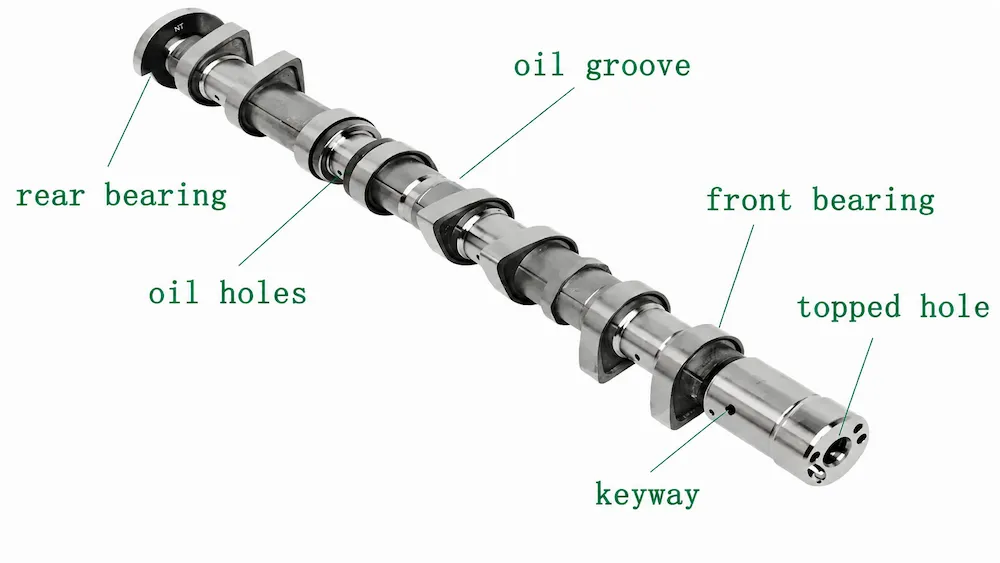
In addition to the cam lobes, the camshaft support and axial-location system affect compatibility.
Related components may include:
- Camshaft journals;
- Camshaft bushings or bearings;
- Thrust plate;
- Retainer;
- Thrust washer;
- Gear-side locating components;
- Oil holes and oil grooves.
A camshaft bushing is normally a separate support component installed in the cylinder block, cylinder head or another support bore. It is not part of the camshaft shaft itself.
Some suppliers may include bushings in a Camshaft Kit, but that is a BOM difference. It does not mean that the bushing is an integral part of the camshaft.
The same cam count and drive-end shape do not prove that the following items are identical:
- Journal count;
- Journal diameter and width;
- Bushing quantity;
- Bushing part number;
- Oil-hole and oil-groove location;
- Thrust arrangement;
- Axial locating method.
Journal dimensions, bushing condition, support-bore condition and camshaft end play should be confirmed by qualified repair personnel using actual measurements and the applicable service information.
Quotation Scope: Bare Camshaft or a Kit with Gear and Followers
Suppliers do not always use Camshaft, Camshaft Assembly and Camshaft Kit in the same way.
Possible supply scopes include:
| Quotation term | Possible supply scope | What must be confirmed |
|---|---|---|
| Bare Camshaft | Camshaft body only | Gear, sprocket, key, pin and thrust components |
| Camshaft | Bare camshaft or camshaft with selected accessories | Formal part number and BOM |
| Camshaft Assembly | Camshaft with selected pre-installed accessories | Exact gear, locating-part and thrust-part list |
| Camshaft Kit | Camshaft with selected related parts | Included Parts List and quantity of each item |
| Camshaft and Follower Kit | Camshaft with selected follower components | Follower, tappet, roller and accessory details |
| ReCon Camshaft, where available | Remanufactured camshaft | Part number, core terms, accessories and warranty |
The camshaft gear or sprocket may be:
- Already installed on the camshaft;
- Supplied with the camshaft but not installed;
- Transferred from the old camshaft;
- Ordered as a separate part;
- Replaced as part of a formal upgrade.
Before accepting a quotation, confirm:
- Camshaft Gear or Sprocket Part Number;
- Whether the gear or sprocket is included;
- Whether it is already installed;
- Whether the key, pin or other locating parts are included;
- Whether the thrust plate or retainer is included;
- Whether camshaft bushings are included;
- Whether cam followers, tappets or rollers are included;
- Quantity of each related part;
- Whether the old gear or sprocket may be transferred;
- Whether a formal supersession or upgrade applies.
Even when an overhaul kit is described as Complete, Full, Overhaul or Rebuild, the camshaft and follower components should not be assumed to be included.
This article does not provide gear or sprocket removal, press-fitting, timing alignment, phase-setting or tightening specifications.
Cam Position Sensor and Fuel-System Drive Interfaces Are Easily Overlooked
Some electronically controlled Cummins engines use a Cam Position Sensor to provide synchronization or position-related information to the ECM.
The sensor may read:
- A target feature on the camshaft;
- The camshaft gear;
- A sprocket;
- A trigger feature;
- Another formally designed target.
The exact sensor location and trigger method must be confirmed from the engine information. It should not be assumed that the sensor is always installed at the end of the camshaft.
When replacing a camshaft, confirm:
- Whether a Cam Position Sensor is used;
- Sensor Part Number;
- Actual sensor location;
- Trigger feature on the camshaft, gear or sprocket;
- Whether the replacement camshaft retains the required sensing or locating feature;
- Whether a revised sensor, gear or locating component is required.
On some engines, the camshaft may also provide mechanical drive for injectors or other fuel-system components. On other engines, separate fuel-system components may be driven through the gear train.
The exact relationship must be confirmed from the engine design, ESN, CPL and formal parts information. The valve-timing side should not be reviewed in isolation.
Distinguish the Service Part Number from Casting and Repair Marks
An old camshaft may carry several types of markings, including:
- Service Part Number;
- Casting Number;
- Forging Number;
- Production Mark;
- Heat-Treatment Mark;
- Manufacturer’s internal number;
- Inspection mark;
- Workshop-added mark.
These numbers serve different purposes.
The formal Service Part Number is used for catalog lookup, supply-channel matching and supersession review. It should be prioritized for purchasing.
A Casting Number or Forging Number may help identify the base blank or structural family, but it is not necessarily the formal orderable part number.
The same basic blank may undergo different:
- Cam-profile machining;
- Journal machining;
- Oil-hole machining;
- Heat treatment;
- Drive-end machining;
- Thrust-structure machining;
- Trigger-feature machining;
and become several different Camshaft Part Numbers.
For quotation review, provide:
- Clear photos of every number and marking;
- The location of each marking;
- Full-length camshaft photos;
- Drive-end photos;
- Opposite-end photos;
- Gear or sprocket photos;
- Sensor-target-area photos;
- Cam-lobe arrangement photos;
- Journal and thrust-structure photos.
Engine Configuration Determines the Specification
The same engine family may use different camshafts because of differences in:
- CPL;
- Production period;
- Emissions configuration;
- Power and speed rating;
- Application;
- Camshaft installation position;
- Single- or multiple-camshaft layout;
- Valve, fuel-system or engine-brake function;
- Drive gear or sprocket;
- Cam follower, tappet or roller version;
- Sensor and trigger feature;
- Formal supersession or upgrade.
Use the ESN, CPL and formal Camshaft Part Number as the primary matching references, together with photos of the old part and the engine’s current configuration.
If the engine has previously been overhauled, fitted with a replacement camshaft, used a reground camshaft or received a different follower version, the current configuration may not be identical to the original factory configuration.
In that situation, also review:
- Current old-camshaft part number;
- Gear or sprocket part number;
- Cam Follower or Tappet Part Number;
- Engine-brake or fuel-system configuration;
- Previous repair records;
- Repair-facility inspection conclusion.
A revised camshaft part number may represent either a normal supersession or a system upgrade.
Even where a formal replacement number exists, confirm whether it also requires:
- A revised Camshaft Gear or Sprocket;
- A different Cam Follower, Tappet or Roller;
- A different sensor or trigger feature;
- A different Rocker Lever;
- A different fuel-system drive component;
- A different engine-brake configuration;
- Complete-set replacement;
- Restrictions on mixing old and new versions.
Valvetrain Noise and Synchronization Fault Codes Do Not Automatically Mean Camshaft Failure
Valvetrain noise, unstable operation, power loss or synchronization-related ECM fault codes may involve the camshaft and related systems, but they do not directly prove that the camshaft itself must be replaced.
Cam Position, Engine Speed or synchronization-related fault codes indicate a signal, position or system-synchronization problem. Possible causes may include:
- Cam Position Sensor;
- Engine Speed Sensor;
- Harness and connectors;
- Trigger feature;
- Gear or chain timing;
- Cam follower, tappet or roller;
- Rocker lever and pushrod;
- Valve clearance;
- Camshaft journals and bushings;
- Lubrication system;
- Other mechanical or electronic components.
Abnormal cam-lobe or journal wear may also be related to:
- Damaged cam follower or roller;
- Roller-pin problems;
- Insufficient lubrication;
- Blocked oil passages;
- Contaminated oil;
- Incorrect lubricant;
- Gear or chain configuration problems;
- Abnormal axial location;
- Assembly problems;
- Other valvetrain faults.
Replacing only the camshaft without checking the follower system, drive mechanism and lubrication system may result in repeated damage.
Diagnosis, measurement, timing confirmation, bushing machining, old-part reuse and rejection decisions should be handled by qualified repair personnel.
This article does not provide:
- Cam-lift or profile measurement procedures;
- Cam-lobe wear limits;
- Camshaft-journal dimensional limits;
- Camshaft-bushing machining parameters;
- Camshaft end-play specifications;
- Valve, fuel-system or engine-brake timing data;
- Gear or sprocket installation and timing procedures;
- Reuse standards for cam followers, tappets, rollers or rocker levers;
- Remote decisions on whether an old camshaft can be reused.
Choosing New Genuine, ReCon, Reground and Quality Alternative Camshafts
Cam-profile accuracy, material, heat treatment, journal machining and drive-end structure all affect the reliability of the valvetrain and related drive systems.
Available product conditions may include:
- New Genuine;
- ReCon, where available;
- Reground or Reconditioned;
- Quality Alternative;
- Used.
New Genuine
Confirm:
- Formal Camshaft Part Number;
- Applicable ESN and CPL range;
- Supersession or upgrade relationship;
- Gear, sprocket and accessory BOM;
- Packaging condition;
- Warranty scope.
ReCon, Where Available
Do not assume that every Camshaft Part Number has a ReCon option.
Confirm:
- ReCon Part Number;
- Current availability;
- Core-return conditions;
- Core-acceptance criteria;
- Whether the gear or other accessories are included;
- Warranty and supply channel.
Reground or Reconditioned
For a reground, reconditioned or Used camshaft of unclear origin, confirm whether the processor completed the applicable:
- Cam-profile inspection;
- Lift inspection;
- Base-circle inspection;
- Journal-dimensional inspection;
- Defect inspection;
- Drive-end inspection;
- Thrust-structure inspection.
Also confirm:
- Whether the base circle has changed;
- Whether follower travel or adjustment range is affected;
- Whether cam-profile or lift inspection records are available;
- Whether journals have been repaired;
- Whether the drive end and thrust structure remain in the original configuration;
- Whether inspection records are available;
- Warranty scope.
Terms such as Reground or Polished do not replace inspection records.
Quality Alternative
For a quality alternative camshaft, confirm:
- Clear cross-reference;
- Applicable ESN and CPL range;
- Specific camshaft function;
- Drive mechanism;
- Gear or sprocket configuration;
- Follower/tappet architecture;
- Sensor interface and trigger feature;
- Material and manufacturing process;
- Heat treatment or surface hardening;
- Cam-profile consistency;
- Journal dimensional control;
- Oil holes and oil grooves;
- Thrust structure;
- Production batch;
- Inspection record;
- Warranty;
- Claim process.
A camshaft is a critical internal engine component. Incorrect matching or inadequate inspection can create substantial removal, rework and downtime costs.
For mining equipment, continuous-duty generator sets and other high-downtime-cost applications, batch information, inspection records and traceability are often more important than the lowest initial price.
Information to Provide Before Ordering
Provide:
- Cummins engine model;
- ESN;
- CPL;
- Equipment manufacturer and complete model;
- Application;
- If the engine may use multiple camshafts, identify which camshaft is required and its function;
- Camshaft drive mechanism, where known;
- Camshaft location, such as In-Block or Overhead, where known;
- Camshaft Service Part Number;
- All markings on the old camshaft;
- Full-length and drive-end photos;
- Gear or sprocket photos and part number;
- Sensor-area and trigger-feature photos;
- Cam-lobe arrangement, journal and thrust-structure photos;
- Cam Follower, Tappet, Roller or Lever Part Number;
- Whether an engine-brake function is installed;
- Whether injector or fuel-system mechanical drive is involved;
- Whether a formal supersession or upgrade has been applied;
- Whether a Bare Camshaft, Camshaft Assembly or Camshaft Kit is required;
- Whether the gear, sprocket, bushings, thrust parts and followers are required;
- Preferred product condition;
- Total order quantity;
- Destination;
- Required lead time;
- Batch, inspection or traceability-document requirements.
How ZEB Power Supports Cummins Camshaft Sourcing
ZEB Power supplies Cummins camshafts and related overhaul parts for highway vehicles, construction machinery, mining equipment, marine engines, generator sets and industrial equipment.
Using the engine ESN, CPL, old camshaft part number and markings, camshaft function, drive-end design, gear or sprocket configuration, cam follower or tappet version and required supply scope, we can assist with confirming:
- Camshaft Part Number;
- Camshaft installation position and function;
- Single- or multiple-camshaft configuration;
- Gear, sprocket, key and locating components;
- Cam follower, tappet, roller and lever;
- Camshaft journal, bushing and thrust configuration;
- Sensor interface and trigger feature;
- Formal supersession or upgrade;
- New Genuine, ReCon and verified Quality Alternative options;
- BOM, quantity and quotation scope.
Available supply options depend on the formal part number, actual engine configuration and current supply channel.
Cam-profile measurement, journal inspection, bushing machining, gear or sprocket installation, valve or fuel-system timing, lubrication inspection, old-part reuse and assembly specifications should be handled by qualified local repair personnel.
Frequently Asked Questions
Are Gear-Driven and Chain-Driven Camshafts Interchangeable?
Do not assume that they are.
Different drive systems normally require different camshaft drive ends, gears or sprockets and related timing components. Compatibility should only be accepted where formal parts information supports it.
Can Sliding-Contact and Roller-Type Followers Be Mixed?
Do not assume that they can be mixed.
Different follower systems may have different contact methods, lubrication requirements and matching cam designs. Confirm compatibility from the formal camshaft and follower part numbers rather than mounting dimensions alone.
Must Tappets or Rollers Always Be Replaced with the Camshaft?
Not always, but the corresponding cam followers, tappets, rollers and other follower components must be inspected at the same time.
Whether the old parts can be reused should be determined by qualified repair personnel using service information and actual condition.
Does a Camshaft Kit Always Include the Gear and Followers?
No.
Kit contents vary by supplier. Confirm the formal BOM, quantity of each component and whether the gear or sprocket is installed before ordering.
Does Valvetrain Noise Always Mean the Camshaft Is Damaged?
No.
The problem may also involve the cam follower, tappet, roller, rocker lever, drive mechanism, sensor, valve clearance, lubrication system or other valvetrain components.
Can One Engine Use More Than One Camshaft?
Yes, some platforms may assign valve, fuel-system drive or engine-brake functions to different camshafts.
When requesting a quotation, identify the required camshaft position and function.
Are Tappets, Rollers and Follower Levers Part of the Camshaft?
No.
They are normally separate follower components with independent part numbers. Purchasing a camshaft does not mean these parts are included.
Can a Casting Number Be Used Directly for Ordering?
Not always.
A casting or forging number may assist identification, but it may not be the formal Service Part Number.
Does a Synchronization Fault Code Mean the Camshaft Must Be Replaced?
No.
The problem may involve the sensor, wiring, trigger feature, gear or chain timing, or other mechanical and electronic components.
Can a Reground Camshaft Be Purchased?
Yes, as one possible supply option.
Confirm the processing source, cam profile, base circle, lift, journals, drive end, defect-inspection records and warranty scope.
Can I Request a Quotation Without the Old Camshaft Part Number?
An initial check may still be possible.
Provide the ESN, CPL, all markings on the old camshaft, drive-end and full-length photos, follower information and the required camshaft function. Final confirmation may still require the formal part number or additional physical information.
Conclusion
A Cummins camshaft should not be selected by engine-family name, journal size or appearance alone.
The matching process should confirm:
Camshaft Part Number + ESN/CPL + Camshaft Function + Drive Configuration + Follower Architecture + Sensor/Trigger Interface + Supply Scope
When contacting ZEB Power, provide the engine ESN, CPL, old camshaft part number and markings, required function, drive-end photos, gear or sprocket information, cam follower or tappet part number, repair status and required quantity.
We can assist with confirming the applicable camshaft and quotation scope.