

Запчасти масляного радиатора Perkins: одно название — пять разных комплектаций

3175
Оглавление
Создание содержания...
An engine oil cooler looks like a simple component: hot engine oil enters, heat is removed, and the cooled oil returns to the lubrication circuit.
In practice, two details are easy to overlook. First, the oil cooler helps control lubricant temperature while also forming an important heat-transfer boundary between the oil circuit and the cooling circuit. If that internal boundary fails, engine oil and coolant can cross-contaminate each other. Second, the term “Oil Cooler” can refer to very different supply scopes depending on the Perkins engine and the supplier’s quotation.
Oil Cooler Arrangements You May Encounter on Perkins Engines
The installation and integration of the oil cooler are not the same across all Perkins engine generations and series. In parts sourcing, several typical arrangements may be encountered:
- Block-mounted oil cooler — some traditional Perkins engines use a compact cooler mounted on the side of the cylinder block, where engine coolant helps control oil temperature.
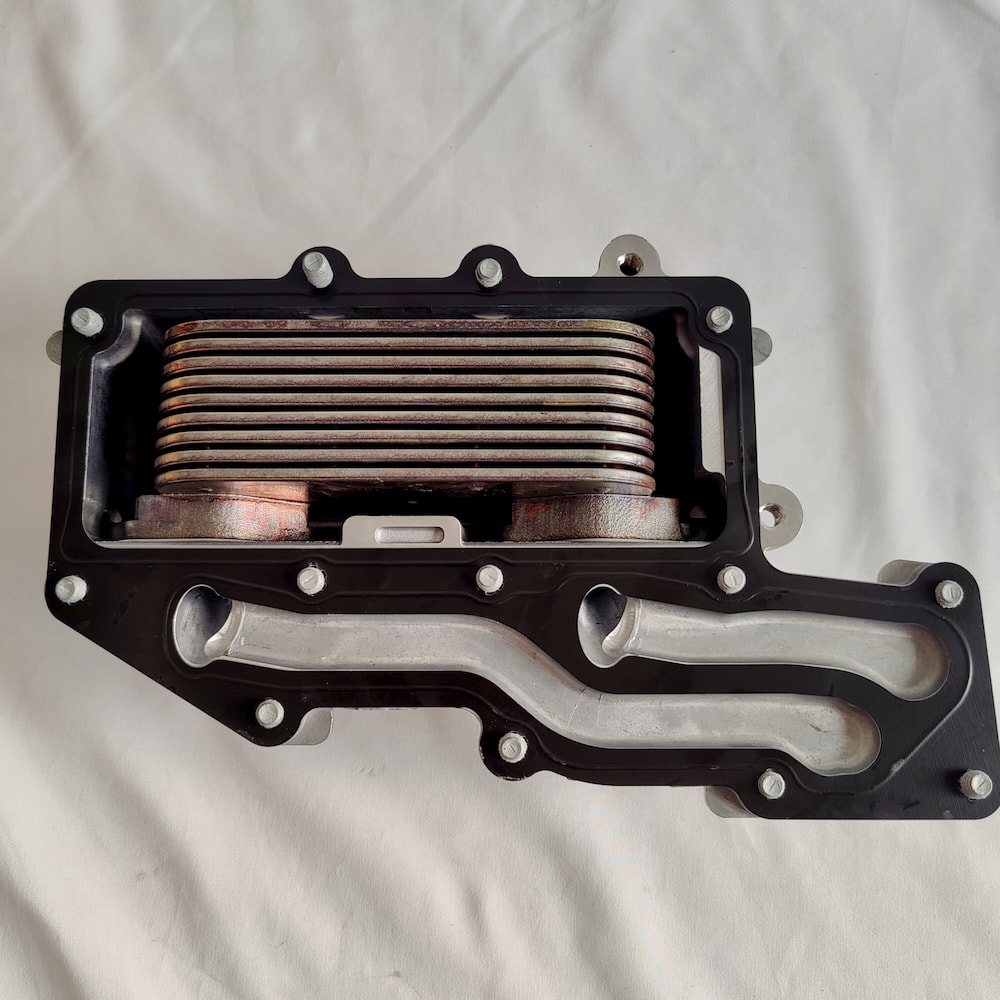
- Oil cooler closely associated with the filter head — on some engines, the oil-cooler passages and oil-filter-head structure are closely related. The filter head and cooler core may still be separate service parts and should not automatically be treated as one component.
- Integrated Fluids Module — some newer platforms, including parts of the 2606 Series, integrate the oil cooler with the water pump, oil filter, thermostats, and other fluid-management components in one module.
The arrangement on a specific engine should be confirmed from the lubrication and cooling-system information for that exact engine. Similar engine model names are not enough to identify the correct structure.
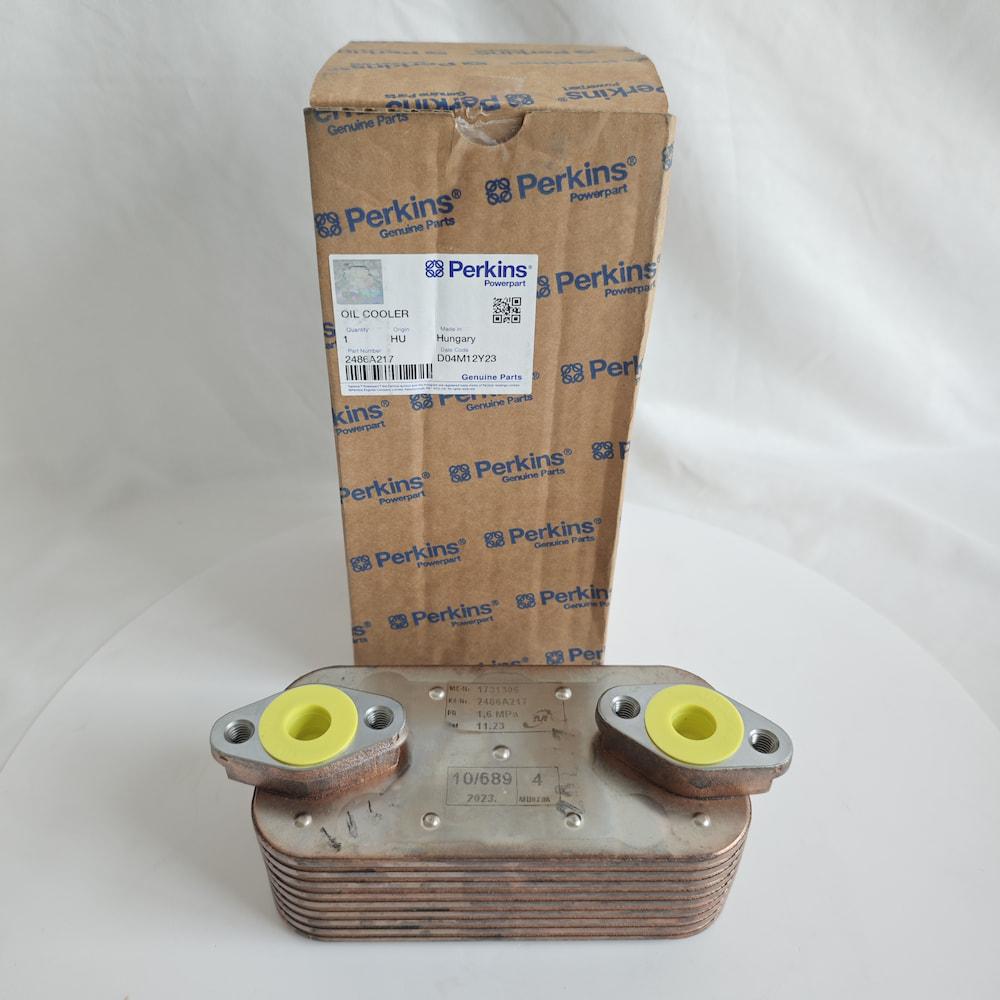
“Oil Cooler” Can Mean Five Different Supply Scopes
Two suppliers may both quote a “Perkins Oil Cooler” while offering very different assemblies.
| Supply Scope | Typically Includes | What to Confirm |
|---|---|---|
| Core / Element | Heat-exchanger core only | Whether the existing housing and seals must be reused |
| Complete Oil Cooler | Cooler assembly | Whether the quotation actually includes the housing and related connections, rather than only the core |
| Oil Cooler Kit | Cooler plus specified installation parts | Which seals, O-rings, joints, or related parts are included |
| Filter Head-Associated Arrangement | Cooler passages and filter-head structure are closely related | Whether the filter head and cooler are separate service parts |
| Integrated Fluids Module | Cooler, water pump, oil filter, thermostats, and other components integrated into one module | Whether an individual subcomponent can be serviced or a larger module-level assembly is required |
Before comparing prices, confirm which supply scope each quotation represents. Otherwise, the totals are not directly comparable.
Even within the same engine family, different production periods or applications may use different oil-cooler versions. Accurate matching still requires the complete Engine Serial Number and Build List rather than the basic engine model alone.
Oil Thermostats and Bypass Arrangements Should Not Be Assumed
Different Perkins engines manage oil flow through the cooler in different ways. It should not be assumed that every oil cooler contains its own bypass valve.
Some newer platforms use a dedicated Oil Thermostat as part of the oil-temperature-control system. For example, the Fluids Module used on certain 2606 Series configurations integrates a separate oil thermostat.
Oil filters may also contain anti-drainback and bypass valves. Those are filter functions and should not be confused with the oil-cooler control arrangement.
Whether a particular engine has a separate cooler-bypass circuit, where the valve is located, and under what conditions it operates should be confirmed from the lubrication-system diagram and service information for that specific engine. A bypass arrangement from one engine family should not be assumed to apply to another.
An External Oil Leak Does Not Automatically Mean the Cooler Core Has Failed
Oil around the cooler, abnormal oil temperature, or suspected oil/coolant cross-contamination all justify further inspection, but none of these symptoms alone proves that the heat-exchanger core has failed.
An external leak may instead come from:
- Housing sealing surfaces;
- Connections or adapters;
- O-rings, joints, or installation seals;
- Interfaces between the cooler and adjacent components.
Replacing only the core without checking these surrounding interfaces can leave the original leak unresolved.
The more serious condition is an internal heat-transfer-boundary failure.
The oil and coolant passages inside the cooler are designed to remain separated. If cracking, corrosion, or another type of damage creates an internal leak, oil and coolant can cross-contaminate each other.
Which fluid shows contamination depends on operating conditions, pressure on each side, the exact leak location, and the severity of the failure. It is not reliable to apply a simple rule such as “the higher-pressure side always leaks into the lower-pressure side.”
Visible deposits inside an expansion tank or around a radiator cap can be one inspection clue, but they are not specific to an oil-cooler failure.
An oil cooler, cylinder-head gasket, cylinder block, or another oil/coolant boundary can produce similar contamination symptoms. The cooler should therefore be treated as one possible source, not diagnosed solely from appearance.
If internal leakage of the cooler core is suspected, pressure or leakage testing should follow the procedure and test pressure specified for the relevant engine. Test conditions should not be transferred from one Perkins model to another.
Likewise, appearance at a single inspection point cannot confirm or rule out cross-contamination. If coolant contamination of the oil is suspected, evaluate the condition of both fluids and use appropriate fluid analysis or service testing where necessary.
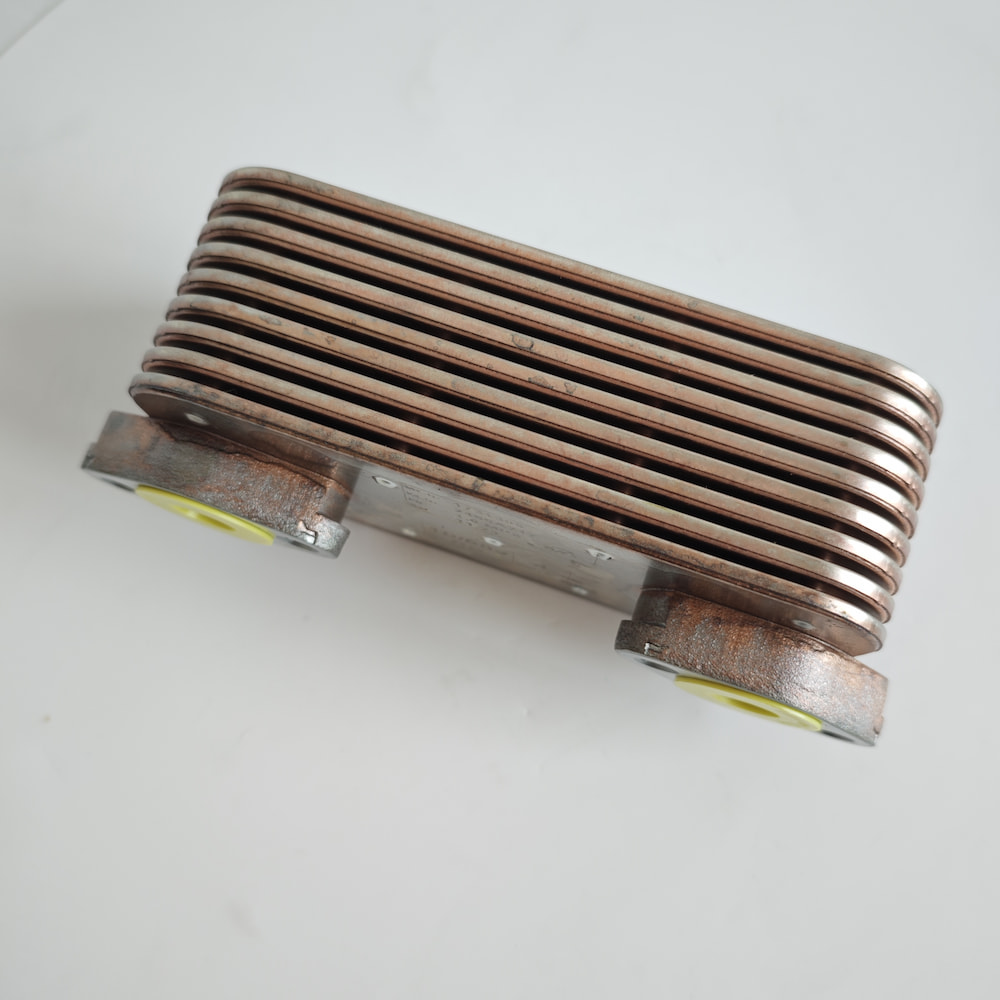
After Cross-Contamination Is Confirmed, Replacing One Part Is Not the End of the Repair
If oil and coolant cross-contamination has been confirmed, replacing the failed component is only one part of the repair.
The contaminated lubrication or cooling circuit should also be handled in accordance with the service requirements for the engine. This may include replacing contaminated fluids and required filters, and checking related passages and components for residual contamination.
The exact flushing, replacement, and inspection scope depends on the contamination level and the applicable service information.
Evidence of cross-contamination expands the inspection and cleanup scope. Replacing the failed oil cooler alone does not automatically complete the repair.
High oil temperature should also not be treated as proof that the oil cooler has failed. Oil-supply and oil-pressure problems can produce different lubrication-system symptoms. Temperature control and oil-pressure diagnosis are related but separate troubleshooting paths.
Information to Prepare Before Ordering
The complete engine model, Engine Serial Number, and Build List are the basic identification information.
If the removed cooler is available, also provide:
- The old oil-cooler part number;
- Clear photographs of both sides of the cooler;
- A photograph showing its installed location;
- An overall photograph of the housing or oil-filter-head area.
You do not need to determine whether the engine uses a block-mounted cooler, a filter-head-associated arrangement, or an integrated module before contacting the supplier. That can be checked from the engine records and the physical configuration.
If the cooler was removed because of an abnormal condition, describe what was found—for example coolant contamination, emulsified oil, visible deposits, or another observed symptom. This helps define the inspection and parts-confirmation scope.
Before ordering, also confirm which supply scope is being quoted and whether the required seals or installation parts are included.
When identification information is incomplete, the quotation should be treated as preliminary rather than final fitment confirmation.
How ZEB POWER Helps Confirm Perkins Oil Coolers
Send us the engine model, ESN, Build List, old part number, and installation photographs.
ZEB POWER can help confirm the applicable part number and supply scope, and determine whether the housing, seals, oil filter head, or related components in an integrated module also need to be checked.
If you are dealing with suspected oil/coolant cross-contamination, include the symptoms and any testing already completed. We can help identify the relevant parts and quotation scope, while the final fault location should still be confirmed by the technician responsible for diagnosis and repair.
Frequently Asked Questions
Are the Oil Cooler and Oil Filter Head the Same Part?
Not necessarily.
On some Perkins configurations, the oil cooler and filter head are closely integrated structurally, but their service-part scope still needs to be confirmed from the specific ESN, Build List, and parts information.
Do not assume they are one component simply because they are installed in the same area.
Do Deposits in the Coolant Mean the Oil Cooler or Head Gasket Has Failed?
Not by themselves.
The oil cooler is one component that should be inspected, but a cylinder-head gasket, cylinder block, or another oil/coolant boundary can produce similar contamination.
The fault source should be confirmed using the inspection and testing procedures applicable to the engine.
Should I Order a Core or a Complete Assembly?
That depends on the engine’s serviceable design, the actual damage, and whether the cooler core is available as an individual service part.
If the core can be supplied separately and the housing, sealing surfaces, and interfaces pass inspection, only the correct core may be required.
If the housing or interfaces are damaged, or if the oil cooler is part of a more integrated module, a broader supply scope may be necessary.
The decision should not be based on appearance alone.
Is Anything Else Required After Replacing a Cooler That Caused Cross-Contamination?
Usually, the contaminated lubrication or cooling circuit also needs to be handled according to the engine’s service requirements.
This can include replacing contaminated fluids and necessary filters and checking related passages or components for remaining contamination.
The exact flushing, replacement, and inspection scope should be determined from the contamination level and the applicable service information.
Do All Engine Oil Coolers Have a Built-In Bypass Valve?
No general rule should be applied.
Different engines control oil flow in different ways. Some use a dedicated oil thermostat, while the oil filter itself may contain a bypass valve.
The lubrication-system arrangement for the specific engine should be checked before ordering or diagnosing related components.