

Perkins Starter Motor Parts: What Does the Quote Include?

6547
Table of Contents
Generating table of contents
When an engine will not start, the first reaction is often:
“The starter is weak. Replace it.”
The difficulty is that a starter-motor fault and a starting-circuit fault can produce very similar symptoms. Slow cranking, a single click without cranking, or no response at all may come from the starter itself, but they may also come from the battery bank, cables, terminals, control circuit or engine mechanical condition.
Before asking which replacement starter to buy, one important point must therefore be established:
The symptom alone does not prove that the starter motor needs to be replaced.
Once testing confirms that the starter is the failed component, the purchasing challenge is still more complex than matching an engine model.
A starter motor has several independent compatibility conditions. The electrical supply must match. The pinion must engage correctly with the flywheel ring gear. The specified direction of rotation must be correct. The mounting flange, pilot diameter, pinion position and solenoid orientation must fit the engine and the available equipment space.
An error in any one of these areas does not merely reduce performance. It may prevent the starter from operating correctly or may damage the pinion and ring gear.
This guide explains those matching conditions and clarifies what an engine model can—and cannot—confirm when ordering a Perkins starter motor. It is intended for generator-set, construction-equipment and agricultural-machinery maintenance purchasing.
Final fault diagnosis, battery and cable testing, ring-gear inspection and installation should be completed by technicians with the appropriate electrical and mechanical service capability.
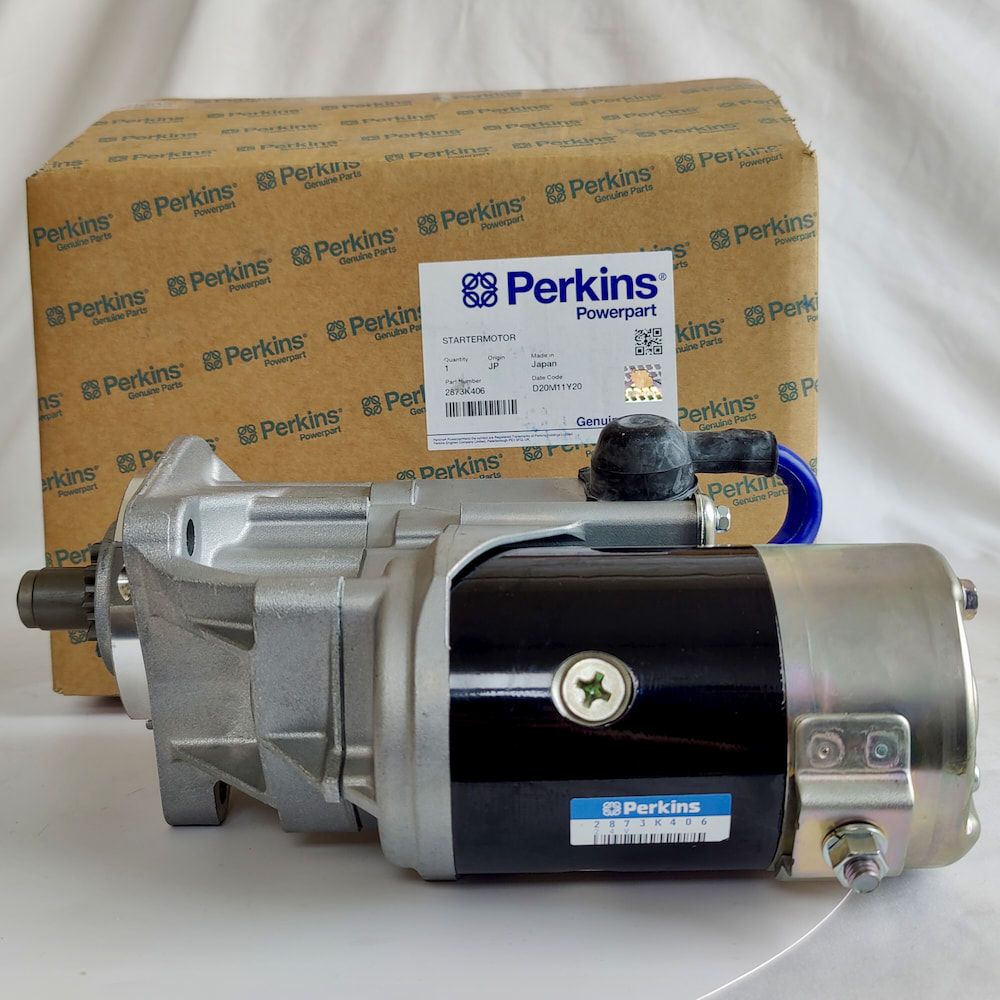
A No-Start Symptom Is Not Yet a Starter-Motor Order
Slow cranking is one of the easiest symptoms to misinterpret.
When the engine turns reluctantly, buyers often assume that the starter has lost power and should be replaced by a higher-output unit. Before increasing starter size, however, the battery bank and main cables should be tested.
A starter draws a large current during cranking. Corroded terminals, loose connections, undersized cables, damaged conductors or poor crimps increase resistance in the circuit. The battery may show the expected open-circuit voltage, while the voltage actually reaching the starter under load is much lower.
The result may be slow cranking, a click without rotation or another symptom that resembles starter failure.
This is why slow cranking should trigger an inspection of the complete starting circuit. It does not by itself prove that the starter has failed, that the original starter is undersized, or that a 12-volt system should be converted to 24 volts.
Installing a larger starter before checking the battery, cables, terminals and engine mechanical resistance may only hide the real problem.
Voltage Is the First Electrical Gate, but the Return Path Also Matters
The replacement starter must be designed for the existing 12-volt or 24-volt starting system. Voltage is not a stock option that can be changed without reviewing the entire electrical platform.
The armature, field system, solenoid and internal contacts are designed for a specific operating voltage. A voltage mismatch may result in poor engagement, inadequate cranking, abnormal electrical stress or component damage.
Correct voltage is still only the first electrical condition.
The negative return path must also be confirmed. Some starters are case grounded: the starter housing and engine structure form part of the negative circuit. Other heavy-duty installations use an insulated-return starter with a dedicated negative terminal rather than relying on the housing as the main return path.
If the replacement uses a different return arrangement, installation may require changes to the cable system rather than a direct remove-and-replace procedure.
The main battery stud and solenoid control terminals must also fit the existing wiring. Terminal size, position and orientation affect whether the cables can be connected without stretching, rubbing or contact with hot or moving parts.
A starter can have the correct voltage and still be unsuitable for the original electrical installation.
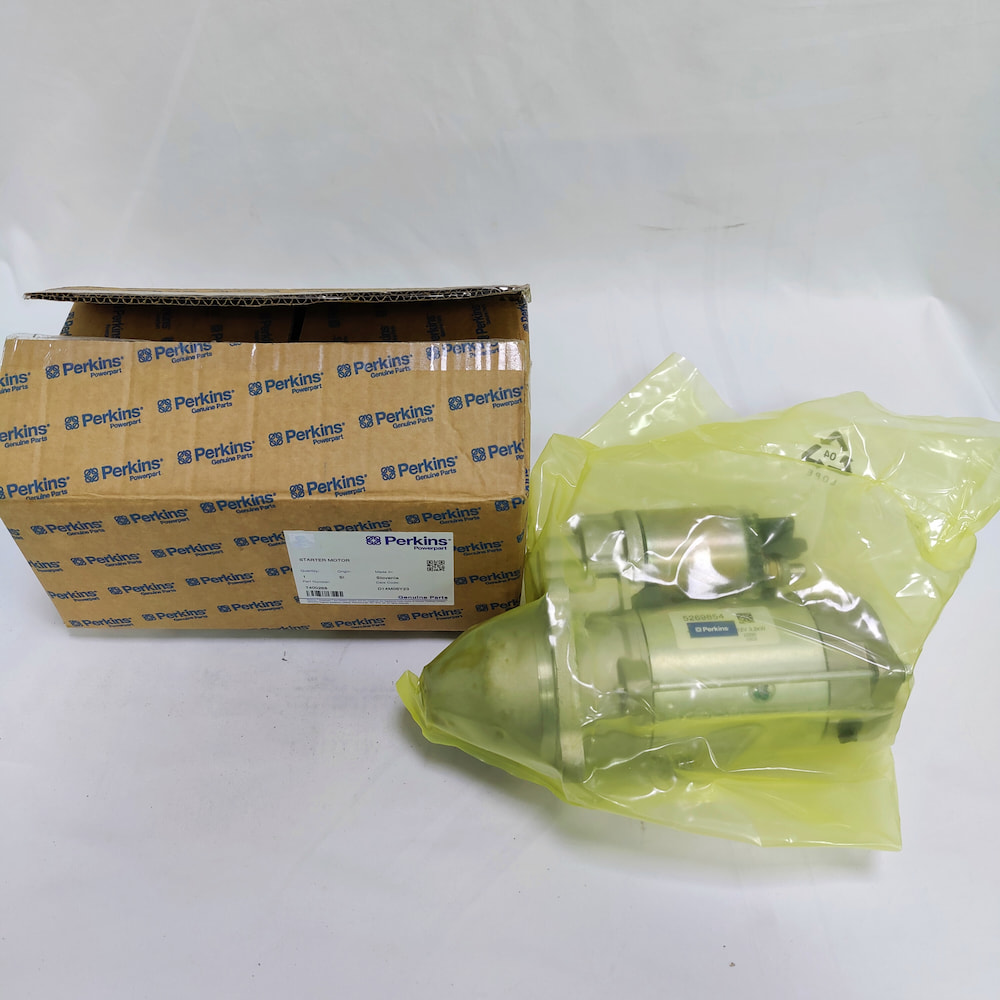
Pinion Engagement: Matching Tooth Count Is Not Enough
The starter transfers torque to the crankshaft through a small drive gear called the pinion, which engages with the flywheel ring gear.
Counting the teeth on the old pinion is useful, but tooth count alone does not confirm compatibility.
Two pinions with the same number of teeth may still differ in pitch or module, outside diameter, tooth width and axial position. The pinion centreline and its distance from the starter mounting face also affect how it reaches the ring gear.
An incorrect tooth form or engagement position may cause impact noise, incomplete engagement, insufficient mesh or damage after repeated starts.
Pinion tooth count should therefore be treated as one matching parameter, not as a complete ordering rule.
The reverse is also important:
A different pinion tooth count does not automatically mean that the replacement starter is wrong.
A verified replacement design may use a different pinion diameter, tooth count or shaft offset while still engaging correctly with the original ring gear. The key question is not whether the old and new tooth counts are identical. It is whether the difference is supported by a formal, validated replacement relationship for the engine and ring gear.
A supplier’s unsupported statement that “this one should also work” is not enough.
Inspect the Ring Gear and Preserve Any Required Spacer
Pinion damage does not always begin inside the starter.
If the flywheel ring gear has rounded teeth, burrs, broken sections or severe local wear, installing a new starter will not correct the ring-gear problem. The damaged gear may quickly harm the replacement pinion.
The appropriate principle is:
Starter damage expands the inspection scope; it does not automatically expand the replacement scope.
When pinion damage is found, the ring gear should be inspected. The flywheel or ring gear should only be added to the parts order when the inspection shows that replacement is necessary.
Spacers and shims also require attention.
Some starter installations use a spacer or shim between the starter and flywheel housing to control the relative position and clearance between the pinion and ring gear. This part may remain attached to the old starter during removal and can easily be discarded as if it were part of the failed unit.
Where the spacer belongs to the engine-side installation, omitting it from the replacement installation may alter the engagement geometry and lead to gear damage.
Before discarding the old starter, record whether a spacer is present, its position and thickness, and whether the replacement procedure requires it to be transferred.
A supplier should not state that no spacer is required without first confirming the original installation.
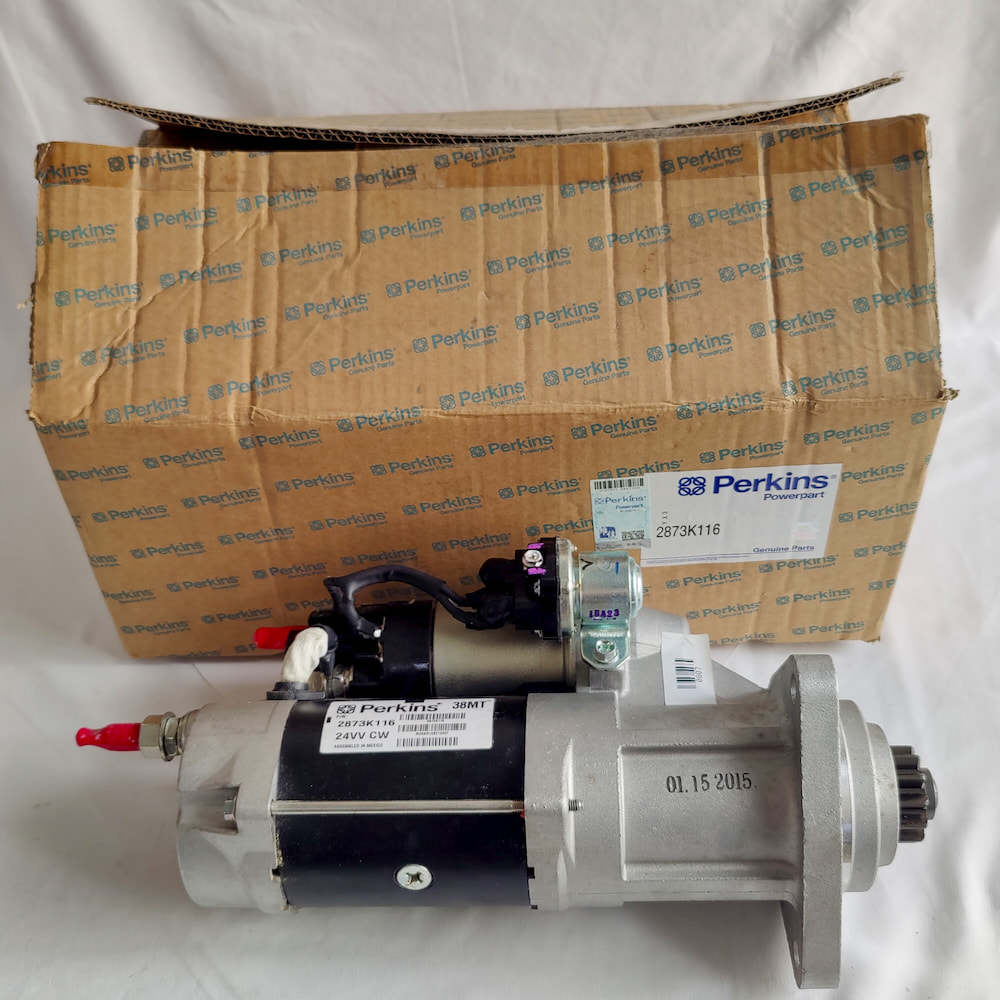
Rotation Cannot Be Confirmed by Saying “Clockwise” Alone
Starter rotation is commonly described as clockwise or counterclockwise, but those words are meaningful only when both parties use the same viewing direction.
A starter viewed from the pinion end may appear to rotate in the opposite direction when viewed from the motor end. A buyer and supplier may therefore give opposite descriptions of the same unit while both believe they are correct.
If the specified rotation does not match the application, the starter cannot be assumed to engage and drive the original ring gear correctly. The result may be failure to crank, abnormal engagement or gear impact, depending on the starter-drive and mounting design.
The safer method is to use the formal rotation specification published for the starter model and to confirm the complete old starter number or a validated cross-reference.
Do not rely solely on hand-turning the old unit, interpreting one photograph, or writing “CW” without knowing the manufacturer’s reference end.
Mounting Geometry and Solenoid Orientation Determine Whether the Starter Truly Fits
A starter is not mechanically matched merely because two or three bolt holes align.
The mounting-hole pattern, bolt diameter, flange thickness, pilot diameter and pinion projection from the mounting face determine the position of the pinion relative to the ring gear.
If the mounting face does not sit flat, or if the wrong spacer or fastener arrangement is used, the starter may be slightly misaligned and produce abnormal gear engagement.
Some heavy-duty starters use a clockable drive housing or another adjustable mounting structure. This allows the starter body, solenoid and terminals to be repositioned relative to the mounting flange.
Clocking is not an improvised solution for an incorrect mounting pattern. It must be performed within the permitted positions and according to the product’s assembly procedure. Terminal positions, drain features and nearby equipment must still be checked.
Solenoid orientation is especially important because the starter is often surrounded by engine mounts, exhaust components, the oil pan, hydraulic pipes, the equipment frame and wiring harnesses.
A replacement with the correct flange may still interfere with nearby structures or leave insufficient room for safe cable routing if the solenoid is positioned differently.
The best evidence is a set of photographs taken before removal. These should show the installed starter, the flange-to-solenoid relationship from the pinion end, the main and control terminals, cable routing and the available surrounding space.
A data-plate photograph may identify the old starter, but it cannot show whether a differently clocked replacement will fit the machine.
An Engine-Series Name Narrows the Search but Does Not Identify One Starter
“Perkins 1104 starter motor” is a useful search phrase. It is not normally a final order description.
The same engine family may use different starter versions because of the starting-system voltage, engine prefix, flywheel housing and ring gear, equipment application, production stage or an approved service replacement.
The full Engine Serial Number, Build List where available, old starter number and installation photographs should therefore be checked together.
The engine identity describes the original factory configuration. The old starter and installation photographs show what is currently installed.
If the electrical system, flywheel housing or engine installation has been modified, relying only on the original engine identity may be incomplete. Relying only on an unidentified old starter may also repeat a previous mismatch.
The two evidence sets should support each other.
A Different-Looking Starter May Still Be the Correct Replacement
A gear-reduction starter uses an internal reduction mechanism to produce the required cranking torque with a more compact motor design. It may therefore look very different from an older straight-drive starter.
A different appearance does not automatically make the replacement incorrect. Verified applications may use a gear-reduction starter in place of a straight-drive unit.
This does not mean that any gear-reduction starter with similar output can be substituted.
The replacement must still match the system voltage and return path, cranking capability, mounting geometry, pinion and ring gear, rotation, spacer requirement, solenoid and control circuit, and available installation space.
Two principles should be applied together:
Different appearance does not necessarily mean incorrect. Similar appearance does not necessarily mean compatible.
A validated application relationship is more reliable than visual similarity.
What Does the Quotation Actually Include?
A quotation labelled “Starter Motor” may refer to very different supply scopes.
It may be a complete starter assembly ready for installation. It may instead cover a solenoid, drive mechanism, repair kit, brush set, armature or another internal component.
The quotation should state whether the product is a complete assembly, whether the solenoid is included, whether mounting hardware or a spacer is supplied, and whether any electrical or mechanical parts must be reused from the old unit.
Product condition is another important distinction.
A new starter normally provides a clearer manufacturing and supply history, although price and lead time may be higher. A remanufactured starter should identify the remanufacturer, the inspection and replacement scope, whether the armature, bearings, bushings, brushes, drive and solenoid were tested or renewed, and whether no-load and load testing was completed.
Any Core Return requirement, warranty and return condition should also be stated.
A verified replacement starter should be supported by a formal cross-reference and complete electrical and mechanical specifications. “Same voltage, same holes and more power” is not sufficient evidence of compatibility.
Two Quotations Must Represent the Same Starting Task
Two quotations may both say “Perkins Starter Motor” while representing different configurations.
Before comparing price, the buyer should align the system voltage, negative-return arrangement, formal starter number, cranking capability and design type; the pinion tooth count, pitch or module and ring-gear relationship; the mounting flange, pilot and installation depth; the formal rotation specification; the solenoid position; any required spacer; and the product condition, warranty, testing and Core terms.
The correct comparison is not simply between two prices.
It is whether both quotations can operate in the same electrical system, engage the same ring gear correctly and fit the same equipment space.
If a supplier can provide only the voltage and a broad engine description but cannot confirm the remaining interfaces, the practical usability of the quotation remains uncertain.
Information to Provide Before Ordering
A starter-motor inquiry that can be checked efficiently should include the complete engine model, full Engine Serial Number, Build List where available, equipment make and model, and the application.
The buyer should also provide the starting-system voltage and battery arrangement, the complete number on the old starter where readable, and photographs of the pinion end, mounting flange, data plate, solenoid and electrical terminals.
State whether the original installation uses a spacer or shim, whether the starter is case grounded or uses a dedicated negative terminal, how much installation space is available, and whether new, remanufactured or verified replacement products are acceptable.
Any completed battery test, cable voltage-drop test and ring-gear inspection should also be reported.
If the old starter is still installed, photograph the main cable, control wiring, solenoid orientation and surrounding equipment before removal. These details are difficult to reconstruct from one data-plate photograph after the unit has been removed.
When Can the Order Be Finalised?
A Perkins starter-motor order should meet four conditions before it is treated as final.
First, the starting voltage, negative-return arrangement and terminal configuration have been confirmed.
Second, the pinion, ring gear and any required spacer relationship have been verified directly or through a formal part number and validated replacement relationship.
Third, the flange, pilot diameter, installation depth, formal rotation specification and solenoid orientation have been checked against the engine and equipment space.
Fourth, the quotation scope and product condition are clear, including whether the offer is for a complete assembly, which accessories are included, and whether Core Return conditions apply.
If these points remain unresolved, a supplier may provide an estimated price and lead time, but the quotation should not be treated as an unchangeable final order.
How ZEB Power Helps Review Perkins Starter Motors
ZEB Power supplies Perkins starter-motor components for generator-set, construction-equipment and agricultural-machinery projects.
Using the engine model, full serial number, Build List where available, old starter identification and installation photographs, ZEB Power can help review system voltage, return-path configuration, pinion compatibility, mounting interface, formal rotation specification, solenoid orientation and validated replacement relationships.
ZEB Power can also help determine whether different quotations represent the same starting task and distinguish among a complete starter assembly, repair components, new units, remanufactured units and verified replacement products.
Final diagnosis of the starting fault, battery and cable testing, ring-gear inspection and on-site installation should remain with technicians who have the appropriate test and service capability.
Provide the engine data plate, full serial number, old starter number, and photographs of the pinion end, mounting flange, solenoid and wiring terminals. ZEB Power can help convert a general “Starter Motor” request into a supply scope that can be checked, quoted and inspected on receipt.
Frequently Asked Questions
Can Perkins Starters Be Interchanged if They Have the Same Voltage?
No. Voltage is only one condition. The return path, pinion engagement, rotation, mounting flange, installation depth and solenoid position must also match.
Why Can a Starter with the Same Pinion Tooth Count Still Be Wrong?
The same tooth count does not guarantee the same pitch, module, diameter or pinion position. These details also determine whether the starter can engage the ring gear correctly.
Does a Different Pinion Tooth Count Mean the New Starter Is Incorrect?
Not always. A validated replacement design may use a different pinion and shaft position while still matching the original ring gear. The difference must be supported by a formal replacement relationship, not only by a supplier’s verbal assurance.
Does One Click Without Cranking Prove That the Starter Has Failed?
No. Battery condition, cable voltage drop, the control circuit, solenoid supply and engine mechanical resistance may produce similar symptoms. The starting system should be tested before the starter is replaced.
Should the Flywheel Ring Gear Be Checked When Replacing the Starter?
Yes. A worn or damaged ring gear may quickly damage the replacement pinion. Whether the ring gear itself must be replaced should be decided from the inspection result.
Can a Straight-Drive Starter Be Replaced by a Gear-Reduction Starter?
Only when the replacement application has been validated and the voltage, return path, cranking capability, pinion, mounting geometry, rotation, spacer, control circuit and equipment space all match.