

Perkins Alternator Parts: Charging Unit or Main AC Alternator?

7324
Table of Contents
Generating table of contents
“I need an alternator for my Perkins generator.”
The request appears to contain all the necessary information: the brand, the equipment type and the component name. Yet the first thing a supplier needs to establish is often not the part number, but which alternator the buyer actually means.
In the generator-set industry, the word “alternator” is naturally ambiguous. It may refer to the engine-mounted charging alternator, which is belt driven and supplies the starting batteries, engine controller, instruments and low-voltage electrical system. It may also refer to the main AC alternator, also called the generator end, which is connected at the flywheel end and determines the generator set’s kVA, voltage, frequency and phase configuration.
Both components are commonly called alternators, but they are completely different products and require different matching procedures. If the buyer needs the main AC alternator, the relevant parameters include kVA, phase, frequency, pole count, excitation and coupling—none of which belong to the purchasing logic discussed here.
The first step is therefore to identify the component clearly.
This guide covers only the engine-mounted charging alternator used with Perkins engines to support the battery bank and low-voltage electrical system.
Once the correct component has been identified, matching can be divided into three levels:
Confirm the electrical identity, verify that the output is suitable for the real operating conditions, and then confirm that the unit matches the original mounting, pulley and rotation configuration.
A charging warning light, a discharged battery or low system voltage does not automatically prove that the alternator itself has failed. That distinction is addressed separately below.
Final electrical diagnosis, system testing and installation should be completed by technicians with the appropriate test capability and service information.
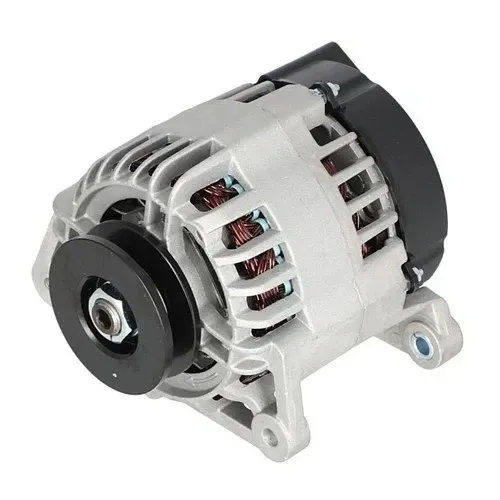
First Level: Electrical Identity—Voltage, Grounding and Regulator Connections
Before output and mounting are considered, the charging alternator must be electrically compatible with the system it will enter.
System Voltage
The charging voltage should not be inferred from engine size or from the number of batteries alone.
Two 12-volt batteries may be connected in parallel to form a 12-volt battery bank, or in series to form a 24-volt system. Battery quantity by itself does not identify the alternator voltage.
A voltage mismatch may immediately produce no charging, overvoltage, abnormal regulation or incorrect operation of electrical components. It may also cause further damage after continued operation. Compatibility cannot be confirmed merely because the plug or mounting interface appears to fit.
Grounding Arrangement
The negative return path is easy to overlook.
Some alternators use the housing, mounting brackets and engine structure as the ground path. Other applications use a dedicated negative terminal or an insulated-return arrangement.
If the original system uses a separate negative connection but the replacement relies on case grounding—or the reverse—the installation may require cable and grounding modifications rather than a direct replacement.
The B+ output stud also needs to match the original cable in size, orientation and insulation. A terminal that is too small, faces the wrong direction or has insufficient surrounding clearance can reduce installation quality and long-term reliability.
Regulator and Control Connections
The regulator type is one of the most frequently missed compatibility conditions.
An internally regulated alternator is not automatically a one-wire alternator. A true self-exciting one-wire design is only one specific type of internally regulated unit. Many internally regulated alternators still require an ignition or excitation signal, a warning-lamp circuit, or a separate Remote Sense connection.
Remote Sense monitors voltage at the battery or a main distribution point and allows the regulator to compensate for voltage drop between the alternator and the battery.
If the original system depends on Remote Sense but the replacement does not provide the same function, the wire is connected incorrectly, or the sensing point is wrong, the battery may not receive the charging voltage intended by the original system.
Different alternator models respond differently when the Sense circuit is disconnected. Some may revert to internal sensing, while others should not be assumed to behave in the same way. A clear warning may not always be produced. The correct connection must be confirmed from the wiring information for the specific product.
A mismatch in the connector or control logic may result in no charging, excitation problems, incorrect voltage regulation or loss of related signals.
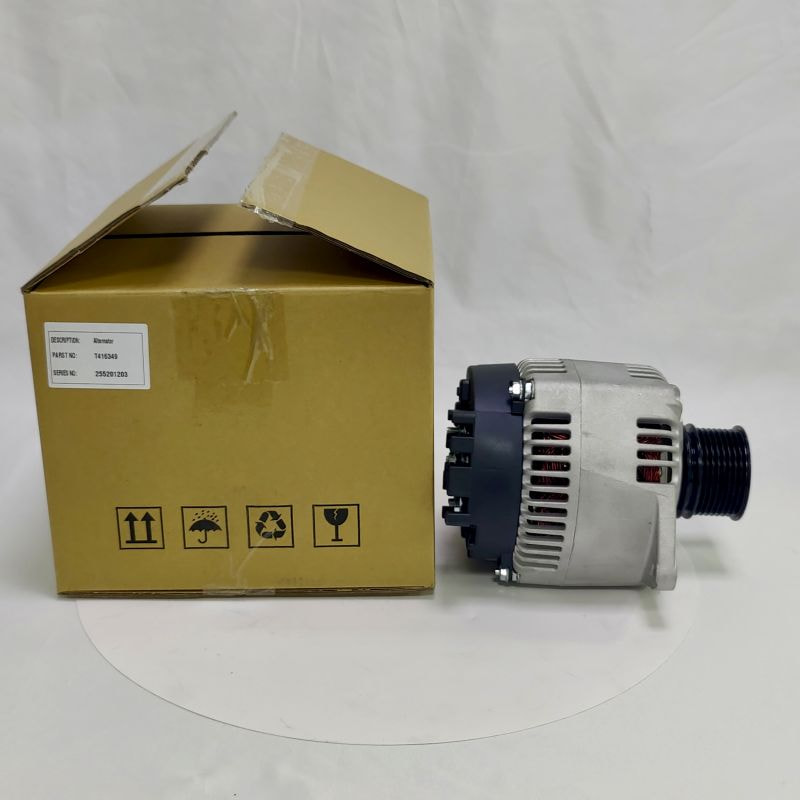
Second Level: Output Must Match the Operating Conditions, Not Just the Nameplate
Rated output is the alternator’s maximum stated capability under defined conditions. It is not the current that the alternator delivers continuously whenever the engine is running.
Actual output depends on the electrical load, battery state of charge, regulator control and alternator speed.
Two operating patterns should be distinguished.
Equipment that spends extended periods at low engine speed or idle—such as some industrial machines or marine auxiliary applications—requires particular attention to low-speed output.
A generator set operating at a fixed rated speed, commonly 1,500 or 1,800 rpm, should instead be evaluated according to the charging-alternator output available at that operating speed. It does not belong to the same “idle-output reduction” scenario.
The replacement alternator should not have less output capability than the equipment requires under its most demanding normal operating condition. A unit that is consistently undersized may fail to restore the battery state of charge and may operate at high load for long periods, increasing the risk of overheating and shortened service life.
The reverse also needs qualification:
A higher rated current does not mean the alternator will deliver that maximum current at all times.
The system draws significant current when the battery is deeply discharged, additional electrical loads have been installed, or the equipment genuinely demands more power. Under those conditions, the original B+ cable, circuit protection, ground path, belt drive and mounting structure may become limiting factors.
Before upgrading from a 55-amp alternator to a 100-amp or higher-output unit, the likely maximum operating current should be reviewed. The decision should not be based on nameplate amperage alone.
Pulley Diameter and Real Alternator Speed
Pulley diameter directly affects the alternator’s operating speed.
The approximate relationship is:
Alternator speed ≈ engine speed × crankshaft-pulley effective diameter ÷ alternator-pulley effective diameter
A smaller alternator pulley generally increases alternator speed at the same engine rpm and may improve low-speed output. It also raises alternator speed at the engine’s maximum rpm.
A larger alternator pulley has the opposite effect.
Two alternators with the same rated current may therefore deliver different real-world output on the same engine if their pulley diameters differ.
Third Level: Physical Installation—Brackets, Pulley and Rotation Configuration
An alternator that can be placed near the original mounting position is not necessarily capable of being secured and tensioned correctly.
The mounting-ear spacing, ear thickness, bolt diameter, pivot position and adjustment-arm location all need to match.
If the ear spacing is different, the installation may require non-standard spacers or bracket modification. If the adjustment arm is positioned differently, the belt may not be capable of reaching the correct tension.
The mounting bracket also carries the alternator’s operating load. Improvised welding, excessively long bolts or large stacks of washers should not be used to compensate for a clearly incompatible mounting structure.
Pulley Configuration
The pulley must be checked for:
- belt type, including V-belt or multi-rib;
- number of grooves;
- effective diameter;
- offset;
- shaft and hub connection;
- alignment with the crankshaft and other driven accessories.
The question is not merely whether the belt can be placed over the pulley.
If the replacement alternator is supplied without a pulley, the buyer must confirm that the old pulley can be removed without damage and transferred to the new unit. The shaft diameter, keyway, thread and fastening method must also match.
If the quotation includes a pulley, its groove profile, diameter and offset should correspond to the original drive system.
Rotation Configuration
Rotation should not be inferred from the engine model or from external appearance.
The polarity of the alternator’s DC output is established by its internal rectifier system, so reversing shaft rotation should not be simplified into a universal statement that the alternator will produce no charge.
However, a specific alternator may have rotation requirements because of its cooling fan, overrunning pulley, internal airflow or accessory-drive design. Some products permit bidirectional rotation, while others are specified for one direction.
The old alternator number and the manufacturer’s specifications should therefore be used to confirm the approved rotation. Reverse operation should not be assumed acceptable without verification.
Low Charging Voltage Does Not Prove That the Alternator Has Failed
Low battery voltage, an illuminated charging lamp or repeated battery discharge is often converted directly into an alternator order.
The real cause may instead be:
- a loose or slipping belt;
- a corroded or loose B+ terminal;
- excessive positive-cable voltage drop;
- poor engine or alternator grounding;
- an ageing or damaged battery;
- a Remote Sense fault;
- an excitation or warning-lamp circuit problem;
- insufficient alternator speed.
The more reliable principle is:
A charging fault should expand the inspection scope across the complete charging circuit; it should not automatically place the alternator on the replacement list.
If the alternator is replaced while a corroded terminal, poor ground or slipping belt remains unresolved, the replacement unit may show the same symptoms and may also be exposed to further damage.
One Perkins Engine Series May Use More Than One Alternator Version
“Perkins 1104 alternator” is useful as a search phrase, but it is normally insufficient as a final order description.
One engine family may use different charging-alternator versions because of system voltage, rated output, production stage, equipment application or electrical-load requirements.
The Engine Serial Number and Build List describe the original configuration. The old alternator number and installation photographs show what is currently installed.
These information sources should be checked together.
If lighting, heaters, controllers or other electrical loads were added later, the original alternator may already have been upgraded. If the installed alternator is an unidentified replacement, purchasing another unit solely from the old part may repeat an earlier mismatch.
Engine identity, old-unit information and the current electrical load should therefore be considered together.
Align the Quotation Scope Before Comparing Price
“Alternator” is not a fixed bill of materials.
One quotation may cover the alternator body only. Another may include the regulator, pulley, cooling fan or adjustment bracket.
If the supply scope is not clarified before price comparison, the apparently cheaper quotation may require additional pulleys, brackets or electrical parts after delivery.
Product condition also matters.
A new alternator normally provides the clearest manufacturing source and warranty boundary, although its price and lead time may be higher.
A remanufactured alternator should identify the remanufacturer, the parts inspected or replaced, the test scope and any Core Return requirements.
A Rewound unit usually emphasises that the stator or rotor winding has been repaired or rewound. That description alone does not prove that the complete alternator has undergone a full remanufacturing process. The supplier should state separately whether the bearings, brushes or slip rings, rectifier, regulator and pulley were inspected or replaced.
The term “Rewound” should not be treated as an industry category with one universally fixed processing scope.
A verified replacement alternator may be a reasonable option, but the supplier should be able to confirm the cross-reference and take responsibility for the output, regulator, pulley and mounting interfaces.
Before comparing price, confirm exactly what each quotation includes.
Information to Provide Before Ordering
Begin by stating whether the requirement is for an engine-mounted charging alternator or the generator set’s main AC alternator.
For a charging-alternator inquiry, provide:
- the complete engine model;
- the full Engine Serial Number;
- the Build List, where available;
- equipment type and application;
- system voltage;
- battery-bank connection;
- old alternator part number and manufacturer number;
- nameplate photographs;
- pulley, mounting-bracket and rear-terminal photographs;
- belt type, groove count and pulley diameter;
- grounding arrangement;
- regulator connector and terminal wiring;
- details of any additional electrical loads or modifications.
A full set of photographs is more useful than a single front view.
If the alternator is still installed, photograph the belt path, mounting bracket, adjustment arm, terminal wiring and surrounding clearance before removal.
When Can the Order Be Finalised?
A Perkins charging-alternator order should not be treated as final until the following points have been confirmed:
- The requested component is the engine charging alternator, not the generator main alternator.
- System voltage, grounding arrangement and rated output have been verified.
- Pulley specifications, mounting interfaces and belt alignment have been checked.
- Regulator type, terminal functions and quotation scope are clear.
If this information remains incomplete, the supplier may provide an estimated price and lead time, but the quotation should not be treated as an unchangeable final order.
How ZEB Power Helps Review Perkins Charging Alternators
ZEB Power uses the engine model, full serial number, Build List where available, application, old alternator number and photographs to help buyers identify whether they require an engine charging alternator or a generator main alternator.
For engine-mounted charging alternators, ZEB Power can help review the system voltage, grounding arrangement, rated output, pulley, mounting interface, regulator and terminal configuration, and can compare whether different quotations cover the same charging task.
Final diagnosis of the charging fault, battery and cable testing, electrical-load assessment and on-site installation should remain with technicians who have the appropriate test capability.
Provide the Perkins engine data plate, full serial number, old alternator number, and photographs of the pulley, mounting bracket, regulator connector and wiring terminals. ZEB Power can help convert a general “Alternator” request into a supply scope that can be checked, quoted and inspected on receipt.
Frequently Asked Questions
Does “Alternator” Always Mean the Engine Charging Alternator on a Generator Set?
No. In the generator-set industry, it may also refer to the main AC alternator or generator end. The required component should be identified before parts matching begins.
Can Two 24-Volt Perkins Charging Alternators Be Interchanged?
Not automatically. Rated output, grounding arrangement, regulator type, pulley and mounting interface must also match.
Can a Higher-Output Alternator Replace the Original Unit?
Not on rated output alone. The B+ cable, circuit protection, grounding, belt drive and mounting structure should be checked against the maximum current the system may actually demand.
Will an Alternator Stop Charging if It Rotates in the Opposite Direction?
Not necessarily. The DC output polarity is controlled by the internal rectifier system. However, a specific model may have rotation requirements because of its cooling fan, overrunning pulley or airflow design. The approved rotation should be confirmed from the part number and manufacturer specifications.
Does Low Charging Voltage Prove That the Alternator Is Faulty?
No. Belt slip, battery condition, cable voltage drop, poor grounding and excitation or Sense-circuit faults can produce similar symptoms. The complete charging circuit should be tested first.
Are Rewound and Remanufactured Alternators the Same?
Not necessarily. “Rewound” usually indicates winding repair or replacement, while the condition of the bearings, brushes, rectifier, regulator and other components must be confirmed separately.
Does Pulley Diameter Affect Charging Output?
Yes. The pulley ratio determines alternator speed at a given engine speed, which directly affects real output—particularly at low rpm.