

Cummins Starter Motor: 12V/24V, ESN & Part Number Matching

8647
Table of Contents
Generating table of contents
A Cummins starter motor may look like a simple component that only needs to be bolted into place and connected. In practice, it is one of the higher-risk electrical parts to match correctly.
A similar housing or mounting pattern does not guarantee that the system voltage, pinion specification, rotation, rated power, or grounding arrangement is compatible. A mismatch may result in installation problems, weak cranking, incorrect gear engagement, or abnormal wear. In more serious cases, it may damage the starter motor or flywheel ring gear.
Another common purchasing issue is quotation scope. Different suppliers may use the same term, “starter motor,” for different products. One quotation may cover a complete starter assembly, while another may cover only the motor body, solenoid, drive, or individual repair parts. These prices are not directly comparable.
This guide explains:
- What Starter Motor, Complete Starter, Solenoid, and Starter Drive normally mean
- Which electrical and mechanical parameters must be checked
- How to choose among genuine new, formal remanufactured, and aftermarket new options
- What information to prepare before ordering
- How to compare quotations from different suppliers
No-crank, slow-crank, clicking, or free-spinning symptoms do not prove that the starter motor itself has failed. The actual cause should be confirmed by a qualified local workshop. This article focuses on how to purchase the correct part after replacement has been confirmed.
It is intended for maintenance and purchasing teams responsible for construction machinery, mining equipment, generator sets, and industrial equipment, particularly where both 12V and 24V systems are in service or several supplier quotations must be compared.
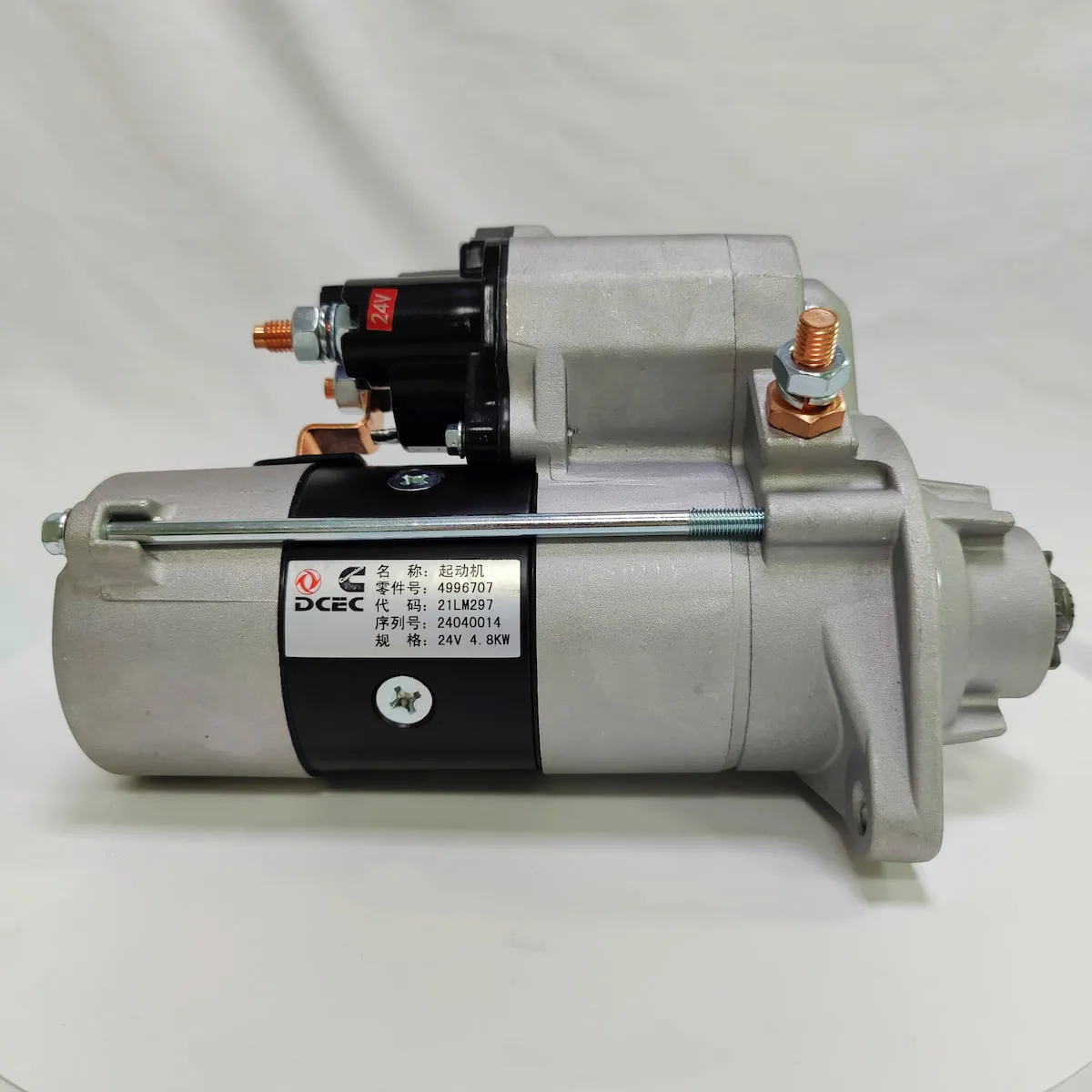
Starter Motor, Complete Starter and Solenoid: Confirm the Quotation Scope
Before comparing prices, confirm whether the supplier is quoting a complete assembly or an individual component.
| Term | Common meaning | What to confirm |
|---|---|---|
| Starter Motor / Starting Motor | General term for the electric starting unit | Complete assembly or motor body only |
| Starter Assembly / Complete Starter | Fully assembled starter motor | Whether it includes the solenoid, drive assembly, mounting flange, and terminals |
| Starter Solenoid | Electromagnetic switch that connects starting current and operates the drive mechanism | Supplied separately or included with the complete starter |
| Starter Drive / Pinion Drive | Drive assembly that engages the flywheel ring gear | Tooth count, pitch, offset, drive design, and applicable starter model |
| Starter Relay | Relay in the starting-control circuit | Must not be confused with the starter-mounted solenoid |
| Starter Repair Parts | Brushes, bearings, bushings, drive parts, solenoids, and other service components | Exact contents, applicable starter model, and local repair capability |
A quotation described as a “Cummins Starter Motor” may actually cover:
- A complete new starter motor
- A starter body without certain accessories
- A separate starter solenoid
- A starter drive
- A repair kit or individual internal part
- A genuine new, formal remanufactured, aftermarket new, or ordinary rebuilt unit
The inquiry should therefore ask directly:
Is this a complete starter motor assembly, and does the quotation include the solenoid, drive assembly, and required installation parts?
Why Starter Motors Are Easy to Mismatch
Starter motor selection is not determined by the engine model alone. The following specifications normally need to be checked together:
- System voltage: 12V or 24V
- Pinion and engagement specification: pinion teeth, pitch, module, offset, and drive design
- Rotation: clockwise or counterclockwise
- Rated power and application: whether it meets the starting requirement of the engine and equipment
- Mounting interface: SAE #1, SAE #3, pad mount, or another arrangement
- Grounding arrangement: grounded or insulated
- Solenoid position: whether cable routing and surrounding clearance are suitable
- Protection configuration: OCP or another protection feature, where applicable
- Part number and supersession: whether the quoted number is a valid replacement
Many of these differences are difficult to confirm from appearance alone. This is why descriptions such as “6BT starter,” “QSB6.7 starter,” or “24V Cummins starter” are usually not sufficient for final parts matching.
The same Cummins engine family may use different starter motors because of differences in the electrical system, flywheel housing, equipment application, production configuration, or previous field modification.
A Starting Problem Does Not Always Mean the Starter Has Failed
A no-crank condition, slow cranking, a clicking sound, or a starter that spins without engaging does not prove that the starter motor itself is defective.
Similar symptoms may involve:
- Battery condition
- Main power cables and grounds
- Starting-control circuit
- Starter relay or solenoid
- Long-term undercharging by the alternator
- Excessive mechanical resistance in the engine
The detailed checks should be carried out by a qualified local workshop using the equipment documentation and suitable test tools. This article does not provide a full starting-system diagnostic procedure.
Before ordering, confirm:
- Whether the workshop has determined that starter replacement is required
- Whether the requirement is for a complete starter, solenoid, or another component
- Whether the equipment uses a 12V or 24V starting system
- Whether the formal part number can be read from the old starter
Symptoms may be supplied as background information, but they do not replace the engine serial number, old part number, and physical configuration details.
Voltage: The First Specification to Confirm
Whether the equipment uses a 12V or 24V starter is one of the most basic and important questions.
The same Cummins engine family may be installed in equipment with different starting-system voltages. Mining contractors, generator-set operators, and construction-equipment fleets may also operate both 12V and 24V machines, making purchasing errors more likely.
A voltage mismatch may result in:
- Abnormal cranking speed
- Insufficient cranking performance
- Starter overheating
- Damage to the starter motor or related electrical components
A 12V and 24V version should not be treated as interchangeable simply because the housing and mounting holes appear identical.
Check the voltage using, in order of preference:
- The old starter nameplate
- The equipment wiring diagram or technical documentation
- The actual battery-bank connection
- The formal old starter part number
Two 12V batteries do not automatically indicate a 24V system. They may be connected in series or in parallel. The actual arrangement should be confirmed from the equipment documentation or by the local service provider.
When the voltage cannot be confirmed immediately, send the old starter nameplate, overall photos, and engine ESN so that the supplier can check the available references.
Pinion Teeth, Pitch and Flywheel Ring-Gear Engagement
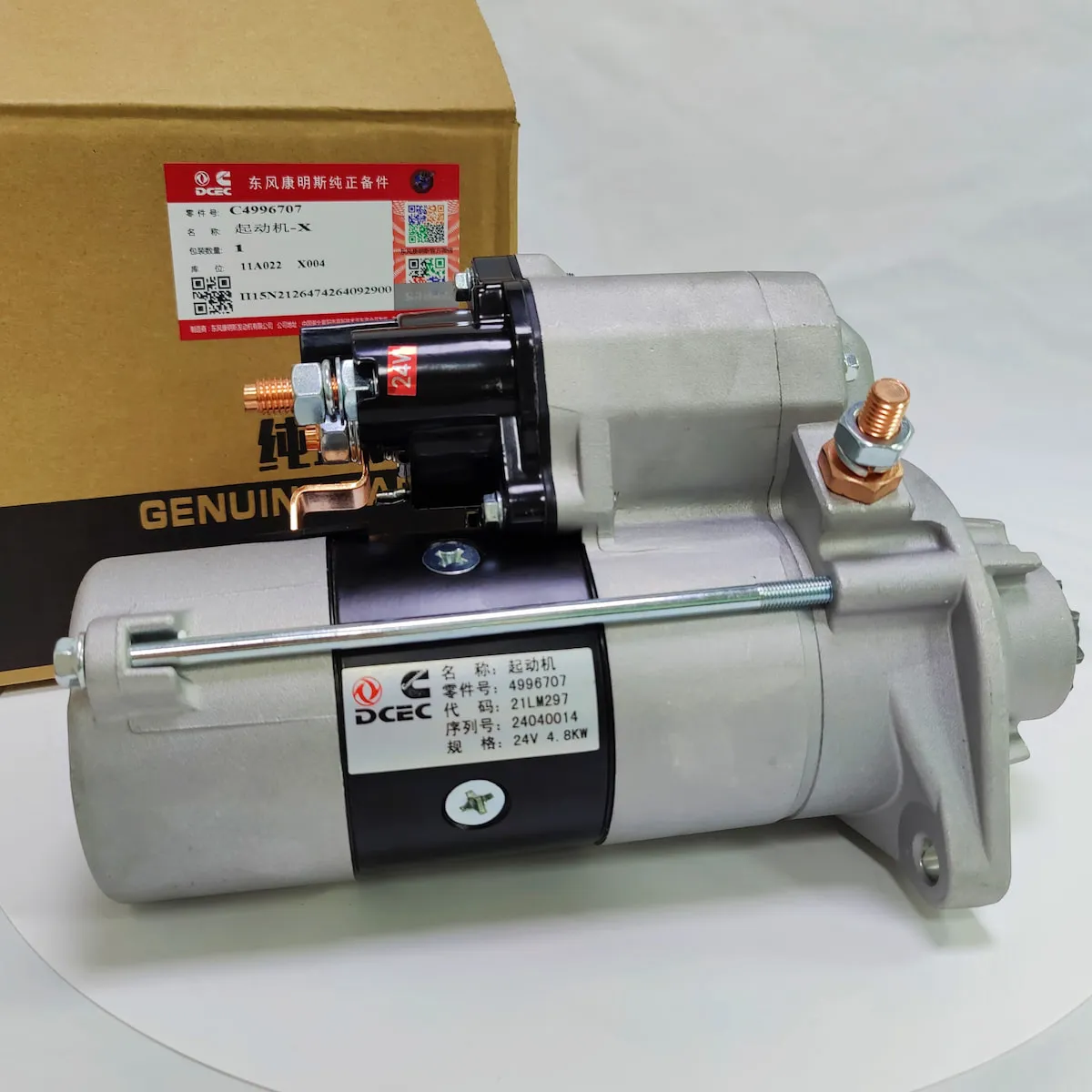
The starter pinion must be compatible with the tooth form, pitch, and engagement arrangement of the engine flywheel ring gear.
One common misunderstanding should be avoided:
The starter pinion and flywheel ring gear do not need to have the same number of teeth. They are designed as gears with different tooth counts.
What needs to be checked includes:
- Pinion Teeth: starter pinion tooth count
- Pinion Pitch or Module: tooth pitch or module
- Pinion offset
- Drive design
- Compatibility with the applicable flywheel ring gear
Two starter motors may have the same pinion tooth count and still be incompatible because the pitch, offset, or drive design is different.
Conversely, a manufacturer-approved supersession may occasionally use a different pinion tooth count or drive design from the original unit. Counting teeth by hand is therefore useful only as supporting information. It cannot replace the formal part number and confirmed supersession.
Photos can help identify the pinion shape and drive arrangement, but an incomplete viewing angle may still lead to an incorrect conclusion. The old starter part number should take priority over appearance and manual tooth counting.
An incorrect drive configuration may cause:
- Failure to engage correctly
- Abnormal noise during cranking
- Starter free-spinning
- Abnormal wear of the pinion or flywheel ring gear
- Failure after installation
Rotation: Do Not Rely on a Verbal Description Alone
Starter rotation is commonly listed as:
- CW: clockwise
- CCW: counterclockwise
The rotation must match the engine and installation configuration.
An incorrect rotation may cause:
- The starter to operate incorrectly
- The drive to fail to engage as intended
- Abnormal wear
Different documents may define rotation from different viewing ends, such as the drive end or the rear end. A verbal description such as “clockwise” or “counterclockwise” may therefore be ambiguous.
More reliable matching references are:
- The formal old starter part number
- Starter nameplate
- Manufacturer specification
- Engine ESN
- Confirmed cross-reference and supersession records
When only a rotation description is available, the viewing direction should also be stated, together with photos and the old part number wherever possible.
Rated Power, Mounting Interface, Grounding and Solenoid Position
Rated Power and Application
The starter motor must provide the cranking performance required by the specific engine and equipment configuration.
The requirement may be affected by:
- System voltage
- Equipment application
- Ambient temperature
- Battery configuration
- Starting cables
- Original engine design
- Space available around the starter
An undersized starter may crank slowly, run hot, or have a shorter service life. A larger kW rating is not automatically better because the unit must still match the system voltage, mounting interface, cable system, and available space.
Starter power should therefore not be selected from engine displacement alone.
Mounting Interface
Starter motors may use:
- SAE #1 mount
- SAE #3 mount
- Pad mount
- Fixed flange
- Rotatable flange
- Nose-type construction
- Noseless gear-reduction construction
Even when the voltage and pinion specification appear correct, the following differences may prevent installation or correct alignment:
- Number of mounting holes
- Hole spacing and diameter
- Flange orientation
- Drive-end projection
- Overall starter length
- Spacer requirement
- Clearance around nearby components
A formally approved replacement may use a different housing, gear-reduction design, or rotatable flange from the original starter. A different appearance does not automatically mean that the part is incorrect, but the replacement must be supported by a valid supersession and installation instructions.
Mounting holes should not be enlarged and spacers should not be added arbitrarily to force a fit. Any installation difference should be handled according to the approved replacement instructions.
Grounded and Insulated Designs
Some starter motors are specified as grounded, while others use an insulated arrangement.
This affects the ground-return path and cable configuration and cannot always be determined from the housing and terminal appearance.
Confirm:
- The grounding arrangement of the original starter
- Whether the replacement changes the polarity or ground-return design
- Whether an additional or revised ground cable is required
- Whether the equipment electrical system supports the replacement
Even when the voltage and mounting interface match, a grounded and insulated starter should not be assumed to be directly interchangeable.
Solenoid Position and Terminal Direction
Solenoid position affects:
- Main-cable direction
- Harness length
- Clearance from the flywheel housing and nearby accessories
- Installation and service access
Some starters use a rotatable flange that allows the solenoid position to be adjusted according to the manufacturer’s instructions. A fixed-flange model should not be assumed to allow the same adjustment.
The solenoid position should therefore be checked even when the voltage, pinion, and mounting interface are otherwise compatible.
OCP and Other Protection Features
Some starter motors may include over-crank protection or another protection feature.
When the original starter includes OCP and the proposed replacement does not, or the replacement introduces a different protection configuration, confirm whether the equipment control system and application accept the difference.
OCP is not relevant to every starter model and only needs to be checked where it appears in the original or replacement specification.
Why the Engine Model Alone Is Not Enough
Names such as “6BT Starter Motor,” “QSL9 Starter,” or “ISX Starter” identify only the general engine family. They do not identify the exact starter part number or configuration.
The same engine family may use different starters because of:
- 12V or 24V electrical system
- Application and production configuration
- Flywheel housing
- Mounting interface
- Pinion teeth and pitch
- Rotation
- Grounded or insulated construction
- Solenoid position
- Rated power and starter body size
- Part-number supersession
- Previous starter upgrades or equipment modifications
The preferred matching references are:
- Engine ESN
- Formal old starter part number
- Original and superseded part-number relationship
- Old starter nameplate and physical photos
- System voltage and equipment application
The CPL may support configuration checking, but it should not be used alone to identify the starter motor.
Cummins Numbers, Manufacturer Numbers and Supersessions
A starter used on a Cummins engine may carry several numbers:
- Cummins part number
- Delco Remy, Prestolite, or another manufacturer number
- Equipment OEM number
- Remanufactured part number
- Original and current superseded numbers
- Casting or housing markings
These references do not have the same value.
| Reference | How it is used |
|---|---|
| Engine ESN | Identifies the engine build configuration |
| Formal old starter part number | Most direct reference for the removed unit |
| Starter manufacturer number | Identifies the starter family and specification |
| Original and superseded numbers | Confirms whether the quoted part is a valid replacement |
| Equipment OEM number | May cross-reference to an engine or starter manufacturer number |
| Remanufactured number | Separates the reman product from the new product number |
| Casting or housing number | Supporting reference only; not a substitute for the formal part number |
A supplier quotation number may differ from the number on the old starter because:
- The original number is obsolete
- A new number officially supersedes it
- A direct-drive starter has been replaced by a gear-reduction design
- The new model uses a rotatable flange
- New and remanufactured products use different numbers
- An equipment OEM number cross-references to a starter manufacturer number
A different number does not automatically mean that the quotation is incorrect. However, the buyer should not accept a replacement only from a verbal statement. The quotation should identify the original number, replacement number, and any relevant specification differences.
Complete Starter, Solenoid or Repair Parts?
Complete Starter Assembly
A complete starter may be preferred when:
- The extent of damage to the old starter is unclear
- Equipment downtime is expensive
- The site does not have specialist starter-repair capability
- The buyer wants to shorten repair time
- A clear assembly warranty is required
Still confirm:
- Whether the solenoid is included
- Whether the starter drive is included
- Whether spacers, washers, or electrical installation parts are included
- Whether the unit is new, formal remanufactured, or another condition
Starter Solenoid
A solenoid should normally be purchased separately only when the starter body has been confirmed serviceable and the fault has been isolated to the solenoid.
A solenoid cannot be selected from voltage alone. Also confirm:
- Applicable starter model
- Formal part number
- Terminal arrangement
- Mounting holes
- Plunger or actuation design
- Voltage
- Terminal direction
Starter Drive and Repair Parts
Repair parts may include:
- Starter drive
- Brushes or brush holder
- Bearings and bushings
- Solenoid
- Armature
- Other internal components
These parts are more suitable for a specialist repair shop that can dismantle, inspect, measure, assemble, and bench-test the starter.
ZEB Power can support part-number and quotation verification but does not replace the local repairer’s inspection, rewinding, assembly, or bench-testing work.
Genuine New, Formal Remanufactured or Aftermarket New?
Starter motors should not be compared on price alone. Product condition and supply system also need to be distinguished.
| Product condition | General characteristics | What to confirm |
|---|---|---|
| Genuine new | When the part number and application are correct, the specification, source, and traceability are generally clear | Correct part number, supply channel, packaging identification, traceability, and warranty |
| Formal manufacturer reman, where available | Completed under a defined manufacturer or professional remanufacturing process and usually supplied with a separate part number, test requirements, and warranty | Reman part number, reman scope, core charge, core-return requirement, testing, and warranty |
| High-quality aftermarket new | May balance budget and lead time | Exact cross-reference, electrical and mechanical specification, test information, batch traceability, and warranty |
| Ordinary rebuilt or refurbished | Quality depends heavily on the repairer and actual process | Replaced components, bench testing, source, and warranty scope |
Formal remanufactured products may offer a price advantage, but the actual price is also affected by brand, core charge, supply channel, and warranty. “Reman” should not automatically be understood as the lowest-price option.
Ordinary rebuilt, repaired, or refurbished units should not automatically be treated as equivalent to Cummins ReCon or a formal starter-manufacturer remanufactured product.
Regardless of product condition, the exact version should be confirmed first from the engine ESN, formal old starter part number, and valid supersession. The CPL is supporting information only.
Pre-Order Matching Checklist
| Information | Priority | Purpose |
|---|---|---|
| Engine ESN | Highest | Identifies the engine build configuration |
| Formal old starter part number | Highest | Most direct matching reference |
| Original and superseded numbers | Highest | Confirms that the quoted number is a valid replacement |
| System voltage | Highest | Confirms the 12V or 24V version |
| Old starter nameplate photo | High | Confirms manufacturer number, voltage, model, and specification |
| Drive-end photos | High | Supports pinion and drive-design checking |
| Mounting-interface photos | High | Supports flange, hole-pattern, and drive-end dimension checking |
| Pinion teeth and pitch | High | Supports drive-gear verification |
| Rotation, polarity, and solenoid position | High | Confirms rotation, ground design, and installation direction |
| Engine model and nameplate | High | Supports engine and application verification |
| CPL | Supporting | Supports configuration checking but cannot identify the starter alone |
| Application | Supporting | Helps evaluate operating conditions and product-source preference |
| Fault description | Supporting | Provides inquiry background but cannot identify the part |
Photos help identify the nameplate, pinion, flange, and terminals, but they do not replace the formal part number and confirmed supersession.
Information Required for a Cummins Starter Motor Inquiry
The buyer does not need to provide every specification in the first message. Information can be supplied in two stages.
Stage 1: Basic Inquiry Information
- Engine Model
- ESN
- CPL, if available
- Existing Starter Part Number, if available
- Starter Voltage: 12V / 24V / Unsure
- Application
- Quantity
- Destination Country
- Genuine / Reman / Aftermarket Preference
- Starter Nameplate Photo, if available
Stage 2: Additional Information After Removal
- Old starter nameplate and overall photos
- Front and side drive-end photos
- Pinion teeth and pitch, if known
- Mounting-flange and bolt-hole photos
- Solenoid and terminal photos
- Rotation, if known
- Grounded or insulated design, if known
- Whether a formal supersession is acceptable
- Required lead time
Fault descriptions may also be provided as supporting information, for example:
- No Crank
- Slow Cranking
- Clicking Only
- Starter Spins but Does Not Engage
These descriptions do not identify the starter model by themselves.
When complete information is not yet available, send the engine ESN, model, system voltage, and old-part photos first. The part number and structural details can be added as they become available.
How to Compare Supplier Quotations
Supplier prices are directly comparable only when the part number, electrical specification, mechanical interface, and product condition are substantially equivalent.
| Comparison item | What to confirm |
|---|---|
| Final part number | Relationship among the old number, superseded number, and quoted number |
| Product scope | Complete starter, motor body, solenoid, starter drive, or repair part |
| System voltage | 12V, 24V, or another specification |
| Rated power | Suitable for the applicable engine and equipment |
| Mounting interface | Flange, hole pattern, and drive-end dimensions |
| Pinion and drive | Pinion teeth, pitch, module, and drive design |
| Rotation | CW or CCW according to the manufacturer definition |
| Grounding arrangement | Grounded or insulated |
| Solenoid position | Suitable for cable direction and equipment clearance |
| Protection features | OCP or another feature matches the original, where applicable |
| Product condition | Genuine new, formal reman, aftermarket new, or ordinary rebuilt |
| Matching basis | ESN, old part number, and confirmed supersession |
| Installation parts | Spacer, washers, terminals, or other parts included |
| Warranty | Duration, coverage, and claim conditions |
| Quotation unit | Complete assembly or individual component |
When two quotations differ significantly, first check:
- Whether both use the same part number or a confirmed supersession
- Whether both include the solenoid and starter drive
- Whether the product condition is the same
- Whether the same installation parts are included
- Whether the warranty coverage is equivalent
- Whether a core charge or core return is required
The total price alone does not show which quotation offers the better value.
How ZEB Power Supplies Cummins Starter Motors
ZEB Power supplies starter motors and related parts for Cummins diesel-engine applications, primarily covering:
- Construction machinery
- Mining equipment
- Generator sets
- Industrial equipment
Using the engine ESN, formal old starter part number, nameplate, and physical photos, we can help verify:
- System voltage
- Rated power
- Pinion and drive specification
- Rotation
- Mounting interface
- Grounded or insulated construction
- Solenoid position
- Original and superseded part numbers
Depending on the exact part number and current supply channel, the quotation may cover:
- Complete Starter Motor
- Starter Assembly
- Starter Solenoid
- Starter Drive
- Selected repair parts
- Genuine new
- Formal remanufactured, where available
- High-quality aftermarket new
The quotation will, where available, clarify:
- Final part number
- Original and superseded numbers
- Applicable engine and equipment
- Main electrical and mechanical specifications
- Product condition
- Available testing or traceability information
- Warranty terms
- Lead time and excluded items
ZEB Power supports parts matching and quotation-scope confirmation. Starting-system diagnosis, circuit testing, starter dismantling, and bench testing should be completed by a qualified local workshop.
Frequently Asked Questions
1. How can I confirm whether the starter motor is 12V or 24V?
Check the old starter nameplate, equipment documentation, and actual battery-bank connection. Do not determine the system voltage from the number of batteries or engine model alone, because two 12V batteries may be connected in series or in parallel.
2. Can two starters be interchanged when the pinion tooth count is the same?
Not necessarily. Pinion pitch or module, offset, drive design, and formal part number must also be checked. Manual tooth counting is supporting information only.
3. What happens when the rotation is incorrect?
The starter may not operate correctly, the drive may fail to engage as intended, or abnormal wear may occur. Rotation should be confirmed from the manufacturer specification and formal part number.
4. Can a 12V starter be used in a 24V system?
It should not be used as a substitute. A 12V starter connected to a 24V system may experience abnormal speed and heat load, while a 24V starter connected to a 12V system may not provide normal cranking performance. Use the version specified for the equipment electrical system and confirmed part number.
5. Are formal remanufactured starter motors reliable?
A formal manufacturer or professional remanufactured product normally has a defined part number, test requirements, and warranty. It should be distinguished from an ordinary rebuilt or refurbished unit of unknown origin.
6. Does a no-start condition always mean that the starter motor has failed?
No. The cause may involve the battery, cables, control components, charging condition, or mechanical resistance in the engine. A qualified local workshop should confirm the cause.
7. Can I request a quotation without the old starter part number?
Yes. An initial check may be possible from the engine ESN, model, system voltage, and old-part photos. Matching accuracy improves when the nameplate, drive-end, and mounting-interface photos are added.
8. Why do two suppliers quote very different prices for a Cummins starter motor?
The part number, product scope, or condition may be different. One quotation may cover a complete starter with the solenoid, while another may cover only the motor body, an ordinary rebuilt unit, or a starter without installation parts.
9. Can grounded and insulated starter motors be interchanged?
They should not be assumed interchangeable. Their ground-return path and cable requirements may differ. Confirm the equipment electrical system and approved replacement instructions.
10. What information is most important for an accurate quotation?
Prioritize the engine ESN, formal old starter part number, system voltage, old starter nameplate, drive-end photos, mounting-interface photos, and terminal photos.
Confirm the Core Specifications Before Comparing Price
A Cummins starter motor should not be purchased only from the engine model, a 12V or 24V label, or a visual impression that the part “looks the same.”
After starter replacement has been confirmed, check:
- Engine ESN
- Formal old starter part number
- Original and valid superseded numbers
- System voltage
- Pinion and drive specification
- Rotation and polarity
- Mounting interface
- Solenoid position
- Product condition and quotation scope
Need a Cummins starter motor quotation? Send the engine ESN, system voltage, formal old starter part number, and photos of the nameplate, drive end, mounting interface, and terminals. ZEB Power can help verify the applicable model, supersession, and quotation scope.