

Cummins Rocker Arms & Valve Train Parts: What to Verify Before Ordering

4329
Table of Contents
Generating table of contents
Rocker arms, rocker shafts and pushrods may not be the most expensive parts in a Cummins engine, but they sit in a critical motion-transfer path between the camshaft and the valves, injectors or engine brake mechanism.
If any part in that chain has the wrong geometry, dimensions, installation position or matching interface, the result may include incorrect valve lash, abnormal valve train loading, insufficient top-end lubrication or engine brake malfunction. In severe cases, an incorrect configuration can increase the risk of mechanical interference between the valves and pistons.
These problems are not always obvious immediately after assembly. An engine may start and run for a short period before symptoms appear under sustained operation, changing load or engine brake activation.
This guide explains what to confirm when sourcing Cummins rocker arms, rocker shafts, pushrods, crossheads and related valve train parts, and why these components should not be selected by appearance or engine family alone.
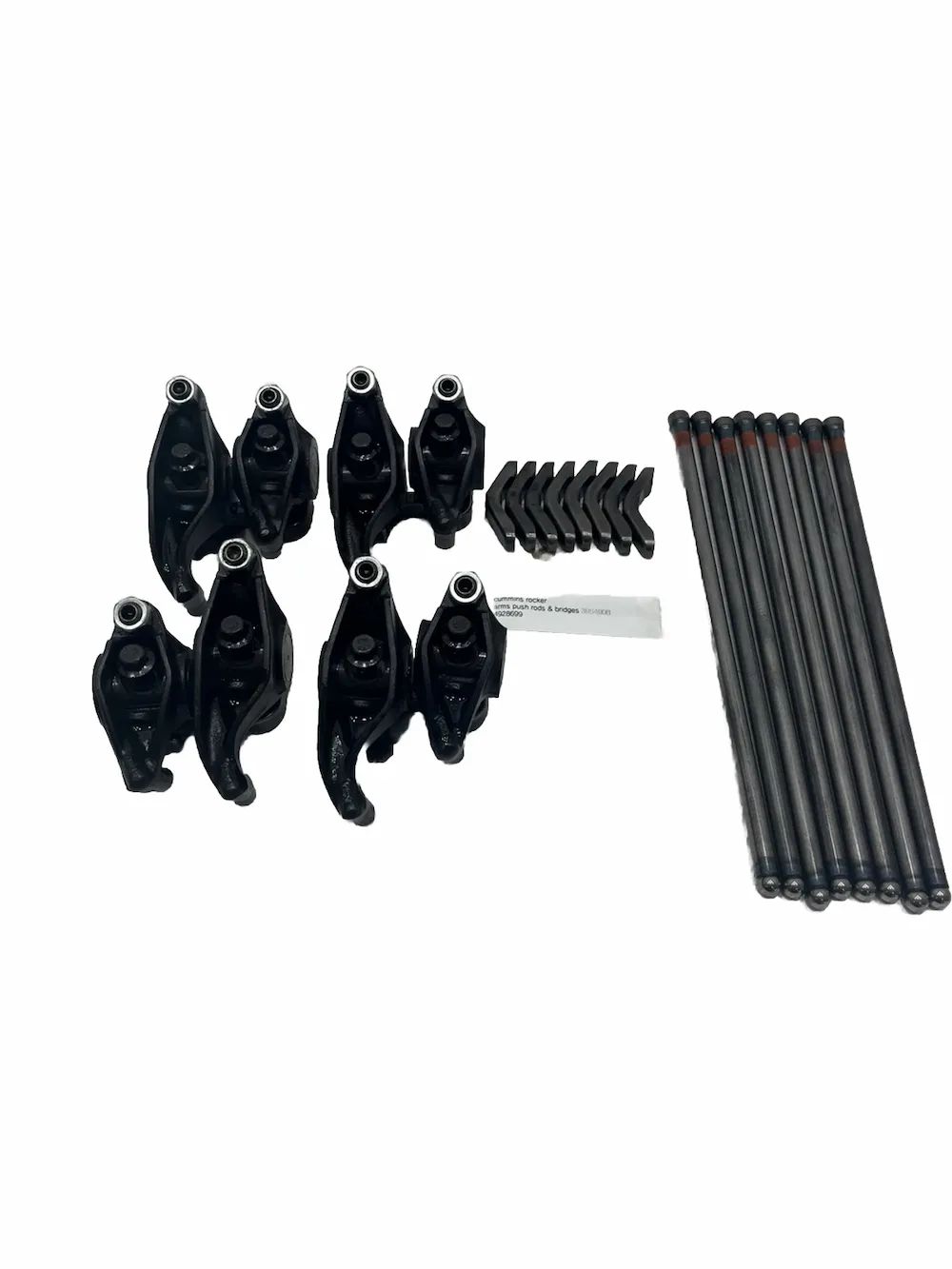
Rocker arms and rocker shafts should be evaluated as a working pair
A rocker arm, also called a rocker lever in some parts catalogs, pivots on the rocker shaft during engine operation. The rocker bore or bushing and the rocker shaft form a continuously moving contact pair.
The rocker shaft is also subject to wear. Replacing only the rocker arm without checking the condition of the original shaft may leave excessive clearance, poor support or lubrication problems in the assembly.
When sourcing parts, consider the following as one related system:
- Rocker arm or rocker lever;
- Rocker shaft;
- Rocker shaft support or pedestal;
- Rocker bushing or bore;
- Adjustment screw and lock nut;
- Spacers, locating parts and related fasteners.
Whether the rocker shaft also needs replacement must be determined by a qualified repair facility using the actual component condition and applicable service information. This article does not provide wear limits, inspection procedures or reuse criteria.
The rocker shaft may also distribute lubricating oil
The rocker shaft is not only a mechanical support. In some engine designs, internal oil passages, drilled holes or grooves in the shaft distribute oil to:
- Rocker bores or bushings;
- Rocker rollers or contact surfaces;
- Adjustment screw areas;
- Other upper valve train components;
- Selected engine brake components.
This is another reason why two rocker shafts with similar length and outside diameter should not be assumed interchangeable.
Confirm:
- Number of oil holes;
- Oil-hole locations;
- Oil-groove direction;
- Oil interface with the support or cylinder head;
- Rocker shaft installation direction;
- Whether the shaft supplies oil to engine brake components.
If the oil passages do not align with the cylinder head, supports or rocker arms, part of the valve train may not receive proper lubrication.
Do not attempt to solve an unverified mismatch by drilling new holes, enlarging oil passages or modifying shaft grooves.
Pushrods: length and end design must both match
A pushrod, sometimes written as push rod or push tube, transfers motion from a cam follower, tappet or other lower drive component to the rocker arm.
Pushrod length is part of the designed valve train geometry and can affect:
- Rocker operating angle;
- Adjustment screw range;
- Valve train motion;
- Contact position between the pushrod, rocker and follower.
Two pushrods may look nearly identical and still be incompatible because of differences in:
- Overall length;
- Ball-end diameter;
- Cup-end depth;
- End combination;
- Tube diameter or stiffness;
- Solid or hollow construction;
- Internal oil passage;
- Intake, exhaust or injector function.
Use the official part number, ESN and CPL as the primary matching references. Measurements and photos from the old part should be treated as supporting evidence rather than the sole ordering basis.
A bent pushrod or abnormal end wear does not automatically mean that only the pushrod should be replaced. Related components may also need inspection, including:
- Cam follower or tappet;
- Rocker arm;
- Adjustment screw;
- Crosshead;
- Valve mechanism;
- Injector rocker;
- Engine brake mechanism.
This guide does not provide pushrod straightness limits, wear limits or reuse standards.
Injector rocker: a separate functional position
Some Cummins engines use an injector rocker or injector rocker lever as part of the mechanical actuation system for the injector.
The injector rocker performs a different function from the intake and exhaust rockers and should not be substituted based on similar appearance.
When sourcing an injector rocker, confirm:
- Engine ESN and CPL;
- Fuel system type;
- Injector rocker part number;
- Original installation position;
- Contact interface with the injector;
- Adjustment screw or ball-end design;
- Interface with the pushrod, cam follower or other drive component;
- Whether it is included in a rocker assembly or rocker shaft assembly.
Not every Cummins engine uses an injector rocker.
Whether an injector rocker is present depends on the engine's fuel system and injector actuation design. It should not be inferred from engine displacement or from a simple mechanical-versus-electronic engine label.
Even when an injector rocker can be physically installed, it may not provide the correct motion if the rocker, injector and adjustment components do not belong to the same configuration.
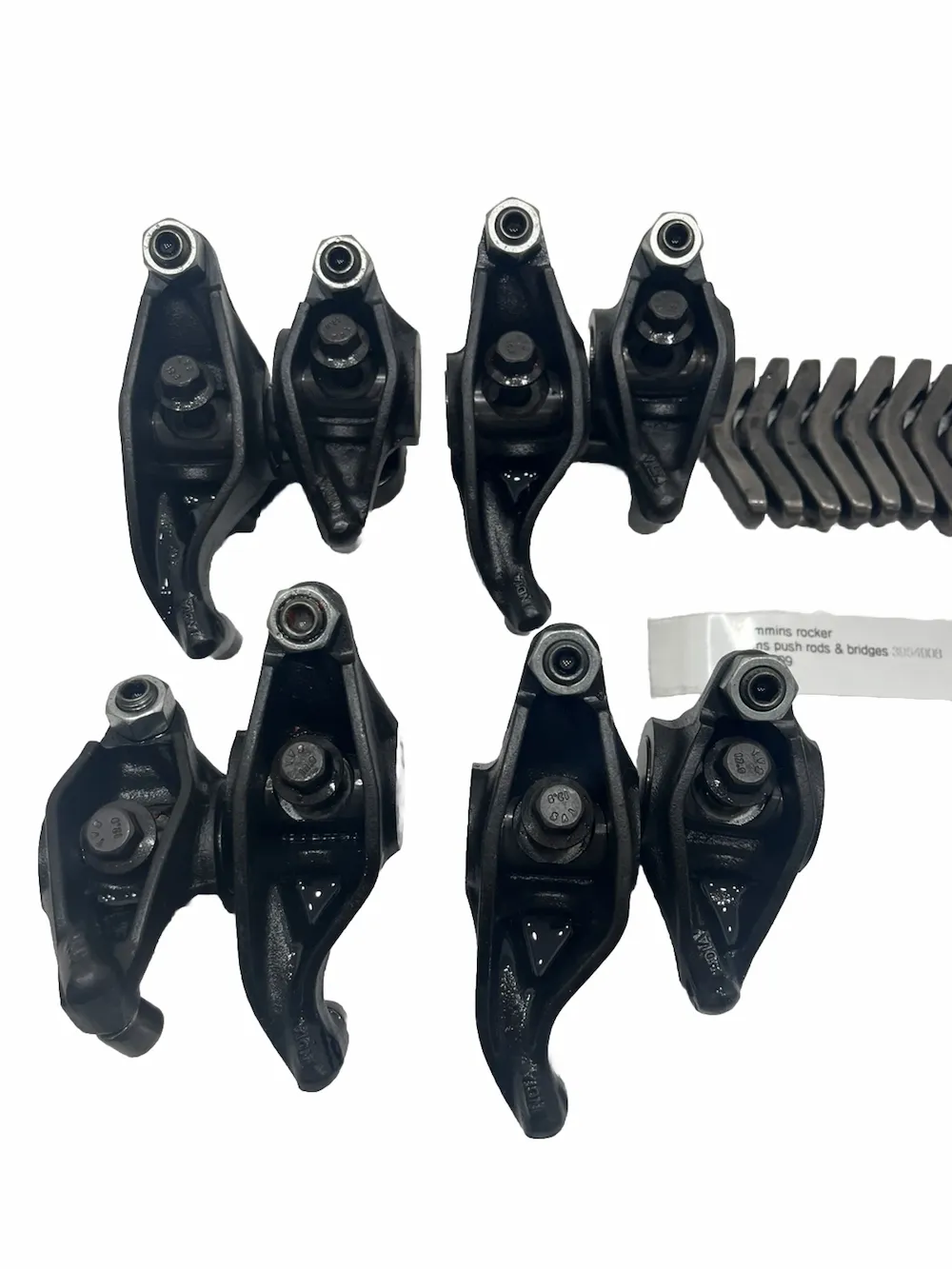
Crosshead: one rocker acting on two valves
Many multi-valve Cummins engines use a crosshead or valve bridge so that one rocker arm can act on a pair of valves in the same cylinder, such as two intake valves or two exhaust valves.
This differs from a simple design in which one rocker acts directly on one valve.
The following crosshead features are part of the matched design:
- Rocker contact surface;
- Valve stem contact points;
- Guide bore or guide pin;
- Locating structure;
- Adjustment screw or pin;
- Intake or exhaust position;
- Engine brake compatibility.
Parts literature may use terms such as:
- Crosshead;
- Valve crosshead;
- Valve bridge;
- Bridge;
- Brake crosshead.
These terms may describe components with similar functions, but the parts should not be treated as interchangeable based on name alone.
Confirm:
- Official crosshead part number;
- Intake or exhaust position;
- Quantity per cylinder;
- Guide design;
- Whether an adjustment screw or other accessory is included;
- Whether it is an engine brake version;
- Whether it is included in the cylinder head, rocker kit or engine brake kit.
A single-valve rocker component should not be applied to a crosshead valve train. A standard exhaust crosshead should also not be assumed to replace a brake-specific crosshead.
The engine brake and valve train must be matched together
Some Cummins engines are equipped with an engine brake or retarder system.
Depending on the design, the system may use:
- Exhaust rocker;
- Separate brake rocker;
- Integrated exhaust/brake rocker;
- Dedicated crosshead;
- Brake housing;
- Slave piston;
- Solenoid;
- Control valve;
- Related oil passages.
These parts act on the exhaust valve mechanism under specific operating conditions to provide auxiliary braking.
As a result, an engine equipped with an engine brake may use different rocker arms, crossheads, supports and control components from a non-brake version of the same engine family.
When requesting parts, provide:
- Whether the engine has an engine brake;
- Engine brake brand or model, if identifiable;
- Whether the brake is original or retrofitted;
- Brake housing part number;
- Brake rocker or exhaust rocker part number;
- Crosshead part number;
- Solenoid part number;
- Photos of the existing assembly and installation position.
Do not order only by engine family, and do not assume that a standard exhaust rocker is interchangeable with an engine brake version.
Weak braking, brake-related noise or intermittent engine brake operation may involve:
- Rocker arm;
- Crosshead;
- Brake housing;
- Slave piston;
- Solenoid;
- Control valve;
- Lubrication circuit;
- Electrical control;
- Adjustment or assembly condition.
The valve train part itself may not be the root cause.
Engine brake adjustment, calibration, oil-circuit inspection and troubleshooting are outside the scope of this article and should be handled by a qualified technician using the applicable service information.
Valve lash is not a universal purchasing specification
Valve lash, injector adjustment and engine brake lash are among the most frequently requested numbers in valve train discussions.
However, the correct values may depend on:
- Engine model;
- ESN and CPL;
- Intake or exhaust position;
- Fuel system;
- Engine brake configuration;
- Cold or hot adjustment condition;
- Service manual revision.
This article does not provide universal valve lash, injector adjustment or engine brake adjustment values.
A generic number described as suitable for a Cummins engine may be wrong for the actual engine or component position. An incorrect value may cause:
- A valve not to close correctly;
- Abnormal valve train impact;
- Accelerated valve train wear;
- Engine performance problems;
- Increased risk of mechanical interference in severe cases.
Use the official service information for the specific ESN, CPL and engine configuration, or obtain confirmation from an authorized or qualified service provider.
Be cautious if a supplier provides a “universal Cummins valve lash” without first confirming the engine configuration.
Quotation scope: one rocker arm or a complete valve train set
Terms such as Rocker Arm Kit, Rocker Assembly, Rocker Shaft Assembly and Valve Train Kit may represent very different supply scopes from one supplier to another.
A quotation may include only:
- One rocker arm;
- Rocker arm with adjustment screw;
- Several rocker arms;
- Rocker arms with rocker shaft;
- Rocker shaft, supports and spacers;
- Pushrods;
- Crossheads;
- Selected engine brake components;
- A larger group of components under the rocker cover.
Before accepting the quotation, confirm:
- Official name of each part;
- Part number of each item;
- Intake, exhaust, injector or brake position;
- Quantity of each part;
- Whether the rocker shaft is included;
- Whether pushrods are included;
- Whether crossheads are included;
- Whether adjustment screws and lock nuts are included;
- Whether engine brake parts are included;
- Whether mounting hardware and gaskets are included.
Complete Rocker Arm Kit and Complete Valve Train Kit are not standardized BOM descriptions. The word Complete does not define the actual contents.
Likewise, a top-end overhaul kit, upper engine kit or cylinder head kit should not be assumed to include the complete rocker, pushrod and crosshead system.
Valve cover noise does not always mean a rocker arm or pushrod has failed
Noise under the valve cover, unstable idle or abnormal top-end motion may involve:
- Rocker arm;
- Rocker shaft;
- Pushrod;
- Crosshead;
- Adjustment screw;
- Cam follower;
- Camshaft;
- Valve;
- Valve spring;
- Injector rocker;
- Engine brake mechanism;
- Top-end lubrication system.
The condition may also result from incorrect valve lash, injector adjustment, insufficient lubrication, assembly errors or another related problem.
The cause should be determined through inspection and measurement by a qualified repair facility. A sound recording, fault code or single wear photo is not enough to confirm which part should be ordered.
For camshaft, cam follower and related drive-component matching, refer to the separate Cummins camshaft guide.
The exact engine configuration determines the correct part
The same Cummins engine family may use different rocker arms, rocker shafts, pushrods and crossheads because of differences in:
- Valve count;
- Fuel system;
- Injector actuation design;
- Crosshead configuration;
- Engine brake configuration;
- Emissions and control version;
- Cylinder head version;
- Camshaft and cam follower configuration;
- Equipment application.
Use the following matching framework:
ESN + CPL + Service Part Number + Original Position + Engine Configuration
Engine family, displacement and appearance can support an initial review, but they cannot replace formal parts matching.
Casting numbers and position marks do not replace the service part number
A rocker arm, crosshead, support or brake housing may carry:
- Service part number;
- Casting number;
- Forging number;
- Position mark;
- Supplier code;
- Production code.
A casting number or position mark can support identification, but it may not be the orderable service part number.
The same basic casting or forging may receive different:
- Oil-hole machining;
- Thread machining;
- Contact-surface machining;
- Heat treatment;
- Bushing or roller installation;
- Adjustment screw configuration.
These variations may result in different finished service part numbers.
Provide clear photos showing both the marking and its location on the component.
If several rocker arms have already been removed, preserve the original sequence wherever possible. Do not mix all parts together and provide only one photo with no position reference.
Choosing between genuine and quality alternative parts
Rocker arms, rocker shafts, pushrods and crossheads operate under repeated motion, contact load and lubrication requirements. Price alone should not determine the selection.
For new genuine parts, confirm:
- Official part number;
- ESN and CPL applicability;
- Intake, exhaust, injector or brake position;
- Supersession;
- Included parts;
- Packaging and corrosion-protection condition;
- Warranty.
For a quality alternative, confirm:
- Clear cross-reference;
- Official applicable part number;
- Function and installation position;
- Rocker shaft interface;
- Pushrod and crosshead interface;
- Adjustment screw configuration;
- Oil-hole and lubrication design;
- Material and heat treatment;
- Machining quality;
- Batch and inspection records;
- Warranty and claim process.
For mining equipment, continuously operated generator sets and other applications with high downtime costs, batch consistency and interface accuracy are especially important.
A single rocker arm may not be expensive, but a part with the wrong function, oil passage or adjustment design can still delay the complete engine assembly.
Information to provide before ordering
- Cummins engine model;
- ESN and CPL;
- Equipment brand, model and application;
- Whether the engine uses a crosshead system, if known;
- Whether the engine has an engine brake;
- Fuel system type, if known;
- Whether the required rocker is intake, exhaust, injector or brake;
- Whether one rocker arm or a kit including rocker shaft, pushrods and crossheads is required;
- Photos of both sides of the old rocker arm;
- Photos of the rocker bore, oil holes and adjustment screw end;
- Photos of the rocker shaft oil holes, ends and supports;
- Full photos of both ends of the pushrod;
- Photos of the top, bottom and guide structure of the crosshead;
- Service part numbers, casting numbers and other visible marks;
- Original installation sequence;
- Required quantity;
- Destination;
- Packaging, labeling, inspection and traceability requirements.
How ZEB Power supports Cummins valve train parts sourcing
ZEB Power supplies Cummins rocker arms, rocker shafts, pushrods, crossheads and related valve train parts for construction equipment, mining machinery, generator sets, industrial equipment and other Cummins engine applications.
Based on the ESN, CPL, old part numbers, original installation position, fuel system, crosshead and engine brake configuration, we can help verify:
- Rocker arm or rocker lever part number;
- Intake, exhaust, injector or brake position;
- Rocker shaft part number;
- Rocker shaft support or pedestal;
- Pushrod part number;
- Crosshead or valve bridge part number;
- Adjustment screw and lock nut;
- Rocker assembly or kit scope;
- Engine brake compatibility;
- Supersession;
- New genuine and confirmed quality alternative options;
- Quantity and quotation scope.
Available options depend on the official part number, actual engine configuration and current supply channel.
Wear inspection, installation, adjustment and reuse decisions should be completed by a qualified local repair facility using the applicable service information.
Frequently asked questions
If the rocker arm is worn, should the rocker shaft also be replaced?
Not necessarily, but the rocker shaft condition, oil passages and running clearance should also be checked. Replacing only the rocker arm without checking the old shaft may leave clearance or lubrication problems. The decision should be made by a qualified technician.
Can only one damaged rocker arm be replaced?
Sometimes, but the decision should not be based on appearance alone. Confirm the old and new part numbers, design version, functional position, rocker shaft, adjustment screw, pushrod, crosshead and engine brake configuration. Whether one rocker can be replaced individually or related parts should be handled together depends on actual wear and the applicable service information.
Do all Cummins engines use injector rockers?
No. An injector rocker is used only in engines with the applicable injector actuation design. Confirm the fuel system, ESN and CPL.
What is a crosshead, and why must it be identified separately?
A crosshead or valve bridge allows one rocker arm to act on a pair of valves. Its guide structure, contact surfaces and engine brake interface may differ, so not all crossheads are interchangeable.
Are rocker parts different on an engine equipped with an engine brake?
They may be. An engine brake configuration can use a different exhaust rocker, brake rocker, crosshead, support or other brake component. State the exact brake configuration when requesting a quotation.
Can rocker shafts be interchanged if the outside diameter and length are the same?
Not necessarily. The oil holes, grooves, support positions, end design, locating system and installation direction must also match.
Can pushrods with the same length be interchanged?
Not necessarily. The ball and cup ends, tube design, functional position and matching rocker arm or cam follower must also be checked.
Does a Rocker Arm Kit always include the rocker shaft and pushrods?
No. Kit scope varies significantly by supplier. Obtain a detailed BOM and quantity list before ordering.
Does valve cover noise mean the rocker arm has failed?
Not necessarily. The noise may involve the rocker shaft, pushrod, crosshead, valve lash, lubrication, camshaft or cam follower. Inspection is required before ordering parts.
Does weak or noisy engine brake operation mean the valve train parts are damaged?
Not necessarily. The issue may involve the rocker, crosshead or brake mechanism, but it may also come from the solenoid, control valve, oil circuit or electrical controls.
What is the correct valve lash specification?
This article does not provide a universal value. Valve lash depends on the engine model, ESN/CPL, intake or exhaust position and engine brake configuration. Use the official service information for the specific engine.
Can I request a quotation without the old part number?
An initial identification review is possible. Provide the ESN, CPL, rocker function and position, crosshead and engine brake configuration, and clear photos showing the old parts in their original sequence.
This information can usually help identify the part category and likely matching range. If the engine has multiple valve train versions, final confirmation may still require the official service part number or additional inspection information.
Need help matching a Cummins rocker arm, rocker shaft, pushrod or crosshead? Send the engine ESN, CPL, required rocker function, crosshead and engine brake configuration, and clear photos of the old parts and visible markings. ZEB Power can help verify candidate part numbers, kit scope and current supply options.