

Cummins Air Filter: Primary vs Safety Element & Housing Fitment

8045
Table of Contents
Generating table of contents
Most air-filter ordering mistakes are not caused by choosing the wrong brand. They usually come from one of three problems:
- A Safety Element is ordered instead of the Primary Element, or vice versa;
- The filter dimensions appear correct, but the sealing design does not match the housing;
- The engine model is correct, but the equipment manufacturer uses a different Air Cleaner Housing from the configuration expected from the engine model alone.
This guide explains these three sourcing risks so purchasing teams can verify the correct element before placing an order, rather than discovering the mismatch after the shipment arrives.
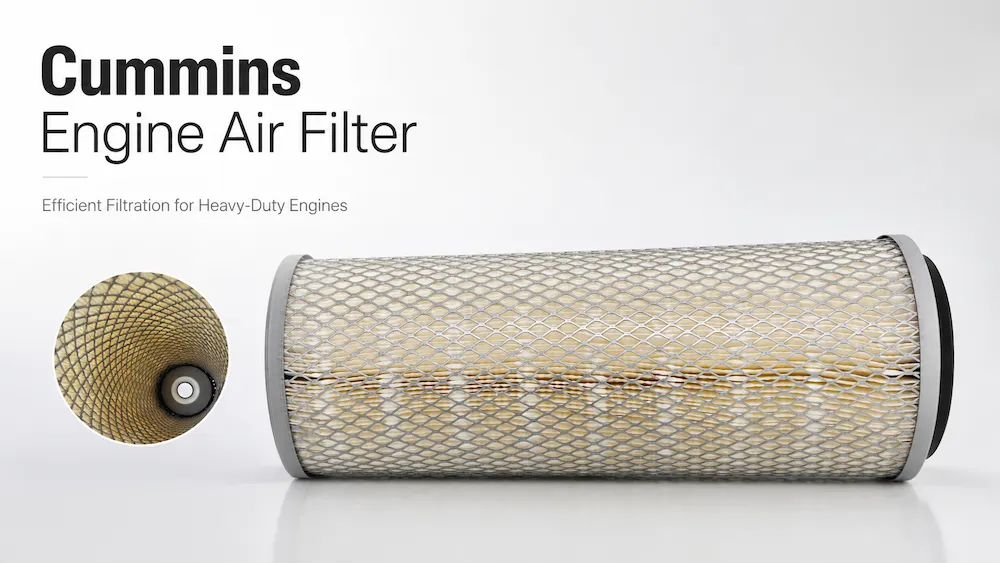
Primary and Safety Elements Serve Different Roles
Some construction machines, mining equipment and other heavy-dust applications use a dual-element Air Cleaner containing both a Primary Element and a Safety Element.
However, not every Cummins-powered machine or Air Cleaner Housing uses this arrangement. Whether the system contains one or two filter elements depends on the specific housing design and equipment application.
The configuration should therefore be confirmed from:
- The equipment model;
- The Air Cleaner Housing number;
- The old filter elements;
- Clear photos of the existing installation.
In a dual-element Air Cleaner, the outer Primary Element performs the main filtration and dust-holding work. It is the principal service element in the intake system. Its replacement timing should be based on the equipment maintenance schedule, manufacturer guidance and intake-restriction condition.
The inner Safety Element, sometimes referred to in the market as a Secondary Element, provides additional protection to the clean side of the intake system if the Primary Element is damaged, incorrectly sealed or disturbed during maintenance.
It should not be treated as a second Primary Element carrying the same routine dust load.
Because their functions are different:
- A Primary Element cannot replace a Safety Element;
- A Safety Element cannot replace a Primary Element;
- A quotation for one Primary Element should not be described as a complete Primary-and-Safety set.
This does not mean that the Safety Element must be replaced every time the Primary Element is changed. The required replacement scope should follow the maintenance instructions for the specific Air Cleaner and the actual inspection findings.
An inquiry that only says:
Cummins air filter
does not tell the supplier whether the buyer needs:
- A Primary Element;
- A Safety Element;
- Both elements;
- Or a complete Air Cleaner Assembly.
When the Air Cleaner has already been confirmed as a dual-element design, the inquiry can specify:
One Primary Element and one Safety Element per set.
When the housing configuration is still unclear, provide the Housing part number and old-filter photos before assuming that two elements are required.
The Safety Element normally has a longer service interval than the Primary Element. Its actual replacement timing should be determined from the equipment or Air Cleaner maintenance instructions, service history and operating environment. This article does not recommend one fixed replacement interval for every application.
Seal Design: Similar Dimensions Do Not Guarantee Fitment
Common engine air-filter sealing arrangements include Axial Seal and Radial Seal designs.
An Axial Seal element normally uses an end gasket that is compressed in the axial direction between the element and the Air Cleaner Housing.
A Radial Seal element normally uses a molded elastomer sealing end that fits radially around the clean-air outlet interface or outlet tube.
These two designs require different housing interfaces.
Two elements may have similar:
- Outside diameters;
- Overall lengths;
- Inside diameters;
- General cylindrical shapes.
They may still be incompatible if the sealing design or sealing location is different.
An incorrectly sealed element can allow dust to bypass the Filter Media and enter the clean side of the intake system. This type of problem may not create an immediate fault. It may only become visible later through abnormal engine wear, dust traces in the clean-air piping or reduced performance.
When communicating with an international supplier, specifying Radial Seal or Axial Seal is normally more useful than simply describing the part as having a rubber seal.
Before approving an interchange, confirm:
- Axial or Radial Seal design;
- Overall length;
- Outside diameter;
- Inside diameter;
- Seal location and profile;
- Open-end and closed-end construction;
- Housing outlet-tube dimensions;
- Internal locating features;
- Tabs, stops, grooves or locking features;
- Compatibility with the Safety Element, where fitted.
If the formal part number is unavailable, provide clear photos of:
- The complete old element;
- The open end;
- The closed end;
- The sealing surface;
- The inside of the Housing;
- The clean-air outlet connection.
Dimensions can assist with initial identification, but they should not replace a confirmed part number or Housing reference.
The Equipment OEM Housing Is Often the Missing Piece
The same Cummins engine can be installed in equipment produced by many different manufacturers.
The Air Cleaner Housing used on the final machine may not be selected solely by Cummins. Construction-equipment manufacturers, generator-set builders and industrial OEMs may select an Air Cleaner based on:
- Available installation space;
- Required engine airflow;
- Dust conditions;
- Inlet and outlet direction;
- Maintenance access;
- Pre-cleaning requirements;
- Machine layout;
- Environmental exposure.
The equipment OEM may choose a standard Air Cleaner from a filtration supplier or use a housing and interface developed specifically for the machine.
As a result, two machines with the same Cummins engine model and power rating may use different:
- Primary Elements;
- Safety Elements;
- Air Cleaner Housings;
- Pre-Cleaners;
- Outlet-tube dimensions;
- Mounting arrangements.
This is why an inquiry based only on the engine model may produce a filter that is suitable for one Cummins-powered application but not for the Housing installed on the customer’s equipment.
When requesting a quotation, provide both:
- The Cummins engine information;
- The complete equipment information.
For construction and mining equipment in particular, the following are highly valuable:
- Equipment manufacturer;
- Complete equipment model;
- Machine serial number;
- Air Cleaner Housing manufacturer;
- Housing part number;
- Housing label photo;
- Old Primary and Safety Element numbers.
The engine ESN helps identify the engine configuration. The Housing number helps identify the actual intake-filtration system installed on the machine. One does not always replace the other.
When Should the Safety Element Be Replaced?
The Safety Element does not carry the same primary filtration and dust-holding workload as the Primary Element, so it is normally not replaced on the same schedule.
However, it becomes the final protective barrier for the engine’s clean-air side when the Primary Element is damaged, incorrectly sealed or contaminated during servicing.
The Safety Element should be inspected and, where required, replaced when:
- The Primary Element is torn, deformed or incorrectly sealed;
- Dust has bypassed the Primary Element;
- The Safety Element has been knocked, scratched or damaged during maintenance;
- The element may have been contaminated while the Primary Element was removed;
- Dust is found on the clean side of the Air Cleaner;
- The equipment maintenance instructions require replacement;
- The element has reached the manufacturer’s specified service limit.
A Safety Element should not normally be treated as a filter that is repeatedly cleaned and returned to service.
Any permitted cleaning or servicing procedure must follow the instructions for the specific Air Cleaner and equipment. Where no approved procedure is available, continued use after cleaning is not recommended.
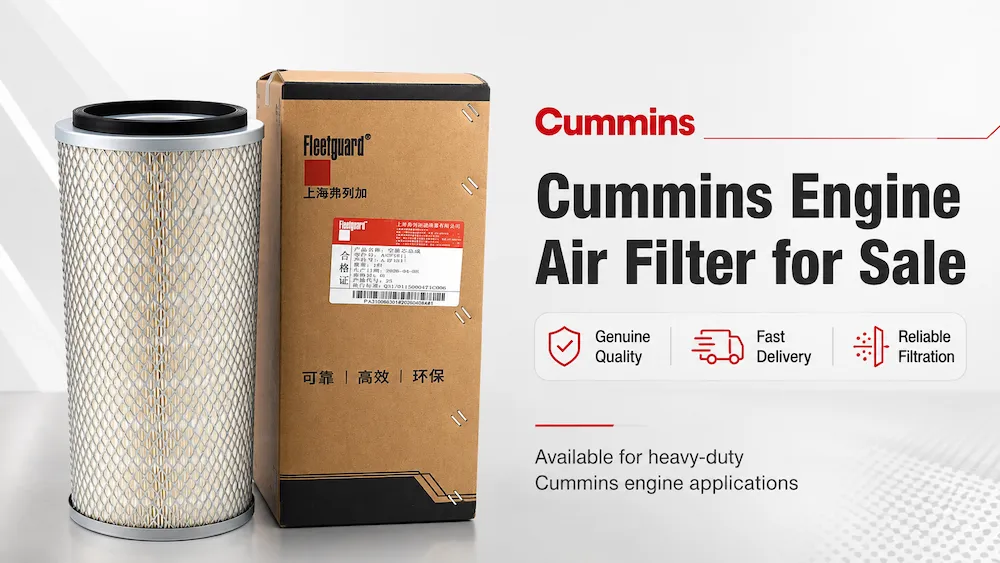
A New Filter Does Not Always Clear an Intake-Restriction Warning
Many heavy-duty intake systems include additional components such as:
- A Pre-Cleaner;
- A Dust Cup;
- A Dust or Vacuator Valve;
- A Restriction Indicator;
- Intake hoses and piping;
- An Air Cleaner Housing with integrated dust-separation features.
A Pre-Cleaner removes larger particles before the air reaches the Primary Element.
A Restriction Indicator monitors intake restriction at its specified measuring point and indicates when the system reaches a maintenance threshold.
If a new Primary Element is installed but the restriction warning remains, the filter itself is not automatically defective.
Other possible causes include:
- Dust accumulation in the Pre-Cleaner;
- A damaged or blocked Pre-Cleaner;
- Foreign material inside the Housing;
- A blocked or damaged Dust Valve;
- A collapsed or deformed intake hose;
- A restricted air inlet;
- A Housing problem;
- An incorrect replacement element;
- A faulty or unsuitable Restriction Indicator.
The Restriction Indicator reflects the combined restriction in the intake path upstream of its measuring point. It should not be interpreted as proof that the Primary Element alone is blocked without checking the complete intake path.
The full system should be inspected by qualified service personnel according to the equipment documentation.
This article focuses on replacement-part identification and does not provide intake-restriction testing or diagnostic procedures.
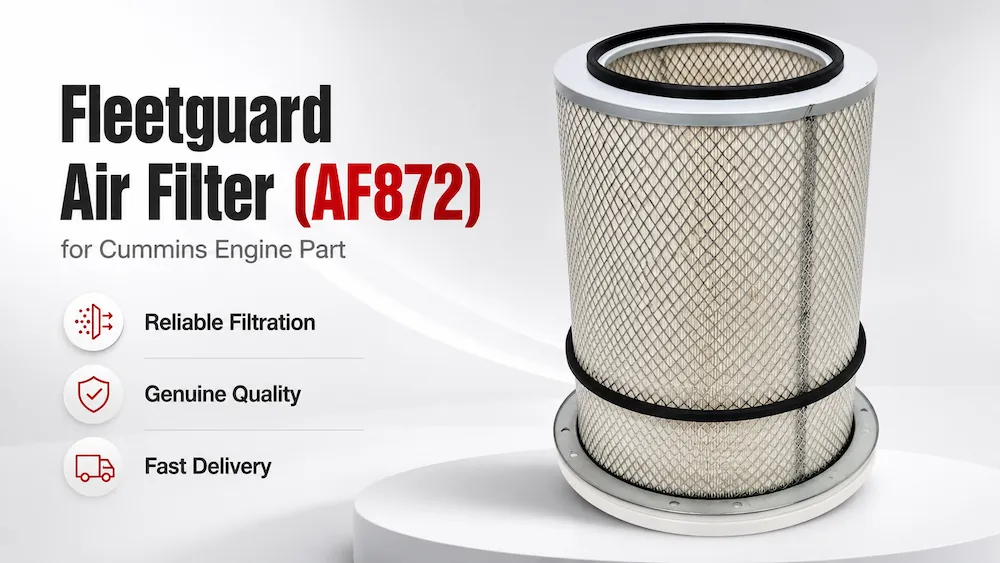
Genuine and High-Quality Aftermarket Air Filters
Air-filter quality cannot be judged reliably from appearance alone.
Important variables include:
- Filter Media specification;
- Filtration efficiency;
- Dust-holding capacity;
- Initial restriction;
- Pleat spacing and stability;
- End-cap construction;
- Seal material;
- Seal hardness;
- Dimensional consistency;
- Housing fitment;
- Manufacturing quality control.
When considering an aftermarket element, request a clear and traceable Cross Reference rather than accepting a broad statement such as:
Fits Cummins engines.
A Cross Reference is useful for initial matching, but it does not by itself prove that two filters have identical:
- Filtration efficiency;
- Dust-holding capacity;
- Initial airflow restriction;
- Seal consistency;
- Structural strength;
- Service life.
For equipment operating in mining, quarrying, dry construction sites or other high-dust environments, filter quality has a direct relationship with intake-system protection and engine life.
Price should therefore not be the only purchasing criterion.
For bulk orders involving dozens or hundreds of filters, buyers should also consider:
- Batch-to-batch dimensional consistency;
- Seal consistency;
- Filter Media traceability;
- Product labeling;
- Packaging protection;
- Moisture protection;
- Cross-reference accuracy;
- Supplier quality control;
- Warranty and mismatch handling.
A small saving on unit price may not justify the risk of inconsistent sealing across a large batch.
Information to Provide Before Ordering
For accurate Cummins engine air-filter matching, provide as much of the following information as possible.
Engine Information
- Cummins engine model;
- ESN — Engine Serial Number;
- CPL, where available;
- Engine nameplate photo.
Equipment Information
- Equipment manufacturer;
- Complete equipment model;
- Machine or genset serial number;
- Application type.
Air Cleaner Information
- Air Cleaner Housing manufacturer;
- Housing part number;
- Housing label photo;
- Whether a Pre-Cleaner is installed;
- Whether the Housing uses one or two elements.
Existing Filter Information
- Primary Element part number;
- Safety Element part number;
- Filter manufacturer;
- Existing Cross Reference, where known;
- Photos of the complete old elements;
- Open-end photo;
- Closed-end photo;
- Seal close-up;
- Housing-interior photo.
Required Product Scope
- Primary Element only;
- Safety Element only;
- Primary and Safety set;
- Complete Air Cleaner Assembly;
- Genuine or verified high-quality aftermarket preference.
Order Information
- Operating environment;
- High-dust or high-humidity conditions;
- Required quantity;
- Destination country;
- Requested delivery schedule.
Overall length, outside diameter and inside diameter can assist with initial identification. They should not replace the Housing number or formal element part number.
In many incorrect orders, the overlooked Equipment OEM Housing—not the Cummins engine model—is the real source of the mismatch.
How ZEB Power Supports Air-Filter Sourcing
ZEB Power supplies Cummins engine air filters and related intake-filtration components for construction machinery, mining equipment, generator sets and industrial applications.
Using the available engine ESN, equipment model, Air Cleaner Housing information and old-element details, we can help verify:
- Primary Element options;
- Safety Element options;
- Primary-and-Safety combinations;
- Housing-related fitment;
- Cross References;
- Genuine and high-quality aftermarket supply options.
Final availability depends on the confirmed part number and current supply channel.
Frequently Asked Questions
Does the Safety Element need to be replaced frequently?
It is normally not replaced on the same schedule as the Primary Element.
It should be inspected or replaced when the Primary Element has been damaged, incorrectly sealed, or when the Safety Element has been contaminated or physically damaged during maintenance. Follow the instructions for the specific Air Cleaner and equipment.
Can two filters with similar dimensions be interchanged?
Not based on dimensions alone.
The sealing design, seal location, end-cap structure, outlet interface, Housing location features and formal Cross Reference must also be confirmed.
Can an air filter be quoted from the engine model alone?
An initial search may be possible, but final confirmation often requires the equipment model and Air Cleaner Housing information because the Housing may have been selected by the equipment OEM.
Can a Safety Element be cleaned and reused?
It is generally not recommended unless the specific Air Cleaner or equipment manufacturer provides an approved procedure. In the absence of clear instructions, replace rather than clean and reuse it.
Can I request a quotation without the old filter part number?
Yes.
Provide the engine ESN, complete equipment model, Housing label, old-filter photos and dimensions for an initial check. Without the formal part number, additional photos of the open end, sealing structure and Housing interior may be required before final confirmation.
Can one fixed replacement interval be used for every machine?
No.
Dust concentration, operating load, environment, Air Cleaner capacity and maintenance strategy vary significantly between applications. Follow the equipment maintenance plan, manufacturer recommendations and applicable restriction-indicator condition.
Request a Cummins Air Filter Quotation
To verify the correct Cummins air-filter element, provide:
- Engine ESN;
- Equipment manufacturer and model;
- Air Cleaner Housing number;
- Old Primary and Safety Element numbers, where available;
- Photos of the old elements and sealing ends;
- Required quantity and destination.
ZEB Power can help verify the applicable element and provide a clearly defined quotation scope.