

Cummins ECM Replacement: Why the Right Part Number Isn’t Enough

1767
Table of Contents
Generating table of contents
Here's a scenario that comes up often: a shop confirms the old ECM has failed, the buyer finds a "compatible" ECM online — same connector, same mounting holes, the seller even says it "fits the same engine family." It arrives, gets installed, and the engine either won't start at all, or runs but with erratic power and a string of fault codes nobody can explain.
The problem usually isn't that the part itself is "wrong." It's that an ECM was never designed to be a plug-and-play component in the first place. Unlike a thermostat or a sensor, where matching the part number is usually enough, an ECM being physically installable doesn't mean it's configured to run this particular engine correctly. This article breaks down the layers involved, so buyers know what information to gather before ordering, what questions to ask a supplier, and why the actual programming work still needs to go through a qualified technician.
This article does not cover ECM flashing, reprogramming, or calibration-file modification procedures. That work should be handled through a Cummins-authorized channel, or by personnel with supported service tools and the relevant technical qualifications.
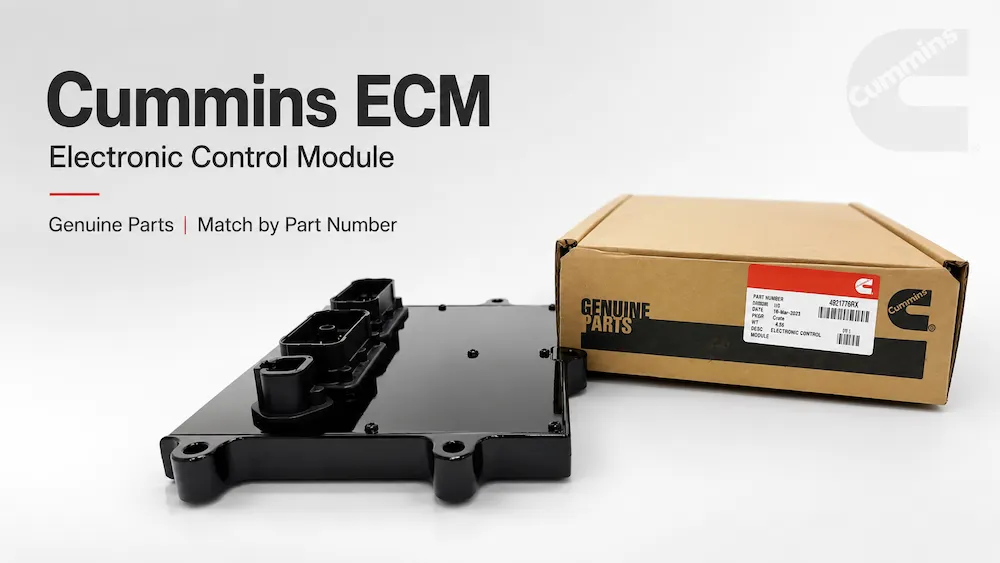
Three layers of information — miss one, and it won't install or won't run right
Layer one: Hardware — the right part number still has to clear calibration-installation requirements
The most common mistake in ECM buying is assuming that quoting an engine family — "this is a QSB6.7" or "this is an ISX" — is enough to identify the part. In reality, the same engine family can span multiple emission stages, power ratings, speed ratings, and equipment platforms, and different configurations may use different ECM hardware — or the same hardware platform loaded with a different calibration. Power rating alone can't tell you whether two hardware part numbers are the same or different — you can have different hardware, the same hardware with different calibrations, or the same hardware and base code with a different rating or revision. So engine family name, horsepower, or housing appearance can't confirm an ECM on their own. Purchasing should start with the engine ESN, cross-checked against the CPL, the complete label from the old ECM, the engine rating, and the application.
Beyond the hardware part number itself, calibration installation is a managed process: installing a calibration typically requires verifying the engine ESN, and the ESN recorded in the ECM should match the physical engine nameplate. Cross-configuration changes, base code changes, and engine rerates may require supported Cummins service tools along with the relevant installation approval and compliance verification. This isn't an arbitrary purchasing obstacle — it's standard practice for how engine calibrations are managed industry-wide. This article doesn't discuss, and doesn't recommend attempting, any form of workaround for this process — unauthorized calibration changes can also violate local emissions regulations. The correct path is a Cummins-authorized channel or a technician with the relevant qualifications.
Layer two: Calibration — correct hardware doesn't mean the software inside is right for this engine
Calibration data lives inside the ECM hardware, but the applicable calibration still needs to be confirmed against the engine's ESN, product line, rating, emissions configuration, and application. A new ECM, a blank ECM, or a used ECM pulled from a different engine may all need the correct calibration installed or verified before they'll work — even if the hardware part number is right. That work typically requires dedicated, authorized software tools; it's not something a buyer can do at home. This is also why "I bought a used ECM with the same part number online" so often goes wrong: that used module may still be carrying another engine's calibration data, and installing it on your engine — even with a matching hardware part number — can lead to abnormal operation.
Layer three: Application parameters — an ECM that controls the engine may not work correctly with this equipment
Beyond the engine's own calibration, some equipment configurations carry additional application or OEM-specific parameters — idle settings, maximum speed limits, remote throttle inputs, remote start/stop signals, fixed genset speed, communication parameters with an equipment controller, and so on. This isn't a suggestion that buyers should adjust these parameters themselves — it's a reminder that before swapping an ECM, it's worth preserving whatever configuration data is still readable from the old ECM and the equipment, because these application-level settings often need to be reconfirmed or reset once the new module is installed.
Before you pull the old ECM, save this information
Once an ECM has failed completely, some of its internal data may no longer be recoverable. So as long as the engine can still communicate with a diagnostic tool, it's worth holding off on removing the old ECM and having a technician capture the following with a supported diagnostic tool — creating a parameter template for reference after the swap, if applicable:
- ECM label: front label, part number, serial number, any additional assembly/module numbers, barcode or QR code, connector location — photograph all of it rather than copying down a single number;
- Engine nameplate: engine model, ESN, CPL, rated power, rated speed;
- Current calibration information (if the old unit still communicates): the calibration or code currently in use, software/revision information, the engine rating currently recorded;
- Fault and operating history: active and inactive fault codes, the circumstances around when they occurred, accumulated engine hours, whether the ECM has recently been replaced or reprogrammed — none of this proves the ECM has failed on its own, but it helps avoid losing context after the swap;
- Connector and wiring condition: connector pins, locking mechanism, signs of water intrusion or corrosion, wear on the harness, whether ground and power connections look intact — if the real issue is power supply, grounding, or wiring, replacing the ECM alone may not fix it, and the new module could fail again.
Worth noting: how much data can be saved or restored varies by ECM, product platform, and access level — not everything transfers cleanly to a new module, and the actual outcome depends on what the technician is able to do.
Five common ECM supply conditions
When a quote comes back for "a Cummins ECM," it's worth confirming exactly what condition that module is in:
- Blank / unconfigured new unit: the hardware is new, but it may not yet carry the base code or calibration your engine needs. Ask about the module's current software state, whether a specific calibration needs to be installed, whether field programming is required, and whether the quote includes that service;
- Pre-programmed new unit: the supplier may have done some prep work based on an ESN and engine configuration you provided — but "pre-programmed" isn't a precise enough description on its own. Confirm which ESN it was prepared against, whether any parameters still need field confirmation, and whether it needs to sync with the equipment's control system;
- Cummins ReCon ECM: part of Cummins' factory remanufacturing program. If a supplier claims to offer a Cummins ReCon unit, ask for the formal ReCon part number, product label, and traceable source — don't take "remanufactured" or "reconditioned" at face value. Still confirm the applicable calibration, field-verification requirements, warranty coverage, and core-return terms; this shouldn't be lumped in with generic third-party rebuilds;
- Third-party remanufactured or refurbished ECM: standards vary a lot by supplier. Confirm the module's source, what testing was done, its current data state, the scope of programming included, warranty, and traceability — a cleaned or repainted housing doesn't mean the process matches Cummins ReCon;
- Used unit of unknown origin: the highest-risk option. It may still carry another engine's calibration data, and matching connectors or engine family alone doesn't mean it's usable. For mining equipment, continuous-duty generator sets, and other high-downtime-cost applications, the risk of an unverified used unit usually outweighs any savings on price.
Whichever condition you're buying, it's worth nailing down before ordering whether the ECM needs calibration and who will be doing the programming — rather than discovering there's still a step missing after the part arrives.
On a genset, the Engine ECM and the set controller are not the same module
This is a common point of confusion in genset purchasing. The Engine ECM handles engine-side functions: fuel and speed control, sensor data processing, engine protection, actuator control, and engine fault codes. The genset controller handles the set and power-system side: auto start/stop, voltage and frequency monitoring, generator protection, load management, synchronizing, and remote monitoring. These are related but distinct control layers — some controllers may read data from the Engine ECM, but that doesn't make them the same module.
When a customer says "Cummins Generator ECM," it's worth confirming whether they mean the Engine ECM itself, or the genset controller, a display module, or another piece of OEM control equipment. For genset ECM inquiries, it helps to also provide: genset model, engine ESN, rated kW/kVA, the rating category (standby, prime, or continuous), rated speed, 50 Hz or 60 Hz, controller model, labels from both the ECM and controller, and any current alarm information. On a fixed-speed genset, an incorrect engine rating or speed configuration will directly affect output frequency and set-level control.
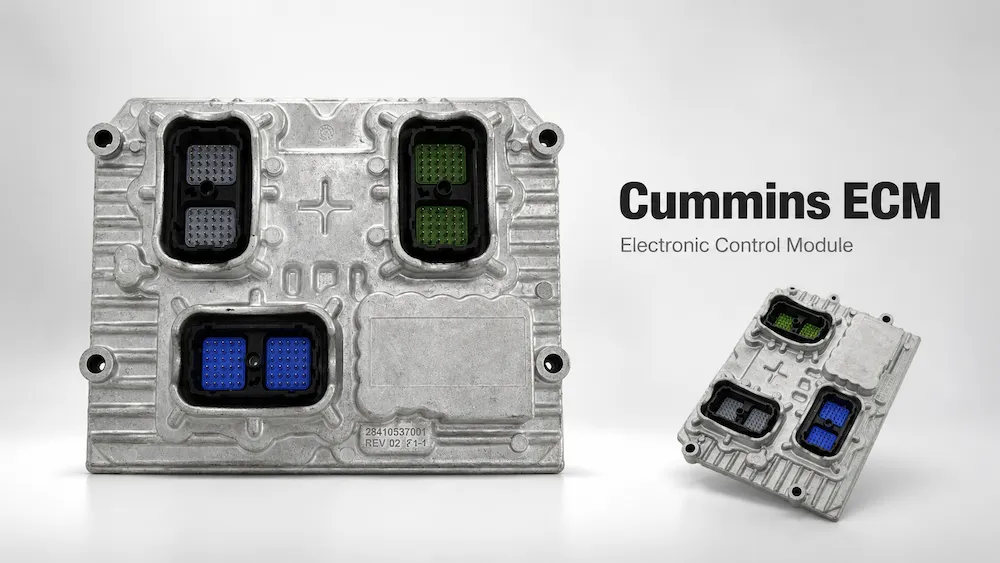
"Programming Included" on a quote isn't enough on its own
If a supplier's quote just says "programming included," that's not enough detail. Worth confirming: which ESN the programming is based on; which ECM part number and calibration version is being used; whether engine rating confirmation is included; whether the customer needs to supply data from the old ECM as a reference; whether a technician still needs to be on-site to connect and verify; whether OEM-specific parameters are included (genset speed settings, for example); whether the module is functionally tested before it ships; and what happens — and who's responsible — if the calibration turns out not to match the actual engine. Asking these questions before ordering is a lot less costly than discovering a missing step after the fact.
If the old ECM is part of an exchange program, it's not just scrap
Some remanufacturing or exchange (core exchange) programs require the old ECM to be returned, and the quote may include a core deposit or core charge, with return conditions usually tied to the condition of the old unit. Where this applies, it's worth confirming before ordering: whether returning the old module is mandatory, the return deadline, who covers shipping, whether water intrusion, fire damage, connector damage, a cracked housing, or missing parts would affect core acceptance and the final credit amount, and whether data needs to be saved from the old unit before it's returned. If your supply channel doesn't involve an exchange program, this step doesn't apply — but it's still worth confirming upfront rather than finding out later.
Information worth gathering before you order
- Engine model, ESN, and CPL. The CPL can help reflect key engine configuration, but the ECM should still be confirmed using the ESN, the complete label from the old unit, current calibration information, engine rating, and the application together;
- Part number, label, and connector photos from the old ECM;
- Application (on-highway, construction equipment, genset, etc.) and rated power — for gensets, also note the controller model;
- Whether you've already lined up an authorized channel for programming, or need help finding one;
- Whether the old unit can be kept for reference data, and if it's badly damaged, a description of the damage;
- Whether a core exchange applies (if relevant);
- Order quantity and destination.
If CPL or the old part number isn't available yet, an initial check can be done with the engine ESN and photos from the field — but final part confirmation and programming prep will generally still need the ESN, the old ECM's label, CPL, and application details.
Where parts supply ends and technical service begins
ZEB Power can help confirm the applicable ECM part number, supply condition, and sourcing options based on the engine ESN, CPL, the old ECM's label, and equipment information — what's actually available depends on the part number and current supply channels. But calibration installation, software programming, engine rating changes, and on-site OEM parameter confirmation fall outside standard parts supply. That work needs to go through a Cummins-authorized channel or a technician with the relevant service tools and access. We can help you nail down which part number and which condition you need — but the programming and commissioning work after installation still needs to go through the proper technical service channel.
Frequently asked questions
If two engines in the same family have different power ratings, does that always mean different ECMs?
Not necessarily. The ECM hardware part number may or may not be the same, but the calibration, engine rating, or application parameters typically need to match the specific engine configuration. You can't confirm an ECM based on engine family or horsepower alone — check the ESN, CPL, the old unit's label, and current calibration information instead.
Can I install a "compatible" used ECM and expect it to work?
The risk is high. A used ECM may still be carrying another engine's calibration data, and a matching hardware part number doesn't guarantee it will work correctly once installed.
Does "pre-programmed" mean it's ready to install and run?
Not necessarily. Confirm which ESN and ECM code the module was prepared against, whether it includes the correct engine rating, whether any field parameter confirmation is still needed, and who's responsible for whatever's left. Calibration installation and programming should go to a technician with supported service tools and the relevant access.
Is a Cummins ReCon ECM the same thing as a generic remanufactured unit?
No. ReCon is part of Cummins' factory remanufacturing program; third-party rebuild standards vary by supplier. The two shouldn't be treated as equivalent — confirm the source and process separately for each.
Should a failed ECM just be thrown away?
Not recommended. The part number, calibration information, and even some operating data on the old unit can be an important reference when sourcing and programming a replacement — and if a core exchange is involved, it needs to be kept anyway. Hold onto it and try to capture its data before finalizing a replacement plan.
Can I get a quote without CPL information?
Yes — an initial check can be done with the engine ESN and photos, but an accurate quote and final programming will typically still require CPL and other configuration details.
Four questions worth getting answered before accepting a quote
- What is the formal part number for this ECM?
- Is it a blank new unit, a pre-programmed new unit, a Cummins ReCon unit, a third-party rebuild, or a used unit?
- Does the quote include calibration or programming matched to the current ESN and engine rating?
- Will a local technician still need to complete parameter confirmation or OEM setup after installation?
If these four questions don't have clear answers, even a low price can be hard to evaluate against the real total cost.
Need to confirm the right part number for a Cummins ECM? Send us the engine ESN, CPL (if available), the old ECM's part number and photos, and details on the application. ZEB Power can help confirm the right supply options — calibration installation and programming still need to go through an authorized channel.