

Cummins ESN vs CPL: Which One Do You Actually Need?

4347
Table of Contents
Generating table of contents
Asking, “Should I give the supplier the ESN or the CPL?” starts from the wrong premise.
The two numbers are not competing sources of authority. They represent different levels of information:
The ESN answers, “Which engine is this?” The CPL answers, “Which critical-performance parts and timing-specification group does it belong to?” The final purchasing decision still has to be tied to a specific Cummins part number.
Together, they form a narrowing chain:
ESN identifies the engine → CPL narrows the critical-parts and timing-specification range → Part Number identifies the exact service part.
ESN and CPL Are Parallel Identifiers, but the CPL Is Not a Single Fixed Parts List
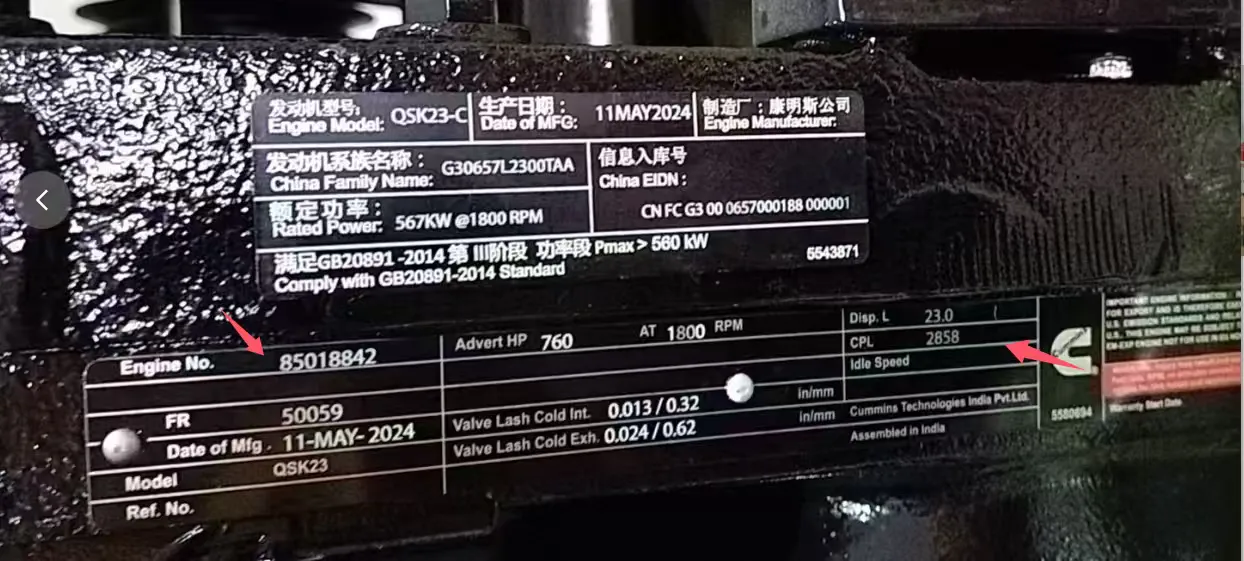
The ESN and CPL are usually shown together on the same engine dataplate, but neither number contains the other.
The ESN, or Engine Serial Number, is the identity number Cummins assigns to a specific engine. Cummins states that it generally consists of eight digits. Older or special products may use different identification arrangements, in which case the relevant Operation and Maintenance Manual and Engine Identification information should be followed.
Moving an engine from one machine to another does not change its original ESN. Where an engine assembly, cylinder block, or dataplate has been replaced or reissued, the Cummins-recognised records and service procedures should be followed. The number should not be reused or altered by field personnel without proper documentation.
The CPL, or Critical Parts List, is commonly shown as a four-digit number on the engine dataplate. Current QuickServe and most parts-service documents use the term Critical Parts List, while some installation documents also use Control Parts List. Both are abbreviated as CPL and should be interpreted in the context of the document.
A common misunderstanding is to treat the CPL as the exact build specification for one individual engine.
It is not.
Cummins documentation explains that engines listed under the same CPL may be built with different combinations of parts, provided those combinations do not change the required engine performance or certification conditions.
This means two engines with the same CPL may not have been assembled with exactly the same individual part combination. The CPL is not the unique factory bill of materials for one engine.
For that reason, the ESN is the more precise reference when identifying the original parts installed on a specific engine. The CPL narrows the search to an approved critical-parts and timing-specification range, but the ESN-specific original parts record is still required to determine what was actually installed on that engine.
When Should You Use the ESN, CPL, or Part Number?
The CPL is especially useful in two situations:
Overhaul-kit identification and initial identification of critical internal configurations, such as pistons, liners, and other components directly related to engine performance or certification.
Cummins provides CPL-based overhaul-kit cross-reference tools for a number of medium- and heavy-duty engine platforms.
However, the official workflow still begins with the ESN. The ESN is used to open the engine’s dataplate information, and the correct CPL is then read from that record for further cross-reference work.
The CPL is a range-narrowing tool, not a replacement for the ESN as the starting point.
If the removed component carries a clear and verifiable Cummins part number, that number can be used to check historical numbers and current supersessions. This is usually more direct than trying to identify one specific part from the CPL alone.
The old part number must still be cross-checked against the ESN-specific parts record, the CPL range, and the engine’s current condition. A number on the removed component may be an obsolete historical number, an aftermarket cross-reference, a number from a previously incorrect repair, or a number belonging to a subcomponent rather than the complete assembly.
The CPL also does not fully describe application-side accessories.
Components such as starter motors, charging alternators, sensors, wiring harnesses, and flywheel housings may vary because of equipment-manufacturer installation, application requirements, or later modification. Even when two engines share the same CPL, these components may not be identical.
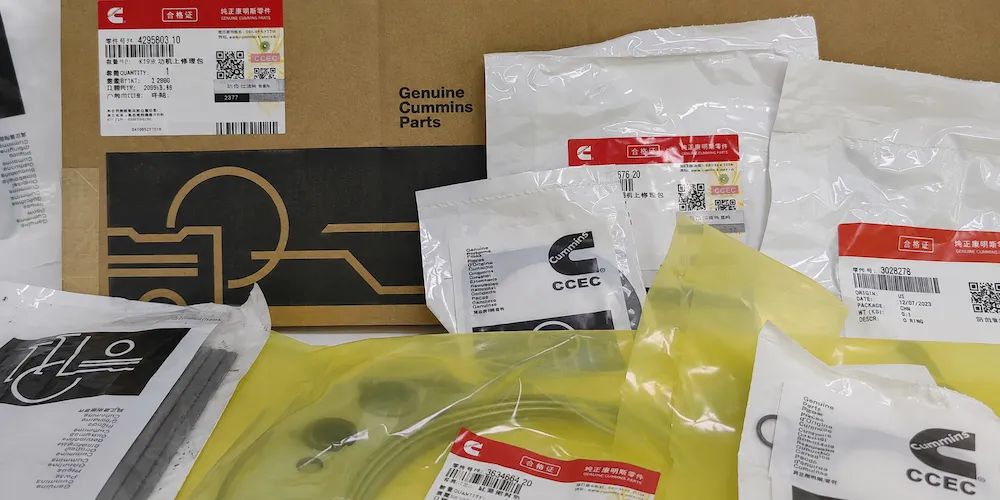
These enquiries should begin with the ESN and the official Cummins identification system. Use QuickServe to review the Engine Dataplate, CPL, and related service information, then use the official parts catalogue to confirm the original installed part, current service part, and supersession relationship.
The CPL also reflects the engine’s original approved configuration range, not necessarily its current condition.
If the engine has since been overhauled, modified, or fitted with non-original replacement parts, its present configuration may no longer match the original CPL range exactly.
Warranty enquiries, original dataplate information, and available service records should use the complete ESN as the primary reference.
If the purpose is to determine what is physically installed on the engine now, the ESN record must be compared with removed-part numbers, interfaces and connectors, modification history, repair records, and any required disassembly or measurement results.
In practical terms:
Use the ESN to begin a complete parts lookup, identify application-side accessories, and review the engine’s original records. For overhaul kits and critical internal configurations, provide both the ESN and CPL whenever possible.
Ordering only by Marketing Model or engine family can also create errors.
Two engines may belong to the same family but use different CPLs and different critical-component combinations. Similar appearance does not mean the same overhaul parts can be used.
Even after the correct CPL is identified, the lookup is not complete. The same CPL range may still include part-number updates, serial-number breaks, or compatibility restrictions between earlier and later components. Current supersessions and relevant technical information must still be checked before ordering.
A Third Identification Layer: Marketing Model and Service Model
In addition to the ESN and CPL, Cummins engine model names also exist at different levels of detail.
The Marketing Model Name is the market-facing product-family name, such as:
ISX15
The Service Model Name includes the control-system or service version, such as:
ISX15 CM2250
This distinction affects which service manual, diagnostic procedure, and technical publication should be used.
Two engines may both be described as ISX15, but different control-system versions can require different diagnostic procedures and may use different electronic components.
When available, the Service Model Name provides more precise service information than the Marketing Model alone.
Where Can You Find the Dataplate?
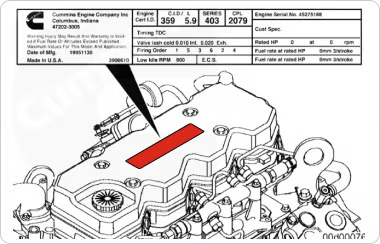
The ESN and CPL can usually be found on the engine dataplate, but the dataplate location varies by engine model.
Some engines have the dataplate on the rocker or valve cover, while others place it near the timing gear housing. The correct location should be confirmed in the Engine Identification section of the relevant Operation and Maintenance Manual.
Before photographing the plate, clean away oil, dust, or paint carefully. Do not read the number once and then rely on memory.
If the dataplate is completely unreadable, some engine models also have the ESN marked at a specified location on the cylinder block. The correct location must be confirmed from documentation for that engine model.
Frequently Asked Questions
Are the CPL and ESN the Same Number?
No.
The ESN uniquely identifies a specific engine. The CPL identifies a critical-performance parts and timing-specification group.
The two fields can usually be found on the same engine dataplate or in the QuickServe Engine Dataplate information, but they are parallel identifiers rather than one number being part of the other.
Do Two Engines With the Same CPL Use Exactly the Same Parts?
Not necessarily.
The same CPL means the engines belong to the same critical-performance parts and timing-specification group. It does not prove that their complete factory BOMs or current configurations are identical.
To confirm what was originally installed on a particular engine, check the records for that engine’s own ESN.
Can You Start a Parts Lookup With Only the ESN?
Yes.
The ESN is the main identification input in the Cummins official information system. It can be used in QuickServe to review the dataplate, CPL, and service information, and in the official parts catalogue to identify relevant parts and supersessions.
Whether the order can be confirmed immediately depends on the component. Overhaul kits and critical internal parts may still require the CPL, current piston or component number, technical publications, removed-part numbers, or measurement results.
Does CPL Mean Critical Parts List or Control Parts List?
Current QuickServe and most parts-service documents use Critical Parts List.
Some Cummins installation documents also use Control Parts List. Both are abbreviated as CPL, so the meaning should be understood from the context of the document.
Why Can Two Engines That Look the Same Use Different Parts?
They may share the same Marketing Model but use different Service Models and control-system versions.
They may also have different CPLs, placing them in different critical-parts and timing-specification groups.
Not Sure Whether to Send the ESN or CPL? Send the Dataplate
If you are unsure which number to provide, send ZEB POWER a clear photograph of the engine dataplate together with the required part information.
When the identification data is complete, we can review the engine’s original configuration and relevant parts range. If only a partial model or incomplete dataplate is available, we can first narrow the likely engine family and explain what additional information is still required.
A partial model can help narrow the search, but it cannot confirm the engine’s exact identity.
For overhaul enquiries, sending the removed piston number or other critical-component numbers at the same time can reduce repeated confirmation.
After the fitment has been reviewed, ZEB POWER can provide a quotation stating:
- The Cummins part number;
- Product condition;
- Supply scope;
- Stock or expected lead time.
Complete information allows the review and quotation process to move more efficiently.